© 2026 Steve Sagnotti.
The 1929 Act is remembered as the moment Congress froze the House at 435. That is true. It is also the smaller part of what happened.
The room had been arranged before
The people who froze the House in 1929 had been arranging the room for forty years. In 1888, with Democrats controlling the House and the presidency, four territories sat waiting for statehood: Dakota, Montana, Washington, and New Mexico. Democrats proposed admitting all four together — the math would balance, since two were expected to vote Republican and two Democratic. Then Republicans won the 1888 election. The compromise disappeared.
What happened next took nine months. Republicans admitted six states in a single accelerated push. Republicans split the Dakota Territory in two. North Dakota, South Dakota, Montana, Washington, Idaho, and Wyoming were all admitted between 1889 and 1890, sending twelve Republican senators to the 51st Congress. New Mexico — expected to produce Democratic senators — waited 23 more years. Arizona waited with it. Republicans held both out until 1912, then admitted them as a matched pair that neutralized each other’s partisan effect.
The people who froze the House in 1929 had watched their predecessors pack the Senate with six states in nine months to lock in a majority. They understood what a room looked like when it was arranged in your favor. They arranged one.
What the 1929 Act actually did
The fight over reapportionment ran for the entire decade of the 1920s. Rural members introduced bills to expand the House enough that no state would lose a seat. Urban members wanted proportional growth. Neither side could agree. The decade ended with both sides exhausted — and with one side holding more leverage than the other.
The Permanent Apportionment Act passed in June 1929. It did two things. The first was visible: it froze the House at 435 and created an automatic reapportionment mechanism so the census fight would never happen again. The second was quiet.
Every apportionment statute from 1842 through 1911 — every one, without exception, for 87 years — had required that congressional districts be contiguous, compact, and equally populated. Contiguous meant a district had to be a single connected piece of geography. Compact meant it had to be roughly proportional in shape — no salamanders, no tentacles reaching across counties to pick up a favorable precinct. Equal population meant districts within a state had to be roughly the same size. These three requirements were the structural constraints that made extreme district manipulation difficult. You cannot effectively gerrymander a district required to be compact.
The 1929 Act dropped all three. Not inadvertently — the legislative record makes clear it was deliberate. Congress in 1929 did not simply decide to stop growing the House. In the same session, it removed the rules that had constrained how the existing House would be drawn. The freeze and the removal of guardrails were the same legislative act, passed by the same people in the same room, with the same vested interest in the outcome.
Congress framed the 1929 Act publicly as a population-counting fix — a technical reapportionment formula, settled and procedural. The repeal of compactness, contiguity, and equal-population requirements rode through in the same bill, framed as nothing in particular. It was never debated as its own question, because raising it as one would have required admitting what it was for.
The freeze is the story everyone tells. The dropped requirements are the mechanism that let the freeze compound into something worse.
Ninety-five years of gerrymandering — the salamanders, the packing and cracking, the maps that convert minority popular votes into supermajority legislative control — flows from that second, quieter decision.
The 1959 exception that proved the rule
The freeze was not absolute. In 1959, when Alaska and Hawaii achieved statehood, Congress temporarily expanded the House to 437 to provide the new states with representation. The expansion was explicit and intentional. It was also explicitly temporary.
The 1929 Act’s automatic reapportionment mechanism was still running. After the 1960 census, the math recalculated. The two new seats disappeared into the algorithm, and the House settled back to 435 in 1963. Congress had not repealed the 1929 framework. The framework had simply done what it was designed to do: absorb the exception and restore the cap. The room closed around the new members and went back to its permanent number.
The question that was never answered
The Permanent Apportionment Act has never been fully tested against Article I, Section 2 of the Constitution, which requires that apportionment reflect population. In 2024, a constitutional challenge — Schroeder v. United States — reached the Supreme Court making exactly that argument. The Court denied certiorari in October 2024. Not on the merits. On jurisdiction. The constitutional question whether the 1929 Act violates the Constitution’s apportionment requirement remains formally unresolved.
The case did not fail. It was not heard. The difference matters. A case that fails on the merits produces a ruling. A case denied on jurisdiction produces silence. The argument that the frozen House violates the document it was built to serve has not been answered. It has been deferred.
What the two moves produced together
The freeze made every seat more valuable. A House that cannot grow means any seat gained is a seat taken from someone else — which means the stakes of drawing the map go up every decade. The removal of compactness requirements made aggressive map-drawing legally available. Together: higher stakes, no rules. The result was not a coincidence. It was geometry.
The Mining Law of 1872 still charges zero royalty on federal minerals. The grazing fee frozen at 1966 levels still runs at $1.35 per animal unit month against a market rate of $23. The spectrum licenses given to broadcasters for six decades were never billed. These arrangements survived because the room that would have revised them was too diluted to act, drawn into districts that guaranteed the votes of the members who set and protected the rates. The freeze and the rigged map are one mechanism. The rates they protected are still running.
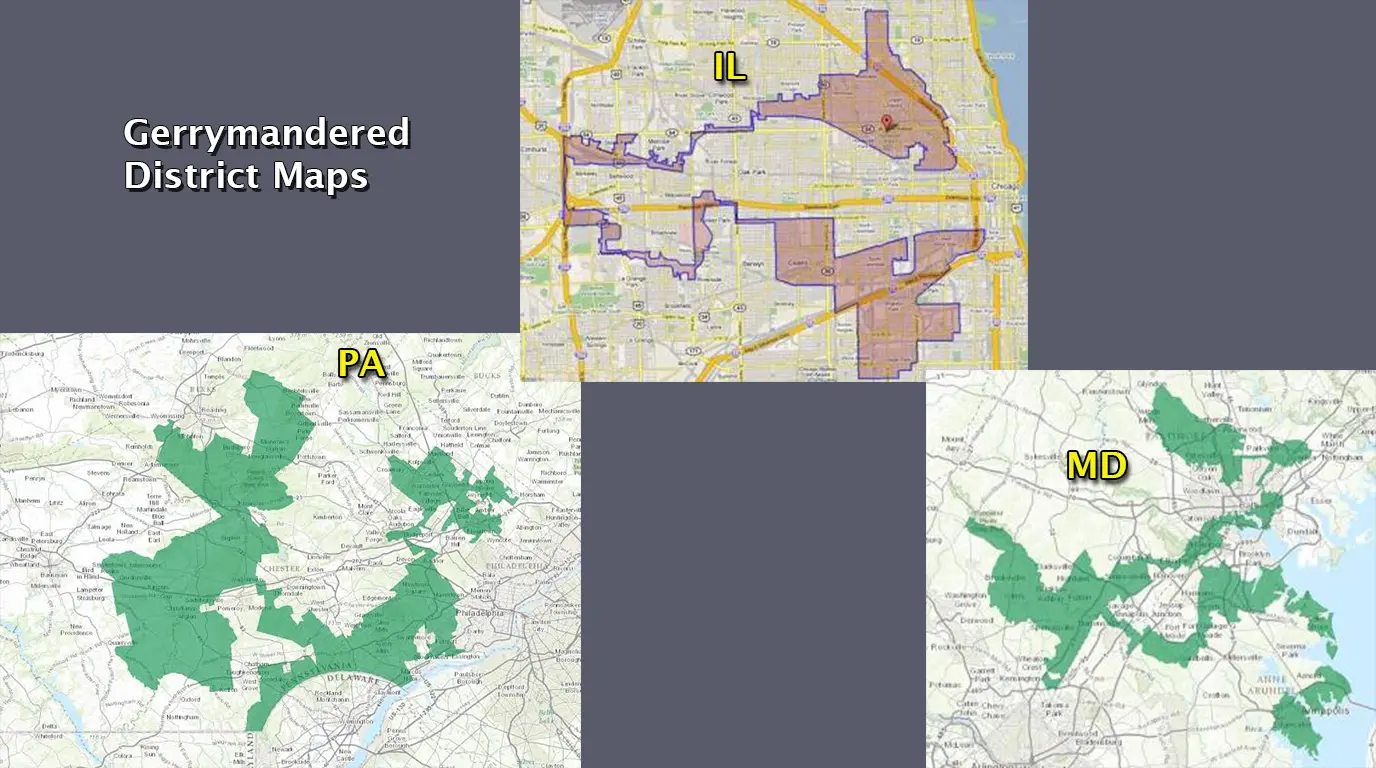
The dropped compactness requirement is also the direct ancestor of the engineered maps that follow. Block 3 shows what got drawn once the only rule constraining the shape of a district disappeared.
The same 1929 act that froze the House also eliminated the 87-year-old rules that prevented extreme gerrymandering — in the same session, by the same people, without public debate.
Sources
1. North/South Dakota, Montana, Washington, Idaho, Wyoming admitted 1889–1890. U.S. Senate Historical Office. https://www.senate.gov/artandhistory/history/minute/Admission_of_New_States.htm
2. Permanent Apportionment Act of 1929. Pub.L. 71-13. https://www.congress.gov/bill/71st-congress/house-bill/11
3. Apportionment requirements 1842–1911. Act of June 25, 1842, Ch. 47 — contiguity, compactness, equal population required; dropped in 1929 Act. https://www.congress.gov/bill/27th-congress/house-bill/9
4. Wood v. Broom, 287 U.S. 1 (1932) — confirmed 1929 Act’s requirements governed existing districts. https://supreme.justia.com/cases/federal/us/287/1/
5. Alaska/Hawaii statehood 1959 / temporary expansion to 437. U.S. House Historical Highlights. https://history.house.gov/Historical-Highlights/1951-2000/Alaska-and-Hawaii-Statehood/
6. Schroeder v. United States, No. 23-1331. Certiorari denied October 7, 2024. https://www.supremecourt.gov/search.aspx?filename=/docket/docketfiles/html/public/23-1331.html
7. Montana disputed election — Senate voted 32–26 to seat Republican credentials. U.S. Senate Historical Office — Montana State Timeline. https://www.senate.gov/states/MT/timeline.shtml — Confirmed from Senate.gov: “On April 16, the Senate voted 32 to 26 to seat the Republicans.”
8. General Mining Law of 1872 — zero royalty on hardrock minerals. https://uscode.house.gov/view.xhtml?path=/prelim@title30/chapter2&edition=prelim
9. BLM Grazing Fee 2026 — $1.69/AUM. https://www.blm.gov/press-release/blm-usda-forest-service-announce-2026-grazing-fees — USDA NASS private rate $23+: https://www.nass.usda.gov/Statistics_by_Subject/index.php?sector=ECONOMICS
Block 2, Article 2. © 2026 Steve Sagnotti.
Leave a Reply