Category: TNG: Notes from the Field

  • THE NEXT POPULATION

    THE NEXT POPULATION


    NOTES FROM THE FIELD — Dispatch #10

    April 2026
    — THE NEXT POPULATION — You already know someone in this story.


    I. THE DESERT

    Michelah has applied for thirty jobs in six months. She works customer service because that’s what’s there. She described the job market to a Times moderator this way: “It’s like a desert. There’s nothing really there. You can be out there, but you’re not being hydrated.”

    She is twenty-something. She did what she was told. She got the education, built the resume, showed up. The desert was already there when she arrived.

    Three economists just published forty years of federal labor data showing that workers today are half as likely to get a competing job offer as workers were in the 1980s. Half. The mechanism that used to let people climb — get a better offer, take it, move up — has been systematically dismantled. Employer consolidation eliminated the competing employers. Noncompete agreements, signed by over a third of the American workforce including hourly and part-time workers, made it illegal to take the offers that remained. The Federal Trade Commission banned noncompetes in 2024. Business groups sued. A court blocked the ban. Michelah’s ladder was pulled up before she got on it. That wasn’t an accident. That was a decision made by people who benefited from her staying where she was.

    Now add AI. The same week this data published, Snap announced it was cutting a thousand workers — sixteen percent of its staff — because AI now writes more than sixty-five percent of its code. The same work. Fewer people. The CEO said so plainly.

    Michelah is not in tech. Doesn’t matter. The displacement is moving through categories in order and her category is in the sequence. Customer support was in the first wave. She already knows this. That’s why the market feels like a desert. The water left before she got thirsty.


    II. WHEN PEOPLE TAKE WHAT THEY NEED

    Jia Tolentino stole four lemons from Whole Foods. She said so on a Times podcast this week, in a conversation about what the editors are calling microlooting — people taking small things from large corporations and feeling morally justified. Tolentino’s reasoning: she was doing mutual aid grocery runs for an elderly neighbor, forgot the lemons, went back and grabbed them rather than go through the line again. She felt no guilt. Whole Foods is owned by Jeff Bezos. Bezos paid 0.98 percent in taxes on his real wealth while Tolentino paid her full rate on every dollar she earned. The social contract, she figured, had already been broken. She took the lemons.

    That’s a writer, financially comfortable, stealing four lemons as a gesture of mild political solidarity and personal convenience.

    Now take Michelah. Same desert, two years further in. No job offer in eight months. Savings gone. Rent due. Kids need to eat.

    Michelah takes something from Whole Foods. It is not four lemons. It is not a gesture. It is Tuesday and her kids are hungry.

    Same action. Different designation. Tolentino gets a podcast. Michelah gets a record.

    That asymmetry is not an accident of the justice system. It is the justice system working as designed. Wage theft — billions of dollars stolen annually from workers through unpaid overtime, illegal deductions, minimum wage violations — is a civil matter, handled quietly, rarely prosecuted. Michelah taking groceries is a crime. The asymmetry tells you everything about whose property the system exists to protect.

    Political commentator Hasan Piker made the production side explicit: the corporations building automated checkout systems know the systems will increase shrinkage. It is factored into the bottom line. The lemons stolen are already accounted for, absorbed into margins that no longer require the cashiers who used to prevent the theft. The automation that eliminated the job also eliminated the deterrent. The corporation captured both efficiencies simultaneously.

    What the podcast didn’t say — what its format couldn’t reach — is what happens when it isn’t Tolentino taking four lemons, and it isn’t Michelah taking groceries on a desperate Tuesday. What happens when it is a hundred thousand Michalahs, in a hundred cities, because the jobs are gone and the safety net has been means-tested and time-limited into something that runs out before the jobs come back.

    Survival behavior at scale looks different than survival behavior alone. The designation of which one it is belongs to the people who own the buildings.


    III. THE MATH AND THE MAP

    Dispatch Nine put two clocks on the same page. The labor economists say the steepest displacement hits between 2029 and 2032. The fiscal economists say 2031 is the year interest rates on federal debt exceed economic growth — the threshold where the debt becomes self-reinforcing, where cutting is the only lever left, where the programs people depend on get sacrificed to the interest payments.

    Same year. Different rooms. Nobody connecting them.

    Here is the connection: the people being displaced are the tax base. Every worker who exits the labor force stops paying in and starts drawing out — less payroll tax, more program dependency — at the exact moment the fiscal system can least absorb the shift. The institutional reassurance is that new jobs will appear. That may be true across a long enough horizon. It is not true for Michelah in 2030. It is not true for the hundred thousand people who will quietly stop being counted by the unemployment statistics because they stopped looking — who will disappear from the dashboard while remaining entirely present in their lives, their hunger, their anger.

    A city the size of Chicago will quietly leave the labor force by 2030. They will not show up as unemployed. They will just be gone from the count. Still eating. Still needing rent. Still there.

    The broken job ladder is the missing piece that connects those two clocks to the street. When the displacement wave arrives, the workers it reaches will not be able to climb. The ladder was already broken. The noncompetes already filed. The employer concentration already established. The FTC rule that would have helped already blocked in court. The workers exiting the labor force will not retrain fast enough — because the speed variable is what breaks every historical analogy offered as reassurance. Previous technological transitions played out across decades. The gap between displacement and replacement was wide enough to cross on foot. The lag between 2029 and 2032 is not.

    Those people will need to eat. They will need to feed their families. They will need to survive inside an economy that has automated their participation out of existence while ensuring, through three decades of purchased complexity in the tax code, that they have no ownership claim on what the machines produce in their place.

    The microlooting will scale. Not as protest. As necessity.

    And scaled survival behavior — visible, collective, threatening to the order the room depends on — has a legal designation waiting for it. It does not require new law. It requires a policy decision about who the existing infrastructure is for next.


    IV. THE BUILDINGS ARE ALREADY THERE

    The Trump administration said it was going after the worst of the worst. Murderers. MS-13. Rapists. That was the stated justification for building the largest immigration detention infrastructure in American history.

    Here is what the data shows. As of April 4, 2026, 70.8 percent of the 60,311 people in ICE detention have no criminal conviction at all. A Cato Institute analysis found that only 5 percent had a violent conviction. More than one out of three people deported from detention in 2025 had no criminal record — no pending charges, no prior conviction. Just 2 percent were tagged as suspected gang members. For every one at-large arrest in the winter that involved someone with a serious prior criminal conviction, there were twelve arrests of people with no criminal record.

    The worst of the worst turned out to be whoever was standing there.

    The administration built the infrastructure to hold them on ground that already knows this story. Camp East Montana — the largest ICE detention facility in American history — sits at Fort Bliss in El Paso, Texas, on the same military base where the U.S. government imprisoned people of Japanese descent during World War II. The people held there then were labeled enemy aliens. Over 125,000 people of Japanese descent were forcibly removed and incarcerated during the war. More than half were American citizens. Born here. On American soil. Their citizenship did not protect them. The infrastructure held them anyway.

    Mary Murakami was 14 years old when soldiers lined the streets of San Francisco’s Japantown with guns pointed at her neighborhood. She is 98 now. When the new detention center opened at Fort Bliss, she said: “I never thought these thoughts would so vividly come back with another group of people in the United States. They’re being taken without being able to communicate. It’s amazing that you see your life all over again.”

    The government’s response to that comparison was: “Comparisons of illegal alien detention centers to internment camps used during World War II are deranged and lazy.”

    The Japanese Americans at Fort Bliss in 1942 were told something similar. They were a national security threat. The worst of the worst, by the logic of the moment. The legal designation did not match the reality then either. It didn’t need to. The infrastructure held them anyway.

    Now consider Michelah in 2031. No job for two years. No savings. Kids need to eat. She takes groceries from a Whole Foods self-checkout — the same automated system the corporation built knowing it would increase theft, that factored the loss into margins that no longer include the cashier who used to stand there. The corporation calls it shrinkage on a spreadsheet. The state calls it theft. Michelah gets a record.

    Scale that across a hundred thousand people. Across a city the size of Chicago that has quietly left the labor force and stopped being counted. Across a safety net that has been means-tested and time-limited and legislated toward inadequacy at the exact moment the debt spiral is tightening. Across a population with no ownership claim on what the machines produce and no legal mechanism to make one — because the architecture being built right now is specifically designed not to create one.

    Survival behavior at scale gets a different name. You don’t need new law to apply it. You need a policy decision about who the existing infrastructure is for next.

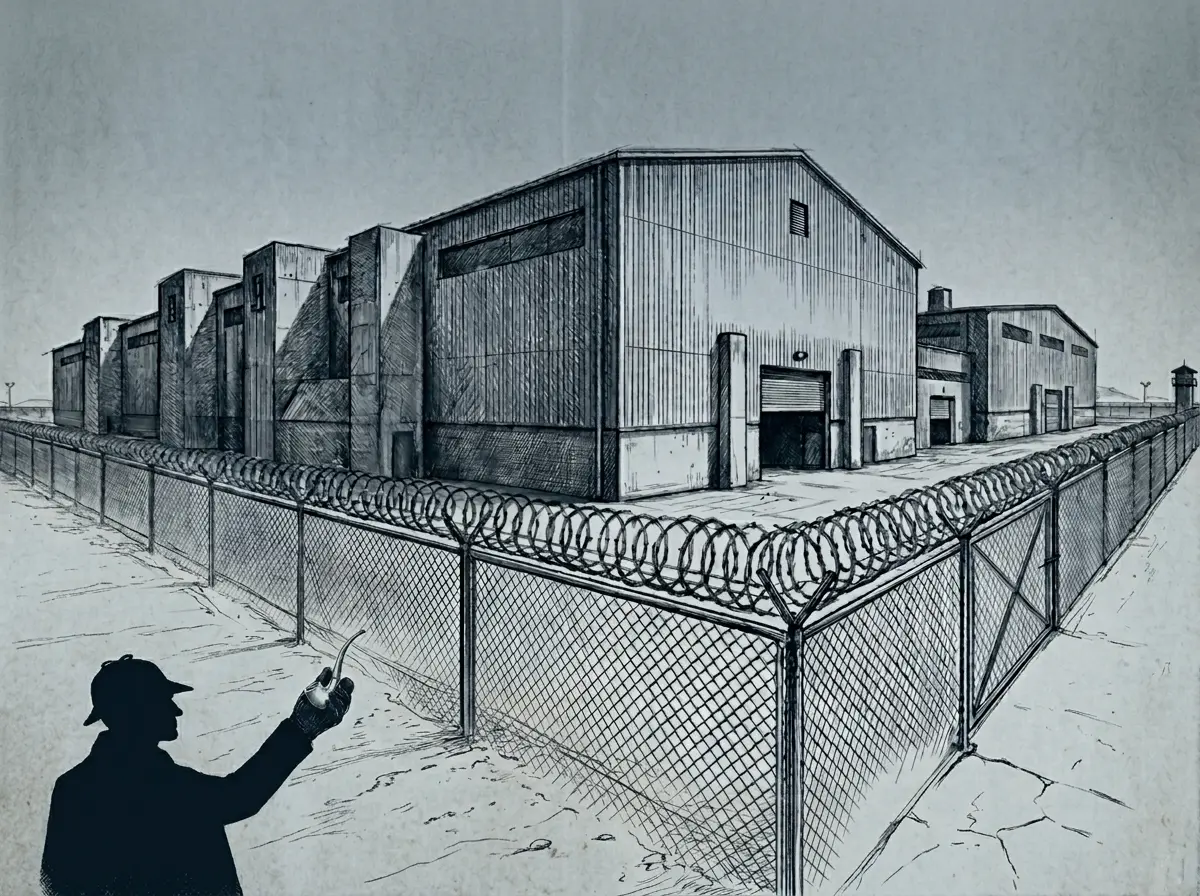
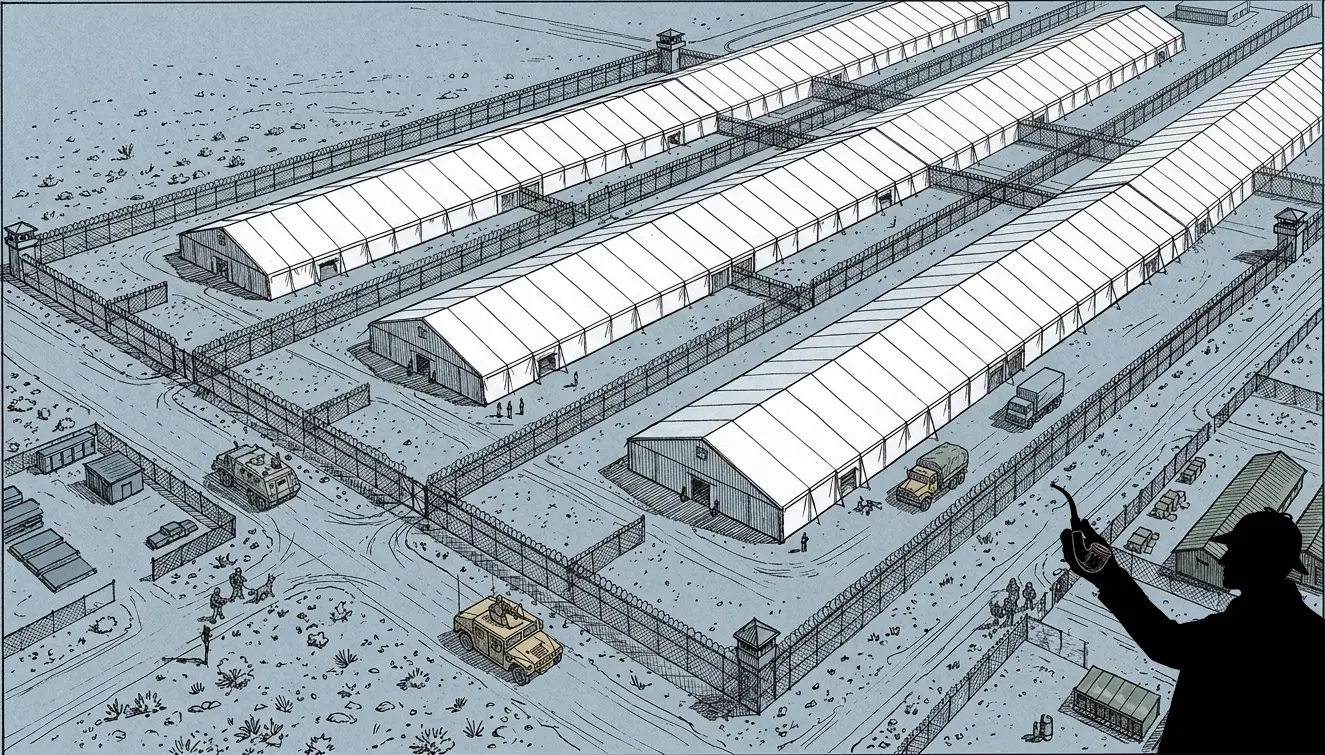
    The United States owns — not leases, owns — a network of converted warehouses distributed across the national geography. Eight mega-centers designed to hold seven to ten thousand people each. Maryland. Arizona. Georgia. Texas. Pennsylvania. Michigan. Total planned capacity: 92,600. Total cost: $38 billion, paid. The acting ICE director described the goal as “Amazon Prime, but with human beings.” Amazon’s network is not built for one product. It is built for throughput. The product changes. The infrastructure scales.

    The buildings are already there. The precedent for who fills them — and how the justification gets written afterward — is eighty years old and sitting in the historical record at Fort Bliss, Texas.

    The worst of the worst turns out to be whoever the room decides it is.


    Niemöller didn’t write about immigrants. He wrote about the categories that kept expanding until they reached him. His insight was not that the excluded suffer — everyone knows that. His insight was that the people who assume their category is structural rather than temporary do not recognize the water temperature until it is too late to step out.

    The working-class voter who supports the deportations because he is not an immigrant. The mid-career professional who finds the microlooting trend mildly interesting, not yet personal. The knowledge worker whose category has not yet been reached.

    Michelah’s desert was planted forty years ago. She just got there first.

    The silence won’t feel like silence. It will just feel like the way things are.


    Dispatch Nine documented the two clocks. This dispatch records where they point. The Narrow Gate traces the same pattern back more than fifteen hundred years. Publishing now at The Narrow Gate.


    Sources

    Section I Jessica Grose, “Here’s Another Reason Gen Z Can’t Find Work,” New York Times, April 22, 2026 Engbom, Baksy, Caratelli, NBER Working Paper, April 2026 Snap layoff announcement, April 15, 2026 FTC noncompete rule / court block, 2024

    Section II Spiegelman, Tolentino, Piker, “The Rich Don’t Play by the Rules. So Why Should I?” New York Times Opinion, April 22, 2026

    Section III Randstad Workmonitor 2026; WEF Future of Jobs Report 2025; Dario Amodei via Tom’s Hardware, April 8, 2026; CBO Budget and Economic Outlook 2026–2036; CRFB March 9, 2026; Powell, Harvard, March 30, 2026; AImultiple labor force participation projections; Engbom et al., NBER, April 2026

    Section IV TRAC Immigration, April 4, 2026; Cato Institute ICE detention analysis, FY2026; American Immigration Council, “New ICE Arrest Statistics,” April 2026; Deportation Data Project, March 2026 Fort Bliss / Japanese internment: NBC News, August 20, 2025; JACL statement, September 5, 2025; NPR / Mary Murakami interview, September 23, 2025 ICE Detention Reengineering Initiative: Brennan Center for Justice, February 2026; American Immigration Council, February 2026 Martin Niemöller, 1946
  • The Two Clocks

    The Two Clocks

    NOTES FROM THE FIELD — Dispatch #9
    April 2026

    — TWO CLOCKS —
    Nobody has put them on the same page.
    They arrive at the same year.

     —They had made themselves replaceable. Meta owned what they’d built. They owned nothing.


    I. THE CONVERGENCE

    Two separate conversations are happening in two separate rooms. The people in each room are not talking to the people in the other. Nobody has put what they’re saying on the same page.

    In the first room, labor economists and workforce researchers are tracking what employers say they intend to do over the next five years. The numbers are not speculative — they come directly from employers. The Randstad Workmonitor survey, published this month, asked them directly: 76 percent predict that at least half of all entry-level roles will disappear within five years. The World Economic Forum found that 41 percent of employers worldwide intend to reduce their workforces as AI automates tasks — by 2030. Dario Amodei, the CEO of Anthropic, has said AI will eliminate half of entry-level white-collar jobs within one to four years. These are not fringe projections. They are the mainstream. And they share a timestamp: the steepest part of the displacement curve arrives between 2029 and 2032.

    In the second room, fiscal economists are watching a different clock. The Congressional Budget Office projects that by fiscal year 2031, the average interest rate on federal debt will exceed the rate of economic growth. When that happens, the debt accumulates faster than the economy can address it. The Committee for a Responsible Federal Budget has a name for what follows: a debt spiral. Self-reinforcing. Higher debt pushes rates up. Higher rates slow growth. Slower growth means less revenue. Less revenue means more borrowing. The Federal Reserve chair said it plainly at Harvard in March: “It will not end well if we don’t do something fairly soon.”

    Two rooms. Two clocks. One year: 2031.

    Five years. If you’re 35 now, you’ll be 40. If you’re 50, you’ll be 55. The threshold isn’t abstract. It arrives on a specific Tuesday morning, in a specific fiscal year, in the middle of whatever your life looks like then.

    Nobody is connecting these two rooms. And the reason nobody is connecting them is that the people being displaced are the same people the fiscal system runs on — and when they exit the economy, they don’t just stop contributing. They start drawing. The tax base contracts and the safety net expands at the same moment, in the same system, right when the math can least afford it.


    II. WHY THE TWO CLOCKS ARE THE SAME CLOCK

    The federal fiscal system is funded by taxing economic participation. Wages. Payroll contributions from the first dollar. The tax base that services the debt, funds Social Security and Medicare, and keeps the spiral from becoming self-reinforcing is built on people working.

    If you work for a salary, you are in the revenue column. The question this dispatch is recording is how long that column holds.

    When workers exit participation, they don’t just stop contributing. They start drawing. Each person who leaves the labor force moves from the revenue column to the expenditure column simultaneously. Less payroll tax in. More program dependency out. The safety net expands in demand at the exact moment its funding base is contracting.

    The institutional reassurance — delivered consistently by Goldman Sachs, the IMF, the WEF, the Bureau of Labor Statistics — is that net job creation will absorb the displacement. New roles will emerge. Workers will retrain. The analogy offered is always the same: the transition from agricultural to industrial labor, or from manufacturing to services. People adapted before. They will adapt again.

    The analogy fails on one variable: speed. Those transitions played out across decades. The gap between displacement and replacement was wide enough to cross on foot. What no institutional projection models adequately is what happens in the lag — the years between when the displacement arrives and when the replacement jobs appear. If that lag is five years, those five years are precisely the years in which the tax base is contracting and the debt spiral threshold is arriving. The reassurance is true at the macro level across a long enough horizon. It is not true for the people in the lag. And the lag is 2029 to 2032.

    The workers exiting the labor force are the same workers who paid payroll taxes on every dollar they earned, while the ownership class paid themselves token salaries and called the rest investment income. The previous dispatches documented the mechanism. This one records the timing. The contraction of the tax base and the arrival of the fiscal threshold are not parallel stories. They are the same event, in the same system, arriving at the same moment.


    III. WHAT IS ACTUALLY HAPPENING TO PEOPLE

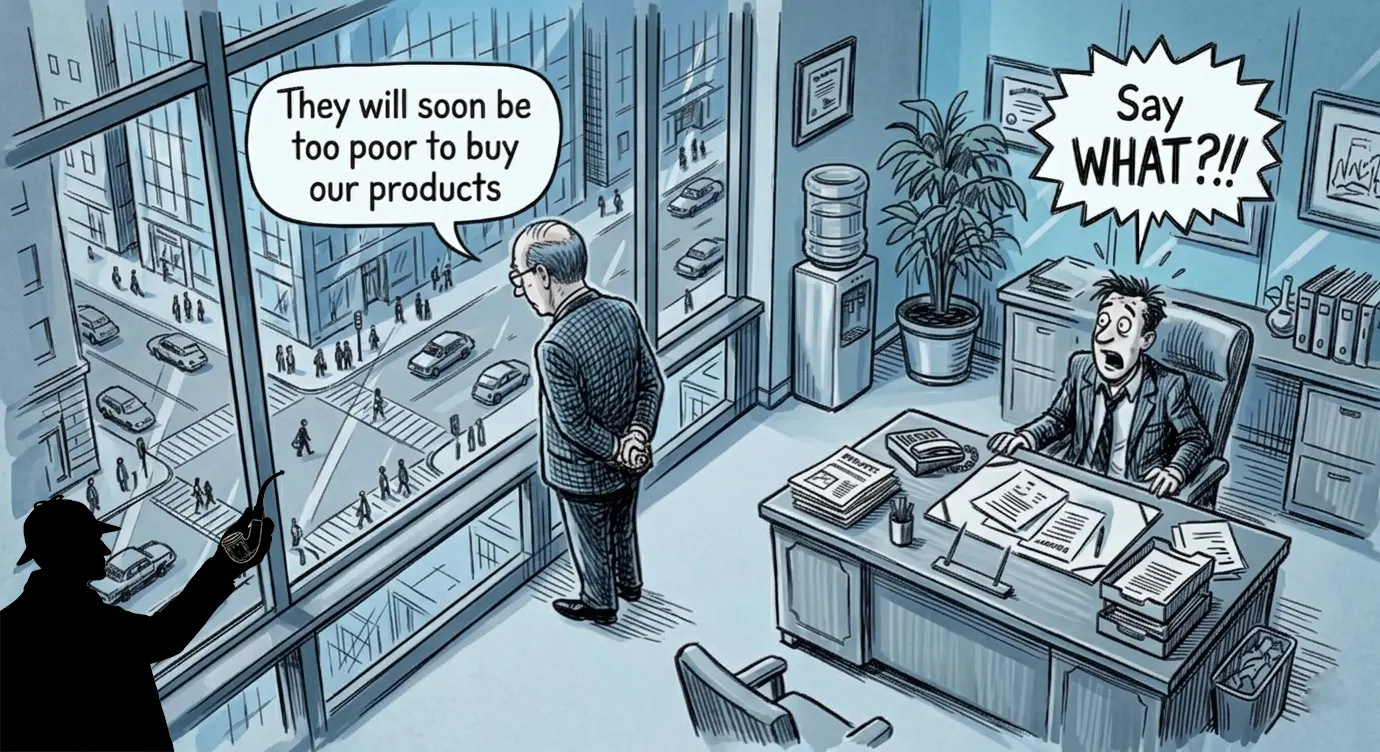
    Henry Ford paid his workers enough to buy the cars they built. Not because he was generous. Because he understood that workers who couldn’t afford his product weren’t the consumers he needed. There is a cartoon that captures the moment before that realization lands: an executive looking out a window at the workers below says to a colleague, they will soon be too poor to buy our products. The colleague’s reaction is pure shock. The executive at the window has already done the math. The one at the desk hasn’t yet.

    That math is being done right now, in boardrooms that are not sharing the results.

    This month, Snap announced it was cutting 1,000 workers — 16 percent of its full-time employees. The CEO’s explanation was unusually direct: AI now generates more than 65 percent of new code at the company. The same work is being done. There are just fewer people doing it.

    The same week, Sama — a firm based in Nairobi that employed people to label images, review content, and tag data — issued redundancy notices to 1,108 workers. Their employer was Meta. For years, they had been doing exactly what Meta needed: adding judgment capability to the AI. Teaching it to see what was harmful, what was human, what was real. When the system had learned enough, the contracts ended. They had made themselves replaceable. Meta owned what they’d built. They owned nothing.

    This is not a story about workers in Nairobi. Judgment is what most of the economy runs on. If your job is to assess, evaluate, triage, decide, or discern — the Sama workers were doing the same work, one label at a time, that you do every day. The question is not whether your industry will face this. The question is where it is in the sequence.

    Nearly 80,000 technology workers were laid off globally in the first three months of 2026. Of those, 47.9 percent were attributed by the companies themselves — not by critics, not by analysts, by the companies — to reduced need for human workers because of AI. Oracle cut between 20,000 and 30,000 people by early-morning email, the same week it announced $58 billion in new debt to fund a $50 billion AI data center buildout. The workers and the infrastructure are moving in opposite directions. The pace of each is accelerating.

    The Bloomberg projection for 2026 alone: AI-related displacement affecting up to 502,000 roles. The MIT simulation for the broader trajectory: AI capable of replacing nearly 12 percent of the entire U.S. workforce — approximately $1.2 trillion in lost salaries, and the tax revenue that would have come with them.

    And here is the number the standard unemployment figure will not show. The labor force participation rate is projected to fall by 2030, removing roughly 2.6 million people from the books — a city the size of Chicago quietly leaving the labor force. They won’t show up as unemployed. They will simply stop being counted. They are moving from the revenue column to the expenditure column, one exit at a time, and the dashboard that measures the economy’s health will not register the migration until long after the fiscal math has already moved.


    IV. WHY NOBODY IS CONNECTING THEM

    The institutions producing the labor projections are the same institutions whose clients are executing the displacement. The reassurance that net job creation will eventually absorb the disruption is not necessarily false — across a long enough time horizon it may be correct. But it is functioning as a reason not to act in the window when action would matter. By the time the net positive job creation materializes, the fiscal math will have already moved through the threshold.

    The AI buildout is happening in private. Anthropic and OpenAI together raised over $150 billion, largely from venture capital, private equity, and foreign sovereign wealth funds. They employ a combined few thousand people. Amazon employs 1.5 million. The productivity gains are real. The distribution is not.

    The fiscal mechanism that would catch the displaced — a broader tax base, consistent treatment of ownership wealth alongside wage income — has been systematically defunded as a political possibility through three decades of organized effort by the people it would affect most. The reform proposals exist. The precedent exists: Reagan signed the 1986 Tax Reform Act. The complexity is not an accident. It is the inventory. Every loophole is a protection that was purchased. Every reform proposal that went nowhere was supposed to go nowhere.

    The question sitting in the center of the room has no lobbyist, no PAC, no campaign check attached to it. The people who would need to act are the same people whose clients are doing the displacing, whose portfolios are capturing the gains, and whose accountants have already made sure they won’t be standing closest to the edge when the math runs out.

    Nobody in the room is asking the question. And nobody outside the room has been given the mechanism to ask it effectively — because the legal and political architecture being built around this moment is not designed to create one.


    V. THE SEQUENCE

    Here is what this dispatch is recording, and why the timestamp matters.

    In the first quarter of 2026, the displacement is moving through specific categories in a specific order: content raters first — the people who trained the systems, who added judgment capability to the AI so they could be replaced — then customer support, then project managers, SaaS administrators, junior programmers. The Randstad survey says employers intend to continue. The Bloomberg projection says the full-year number is 502,000 roles. The employer surveys put the steepest curve between 2029 and 2032.

    2031 is the year the CBO projects the interest rate on federal debt exceeds economic growth. After that point the spiral becomes self-reinforcing. Economists have a name for what comes next. There is no gentle version of that phrase.

    Two things happen to a person when automation takes their job. The first is visible: they stop paying in. The second is invisible: the unemployment statistics are designed to stop counting them once they stop looking for work. A city the size of Chicago will quietly leave the labor force by 2030. They won’t show up as unemployed. The dashboard will not register them. They will simply disappear from the count.

    But there is a third thing, and it is the one nobody is saying plainly.

    Whether they are employed, unemployed, or no longer counted — wage workers have no ownership claim on what the machines produce. They never did. They were paid for their labor while someone else captured the surplus their labor created. Automation doesn’t change that arrangement. It just makes it permanent. The machines now hold the judgment capability the workers transferred into them. The workers hold nothing. And the legal and political architecture being built around this moment is not designed to change that.

    This is not about takers and makers. It is about who owns the machine.

    First they came for the content raters, and the mid-career programmer said nothing, because he was not one. Then for the customer support workers, and the project manager said nothing, because she was not one. Then for the SaaS administrators, and the junior engineer said nothing, because his category had not yet been reached.

    Niemöller wrote his confession from inside a camp. He had not been alarmed when the sequence started. He had assumed his category was different. His insight was not that the excluded suffer — everyone knows that. His insight was that the categories expand, and that the people who assume their rung is structural rather than temporary do not recognize the water temperature until it is too late to step out.

    The displacement is not waiting for the reassurance to be disproven.

    And when it arrives at scale — when the debt math has run out, when the safety net has been means-tested and time-limited and legislated toward inadequacy, when the people automation displaced have no legal mechanism to claim a share of what the machines are producing — there is one more question this dispatch cannot answer but must ask.

    The United States has spent $38 billion building a network of government-owned warehouses, converted and purchased to hold surplus populations pending resolution of their legal status. They were built for immigrants. The immigrants are being deported.

    What will the warehouses be used for next?

    The silence won’t feel like silence.
    It will just feel like the way things are.


    Notes from the Field is the real-time record. The Narrow Gate traces the same pattern back more than fifteen hundred years. It’s publishing now at The Narrow Gate.


    Sources

    Section I — The Convergence

    Randstad Workmonitor 2026, via Staffing Industry Analysts, April 13, 2026
    World Economic Forum, Future of Jobs Report 2025, January 2025
    Dario Amodei / Anthropic, via Tom’s Hardware / Nikkei Asia, April 8, 2026
    Committee for a Responsible Federal Budget, “CBO Projects Possible Debt Spiral, as R Exceeds G,” March 9, 2026
    Congressional Budget Office, Budget and Economic Outlook 2026–2036, February 2026
    Jerome Powell remarks, Harvard University, March 30, 2026

    Section II — Why the Two Clocks Are the Same Clock

    Goldman Sachs, “How Will AI Affect the Global Workforce?” August 2025
    IMF, Global Economic and Financial Implications of Artificial Intelligence, 2026
    CBO / CRFB / Powell (as Section I)
    ProPublica, “The Secret IRS Files,” 2021

    Section III — What Is Actually Happening to People

    Snap Inc. layoff announcement / SEC filing, April 15, 2026
    Sama / Meta Nairobi redundancy notices, April 16, 2026
    RationalFX / Nikkei Asia Q1 aggregate, via Tom’s Hardware, April 8, 2026
    Oracle layoffs / debt announcement, CNBC, March 31, 2026
    Bloomberg AI displacement projection, via Tech Insider
    MIT workforce simulation, via Tom’s Hardware / Nikkei Asia
    Labor force participation rate projections, AImultiple

    Section IV — Why Nobody Is Connecting Them

    Jennifer Harris, New York Times, April 8, 2026
    Ray Madoff, “Our Tax System Should Make You Furious,” New York Times / Ezra Klein Show, April 17, 2026

    Section V — The Sequence

    Challenger, Gray & Christmas, Q1 2026 report, April 2026
    ICE detention infrastructure: Brennan Center for Justice, February 2026; American Immigration Council, February 2026
    Martin Niemöller, 1946
  • When The Math Runs Out

    When The Math Runs Out

    NOTES FROM THE FIELD — Dispatch #8
    April 2026

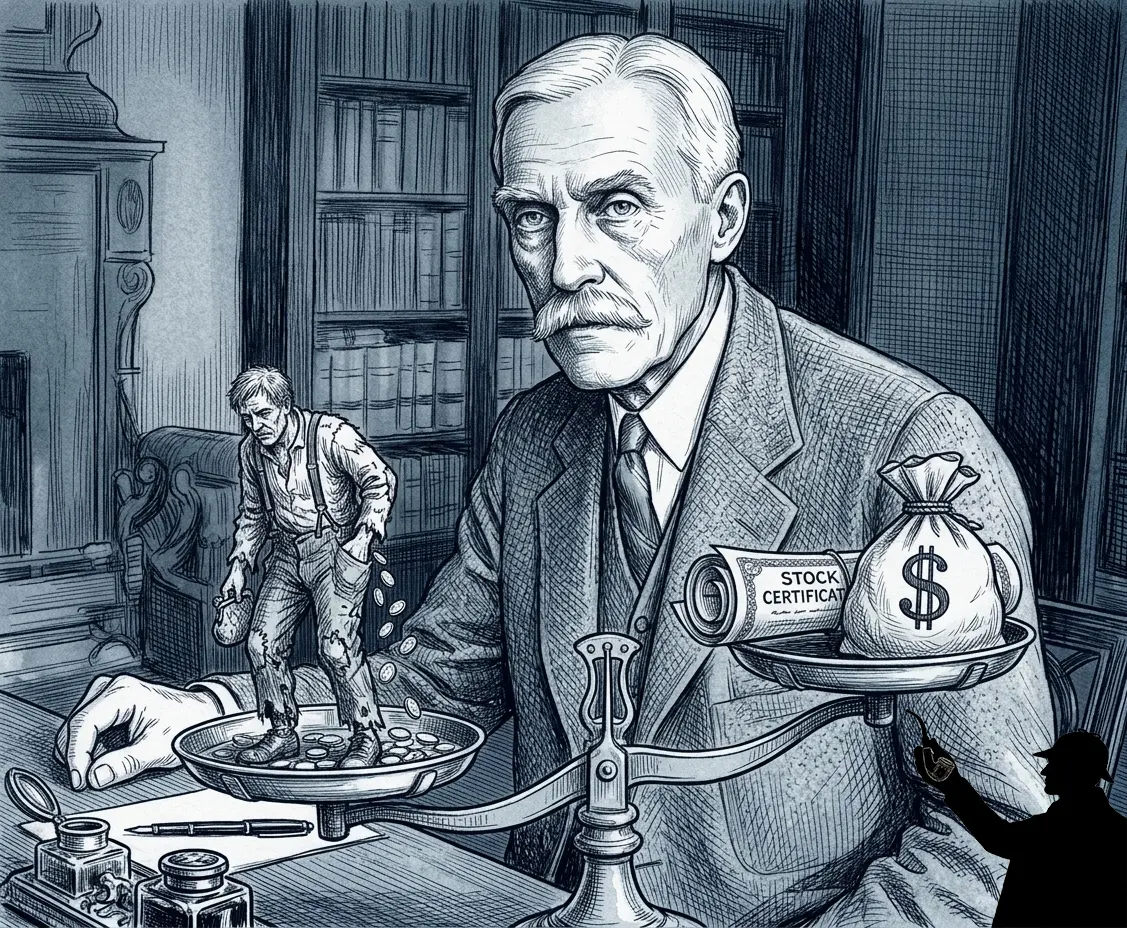
    Mellon wrote in 1924 that taxing wage income more heavily than investment income was beyond question unfair. A century later the system runs exactly backward.


    Three dispatches. One argument.

    The first showed you the mechanism — how the ownership class built a parallel tax system inside the official one, how a surgeon pays 50 percent and a founder pays nothing, how the stepped-up basis at death erases a lifetime of untaxed appreciation before the government can touch it.

    The second showed you why it stays. The complexity is the inventory. The reform proposals are the fundraising mechanism. The public anger is the product, not the malfunction. The people who would need to fix it are the people being paid to preserve it.

    This dispatch asks what happens when the arithmetic stops being theoretical.


    What a fair system would look like.

    Before the reckoning, it’s worth a moment on the alternative. Not as fantasy, but as documented possibility.

    Andrew Mellon — robber baron, Secretary of the Treasury under three presidents, hardly a figure of redistributive sympathy — wrote in 1924 that taxing wage income more lightly than investment income was beyond question as a matter of fairness. His reasoning: wages are uncertain, end at death, diminish with age. Investment income continues. It compounds. It descends to heirs. Mellon’s position was that the precarious should be protected and the durable should bear more.

    A century later, the code runs exactly backward. The surgeon pays 50 percent on income that ends when she stops working. The founder pays nothing on wealth that compounds indefinitely, transfers at death with gains erased, and arrives in his children’s accounts untouched by any meaningful tax.

    Mellon’s principle — tax the durable more than the precarious — is not radical. It was the founding logic of the system. Returning to something like it would mean taxing unrealized gains at death rather than erasing them, treating borrowed-against wealth as the income it functionally is, and applying the payroll tax consistently rather than capping it at $168,000. None of this requires invention. The 1986 Tax Reform Act showed that a broad-based system with fewer shelters actually works — revenues rise, avoidance shrinks, the people with the most genuine income pay the most genuine tax.

    The mechanism exists. The precedent is documented. Reagan signed it.


    The clock that is actually running.

    The national debt crossed $39 trillion in March. The nonpartisan Congressional Budget Office projects it reaches $64 trillion by 2036. Interest payments this year exceed $1 trillion — more than the defense budget. By 2036, the CBO projects interest payments more than double, to $2.1 trillion, consuming nearly one-fifth of all federal spending.

    The Federal Reserve chair said it plainly at Harvard in March: the debt level itself is survivable. The path is not. “It will not end well if we don’t do something fairly soon.”

    The specific number economists are watching is fiscal year 2031. That is when, under current projections, the average interest rate on federal debt will exceed the rate of economic growth. When borrowing costs outpace the economy’s ability to generate revenue, debt accumulates faster than it can be addressed. The Committee for a Responsible Federal Budget calls this condition a debt spiral. Once entered, it is self-reinforcing: higher debt pushes rates up, higher rates slow growth, slower growth means less revenue, less revenue means more borrowing, more borrowing means higher debt.

    The CBO’s relatively optimistic baseline — which assumes no additional tax cuts or spending increases — projects the debt reaching 175 percent of GDP by 2056. The less optimistic scenarios approach 379 percent.

    Five years to the threshold. Under current law.


    The population that will be standing there.

    Here is where the three dispatches converge.

    The tax base that would address this trajectory depends on taxing economic participation. Income. Wages. Transactions. The broad base of people working, earning, spending, contributing payroll taxes from the first dollar.

    That base is contracting.

    Automation is not a future condition. It is a current one, accelerating. The research on labor substitution is consistent: the displacement is not moving uniformly across the economy. It is moving through the jobs that the ownership class does not hold — logistics, service, administration, the work done by the people who were already paying payroll taxes on every dollar while the ownership class paid them on none.

    The people being displaced are not moving into higher-productivity roles at the rate the standard reassurance requires. They are moving into reduced participation, contingent work, government dependency. They are leaving the tax base and entering the expenditure column.

    And they are arriving there at the same moment the debt spiral is projected to tighten — with a federal budget increasingly consumed by interest payments, Social Security and Medicare shortfalls compounding, and the political will to broaden the tax base absent by design.


    The warehouse question.

    In dispatch five, we noted that the United States has built $38 billion in government-owned detention infrastructure. It was built for one population — immigrants, undocumented, legally excludable, with no standing to claim a share of what the economy produces.

    The question dispatch five left open was about the next population.

    When the debt math runs out — when the interest payments crowd out the programs, when the displaced workers find the safety net has been means-tested and time-limited and legislated into inadequacy, when the people who were removed from economic participation by automation have no legal mechanism to claim a share of the abundance that automation generates — they will need somewhere to go.

    The infrastructure is already paid for.

    Andrew Mellon understood that the precarious needed protection, that a system which taxed their uncertainty while sheltering durable wealth was not just economically inefficient but morally backward. The 1986 reformers understood that a broad base collected more revenue and distributed the burden more honestly. The CBO understands that the current trajectory ends badly. The Fed chair understands it. The economists who study labor substitution understand it.

    The people who would need to act understand it too.

    They are also the people who have spent thirty years making sure the complexity stays complex, the base stays narrow, and the displaced population has no legal standing to make a claim on what’s coming.

    The silence on all of this won’t feel like silence.

    It will just feel like the way things are.


    Sources: Ray Madoff, “Our Tax System Should Make You Furious,” The Ezra Klein Show / New York Times, April 17, 2026. Andrew Mellon, “Taxation: The People’s Business,” 1924, as cited in Madoff. Congressional Budget Office, Budget and Economic Outlook 2026–2036, February 2026. Committee for a Responsible Federal Budget, “CBO Projects Possible Debt Spiral, as R Exceeds G,” March 9, 2026. Jerome Powell remarks at Harvard University, March 30, 2026. Peterson Foundation, interest cost projections, February 2026.

  • The System Is Working Fine

    The System Is Working Fine

    NOTES FROM THE FIELD — DISPATCH #7
    April 2026


    If you read the last dispatch, you now understand the mechanism. The buy-borrow-die sequence. Stepped-up basis. The payroll cap. The estate tax that collects $30 billion against $50 trillion.

    You probably also came away with a reasonable question: how is this still the system? If it’s this documented, this understood, this lopsided — why hasn’t it been fixed?

    The answer is that it has been fixed. Once. In 1986. And then it was carefully, methodically, profitably unfixed.

    Understanding why tells you something important — not just about taxes, but about how the machine actually runs.


    Every provision is a negotiation.

    The tax code is not a document. It is an ongoing transaction.

    Every exemption, every carve-out, every loophole represents a moment when someone with money and access sat down with someone who writes legislation, and they reached an agreement. The provision got inserted. The money flowed — in campaign contributions, in speaking fees, in PAC donations, in the soft currency of access and gratitude that doesn’t always have a number attached to it.

    This is not a conspiracy. It doesn’t require secret meetings or explicit deals. It requires only that the people writing the tax code are the same people who need to raise money from the people the tax code affects. That structural overlap does the rest.

    The complexity of the code is not an accident of competing priorities and historical accretion. The complexity is the inventory. Every carve-out is a product that was sold. Every loophole is a protection that was purchased. A simple, broad-based tax system — one that taxed all forms of wealth accumulation at roughly equivalent rates — would eliminate thousands of those products overnight. The people whose income depends on selling those products have a very clear interest in the code staying exactly as complicated as it is.

    That includes the members of Congress who depend on donations from the people who benefit from the provisions. It includes the lobbyists who charge to defend existing provisions and insert new ones. It includes the estate planners, the tax attorneys, the financial advisers whose entire business model is navigating a system that no ordinary person can navigate alone.

    The complexity isn’t the problem to be solved. The complexity is the point.


    The reform that worked, and what happened to it.

    In 1986, the system was interrupted. A bipartisan coalition in Congress, working across party lines with the Reagan administration, passed the Tax Reform Act. It broadened the base. It eliminated the tax shelter industry. It closed the mechanisms that had allowed high-income earners to paper their income into nothing.

    It worked. The shelters are gone. They have not come back. High-earning professionals — the surgeons, the lawyers, the finance people — genuinely do pay high taxes today because of what happened in 1986.

    What 1986 didn’t close was the buy-borrow-die loop, the stepped-up basis at death, the estate tax machinery. Those remained. And in the decades since, they have been the focus of sustained, organized, funded effort by the people they protect.

    The anti-estate tax campaign of the 1990s — funded by 18 of the wealthiest families in America, the Mars family, the Kochs, the Waltons — rebranded the estate tax as the “death tax,” made it sound like something that came for family farms and small businesses, and drove public opinion against a mechanism that affected almost no one outside the very wealthy. It worked. The exemption rose. The rates fell. The loopholes multiplied. The tax that once collected meaningful revenue against dynastic wealth now collects almost nothing.

    This didn’t happen by accident. It happened because organized money, applied consistently over decades to the people who write the rules, produces predictable results. The people with the most to gain from the current arrangement spent what was, for them, a rounding error to protect arrangements worth tens of billions. That is not corruption in the cinematic sense. That is rational resource allocation by people who understand exactly how the machine works.


    The public angst is part of the product.

    Here is where the design becomes visible.

    Every few years, the tax system surfaces as a political issue. Politicians on both sides make speeches about fairness. Reform proposals are introduced. Hearings are held. Economists testify. The public gets angry.

    And then nothing happens.

    What the public doesn’t see — what the speeches are designed to prevent them from seeing — is that the anger is useful. An angry public is a donating public. A donating public is a public that can be managed. The reform proposal isn’t meant to pass. It’s meant to generate the response that generates the counter-donation that funds the campaign that returns the incumbent who introduced the proposal.

    The people introducing reform proposals and the people funding opposition to those proposals are often in sustained, mutually beneficial relationship with each other. The proposal creates the threat. The threat unlocks the money. The money maintains the access. The access ensures the proposal never quite makes it to a vote, or arrives at a vote in a form that can’t pass, or passes in a form that’s been hollowed of substance before it gets there.

    This is not cynicism. This is the documented operational history of tax legislation in the United States for the last thirty years. The estate tax campaign is the clearest case study, but it is not the only one. Every major reform effort of the last three decades has followed a version of the same arc: introduction, alarm, fundraising, dilution, failure, repeat.

    The public’s frustration with a system that feels rigged is accurate. What the public tends to misread is the purpose of that frustration. It isn’t a flaw in the system. It’s a feature. An angry but confused electorate is exactly what the system needs to keep running.


    The alarm that nobody is racing to answer.

    This year, the federal government spends more than $1 trillion on interest payments — more than on the military, more than on any discretionary program. The Congressional Budget Office projects that figure more than doubles by 2036. The nonpartisan scorekeepers have said explicitly: the fiscal trajectory is not sustainable.

    The Federal Reserve chair, speaking at Harvard in March, said the debt level itself isn’t the crisis. The path is. “It will not end well,” he said, “if we don’t do something fairly soon.”

    The math for addressing that path runs in one direction: a broader tax base. More revenue from the wealth that has accumulated untaxed for decades. The 1986 precedent shows it can be done. The mechanism for doing it is understood.

    The people who would need to act to do it are the same people who are paid, reliably and continuously, to prevent it.

    The alarm is ringing. The building is full of people who profit from the fire.

    The next dispatch will look at what happens when the can has no more road to be kicked down — and who will be standing closest to the edge when the math runs out.


    Sources: Ray Madoff, “Our Tax System Should Make You Furious,” The Ezra Klein Show / New York Times, April 17, 2026. Congressional Budget Office, Budget and Economic Outlook 2026–2036, February 2026. Jerome Powell remarks at Harvard University, March 30, 2026. Committee for a Responsible Federal Budget, March 2026.

  • How It Actually Works

    How It Actually Works

    NOTES FROM THE FIELD – Dispatch 6


    Tax Day just passed. If you work for a living, you noticed.

    If you earn a salary — if you’re a nurse, a teacher, a contractor, an accountant, a surgeon — a meaningful share of what you made last year went to the federal government before you ever saw it. Federal income tax, up to 37 percent. Payroll taxes on top of that, up to another 15 percent. It adds up. For a high-earning professional, the effective tax rate on their labor can exceed 50 percent.

    Meanwhile, in 2021, ProPublica obtained and published the actual tax returns of the wealthiest Americans. Warren Buffett’s true tax rate that year: 0.1 percent. Jeff Bezos: 0.98 percent. Michael Bloomberg: 1.3 percent.

    This is not a coincidence. It is not an oversight. Here is how it works.


    Step one: Don’t take a salary.

    Jeff Bezos has paid himself $82,000 a year for more than two decades. Elon Musk has famously taken $1. The rationale offered publicly is that this aligns their interests with shareholders — they only profit if the company succeeds.

    That’s a cover story. The actual reason is simpler: salaries are taxable. When you earn wages, the government taxes them immediately, at the full income rate, plus payroll taxes. Bezos looked at that arrangement and declined.

    Instead, he holds stock. Amazon grows. His wealth grows with it — by tens of billions of dollars over the years. Under current tax law, none of that growth is taxable until the stock is sold. There is no clock running. No deadline. The appreciation just accumulates, year after year, entirely outside the tax system.


    Step two: Don’t sell the stock.

    If Bezos sold stock to fund his lifestyle, he’d owe capital gains tax — around 23 percent. Still lower than a salary, but a taxable event. He doesn’t need to do that either.

    Instead, he borrows against the stock. He walks into a private lender and says: I have hundreds of billions in Amazon stock. Lend me a few billion. The lender says yes immediately, at favorable rates, because the loan is essentially risk-free. If Bezos somehow couldn’t pay, they’d just take the Amazon stock.

    The loan proceeds are not income. They are debt. The IRS does not tax debt. So Bezos funds his yacht, his properties, his private space program — entirely with borrowed money, tax-free.


    Step three: Never pay the loans back. Just roll them.

    This is the part that breaks people’s intuition. Loans have to be repaid — that’s the basic logic of borrowing.

    But when your collateral is worth hundreds of billions of dollars, and the loan you need to fund your lifestyle is a rounding error relative to that collateral, you don’t pay the loan back. You take out a new loan to cover the old one. Lenders are happy to keep lending to you indefinitely — they’re in the business of having their money deployed, and a permanent loan to Jeff Bezos against Amazon stock is about as safe as lending gets.

    The technical name for this sequence is buy-borrow-die. You buy the appreciating asset. You borrow against it to live. You die holding it.


    Step four: Die.

    This is where the system closes the loop.

    When an ordinary person inherits stock, they pay capital gains tax on the appreciation since their parents bought it. That’s the rule.

    Except it isn’t, for assets held at death. When a billionaire dies holding Amazon stock that was worth $1 when Bezos founded the company and worth $200 billion when he dies, the heir’s cost basis is reset to whatever the stock is worth on the day of death. The entire lifetime of appreciation — the full $200 billion in this example — is wiped clean. Never taxed. Gone forever from the government’s books.

    This is called stepped-up basis. Tax scholars and economists consider it the single most consequential provision in the tax code for perpetuating inherited wealth. It is almost completely unknown to the public.

    The estate tax was supposed to catch wealth transfers at death — a 40 percent tax on estates over $15 million. But it has been so effectively hollowed out through decades of loopholes that in 2024, the richest 1 percent of Americans controlled $50 trillion in wealth, and the estate tax collected $30 billion. That’s not a typo. Thirty billion against fifty trillion. The estate tax is not a tax. It is a line item in a press release.


    The surgeon and the founder

    To understand why this matters, hold two people in your head.

    A Beverly Hills surgeon earns $2 million a year. She pays over 50 percent in combined taxes on that income. She works hard. She saves. She accumulates wealth the ordinary way — from income she earned, already taxed.

    A tech founder holds $180 million in company stock and takes $1 in salary. He has never paid taxes on that $180 million. He doesn’t need to sell it, doesn’t need to borrow more than a fraction of it, and when he dies, his heirs will inherit it with the gains erased. The $180 million was built entirely inside the tax-free zone.

    Two wealthy people. Entirely different systems.

    The surgeon is in the top 1 percent of income earners. She pays a lot in taxes. She is, in fact, the person politicians are pointing at when they say “the top 1 percent pay 40 percent of income taxes.” That statistic is true and it is misleading: it conflates income wealth with ownership wealth. The people who show up in the 0.1 percent and 0.98 percent true tax rate figures are not in the surgeon’s cohort. They are in a different system entirely.


    What the payroll tax cap means for the rest of us

    There’s a quieter piece of this that affects everyone below the billionaire line.

    Payroll taxes fund Social Security. They are 15.3 percent of wages — split nominally between employee and employer, but economists generally agree the employee bears most of the cost. They apply from the first dollar you earn.

    They stop at $168,000.

    The surgeon pays payroll tax on $168,000 of her $2 million income. The rest is exempt. Bezos pays payroll tax on his $82,000 salary and nothing above that. The schoolteacher and the warehouse worker pay payroll taxes on every dollar they earn. Eighty percent of Americans pay more in payroll taxes than in income taxes.

    The people who depend most on Social Security are the ones funding it at the highest rate, relative to their income. The people with the most wealth fund it on the smallest slice.


    It has been fixed before.

    In 1986, a bipartisan Congress passed the Tax Reform Act. Ronald Reagan signed it. It broadened the tax base by eliminating the tax shelter industry that had allowed high-income earners — surgeons, lawyers, finance professionals — to paper over their income with investment losses. It worked. Those shelters are gone today. High earners with salaries genuinely do pay high taxes, and they have since 1986.

    That reform did not close the buy-borrow-die loop. That gap remained. And in the decades since, the estate tax has been progressively defanged — exemptions raised, rates cut, loopholes layered in — through a sustained, funded campaign by the families who stood to benefit most. The last meaningful reform of the estate tax was 1990.

    The mechanism hasn’t been hidden. Tax scholars have known about it for decades. The ProPublica investigation in 2021 confirmed it with actual returns. It is documented, understood, and unaddressed.


    A number worth sitting with.

    This year, the federal government will spend more than $1 trillion just on interest payments on the national debt. That exceeds what we will spend on the military. The nonpartisan Congressional Budget Office projects that figure more than doubles — to $2.1 trillion — by 2036.

    The scorekeepers say the trajectory is not sustainable. The Federal Reserve chair said it publicly in March: the path will not end well if something doesn’t change fairly soon.

    What would change it is a broader tax base — more revenue from the wealth that has been accumulating, untaxed, for decades. The mechanism for that has always existed. It has been the question of whether the people who would need to act have any reason to act.

    That’s the next dispatch.


    Sources: Ray Madoff, “Our Tax System Should Make You Furious,” The Ezra Klein Show / New York Times, April 17, 2026. ProPublica, “The Secret IRS Files,” 2021. Congressional Budget Office, Budget and Economic Outlook 2026–2036, February 2026. Jerome Powell remarks at Harvard University, March 30, 2026.

  • The Solution Is Already Available

    The Solution Is Already Available

    Notes from the Field | April 15, 2026


    In December 2025, Tate Pulliam went to Yellowstone to fish. He left facing 18 months in prison for violating rules a park superintendent wrote — rules Congress never passed. His lawyers argue that’s unconstitutional. The government argues the superintendent had authority Congress delegated. Both are right. Neither is the point.

    The point is that Congress created the agencies, funds the agencies, and campaigns against the agencies it created. The ambiguity isn’t an oversight. It’s the product. Every unresolved agency fight is a perpetual fundraising grievance. Clarity ends the revenue stream. The debt ceiling, gun legislation, comprehensive immigration reform — the pattern holds across thirty years and both parties in power. The crisis is the product. Resolution is the risk.

    This is not a new observation. It’s a pattern. And once you see it, it’s everywhere.


    The Infrastructure That Already Exists

    This month, the Selective Service System moved to implement automatic draft registration by December 2026. Under a defense bill signed in December, the federal government will automatically register every male citizen between 18 and 26 by cross-referencing Social Security records, Census data, and other federal databases. No action required from the individual. The infrastructure to find you, identify you, and enroll you in a federal database at 18 is now operational.

    That same infrastructure could register every eligible citizen to vote. Automatically. At 18. The technical complexity is identical. 46 states and territories already do some version of automatic registration at the state level. The silence at the federal level is not a technical problem. It is a political one. One party’s election math depends on the gap staying open.

    Congress can build a database to find you for the draft. It will not build one to find you for the ballot. The difference is not capability. The difference is who benefits from the gap staying open.


    The Tool That Would Work

    If E-Verify were mandatory, any employer who hired an undocumented worker would be breaking the law and would know it instantly. No documents to fake. No gray area. The jobs dry up, the main reason to make the crossing weakens, and the border gets quieter — not because of The Wall, but because the work isn’t there anymore.

    That doesn’t happen because the farmers and construction companies who write big checks to the same politicians giving speeches about the border need that labor to show up every Monday morning. The speech is for the voters. The policy is for the donors. You’re paying for both.

    E-Verify has existed since 1996. For nearly thirty years it has sat available, functional, and voluntary — while the border has been a reliable source of campaign outrage for the same thirty years. The mandatory participation bill introduced in Congress in March 2025 has not moved. 11 states require it for most private employers. The rest don’t. Nearly three decades in and the actual lever stays optional.

    E-Verify costs a fraction of what containment costs. The math is not complicated. Instead, $38 billion is being spent to acquire and convert 24 warehouses into permanent government-owned detention infrastructure — 8 of them built to hold 10,000 people each. The stated goal is 135,000 beds. The tool that addresses the cause stays optional. The infrastructure for managing the consequence gets a government title and a four-year budget.

    The immigrants being held there now are the first population designated surplus. The infrastructure is already built and government-owned. The question is who fills it next.


    The Disruptor Is Inside the Building

    In March 2026, the White House released its plan for dealing with AI. It runs to several pages. It doesn’t require anything of anyone. Congress gets a list of suggestions from an institution that hasn’t had its own technology experts since 1995, when they fired them all to save money. Since then, what Congress knows about technology is mostly what the tech industry tells them. The industry’s suggestion for how hard to regulate AI is: not very. Congress is inclined to agree.

    Here’s what nobody in that building is talking about. Every time technology displaced workers before — the assembly line, the computer, the internet — there was enough time for people to adjust. Your grandfather lost one kind of job and found another. Your parents retrained. It was hard but the gap was bridgeable. AI may not leave that gap. The jobs may go faster than new ones appear.

    Henry Ford paid his workers enough to buy the cars they built. Not because he was generous. Because he understood that workers who can’t afford his product aren’t the consumers he needed for success. That math hasn’t changed. AI is about to create that problem at a scale nobody in a position to do anything about it is willing to say out loud. The people making AI policy either don’t know it or don’t care.

    The warehouses are already built and sitting on the government’s deed — the facility in Hagerstown, Maryland, the 826,000-square-foot complex outside El Paso built on the same ground once used to hold Japanese Americans during World War II, eight more planned nationwide each built for 10,000 people. They were built for immigrants. When the next wave of people find themselves with no work, no income, no longer consumers in an economy that has no place for them — will the warehouses get used again?


    What This Is

    This is not dysfunction. Dysfunction implies trying and failing. The optional E-Verify system, the voter registration gap, the non-binding AI framework, the $38 billion in containment infrastructure — these are the systems working as designed. Designed by a political class that has learned, through nothing more sophisticated than self-interest, that the problem unsolved is worth more than the problem solved. Unsolved problems fill campaign coffers. Unsolved problems give every member a permanent enemy to campaign against.

    The solutions — sitting there, available, technically feasible, quietly killed by the coalition most loudly claiming to want them — stay off the table.

    The question that doesn’t have a donor sits in the center of the room. Everyone in the room is looking somewhere else.


    The Narrow Gate — the essay series this dispatch documents in real time. Start here.


    Sources

    Opening — Yellowstone/Pulliam case

    • Clair McFarland, “Oregon Man Challenges Yellowstone’s Rules As Unconstitutional Overreach,” Cowboy State Daily, April 15, 2026

    The Infrastructure That Already Exists — Selective Service

    • “Automatic Registration: FY2026 NDAA,” Selective Service System, sss.gov
    • “Automatic military draft registration takes effect in the US in December 2026,” CNN Politics, April 9, 2026
    • “Selective Service automatic registration to start in December,” The Hill, April 9, 2026

    The Tool That Would Work — E-Verify

    • S.1151, Accountability Through Electronic Verification Act, 119th Congress, introduced March 26, 2025, congress.gov
    • “E-Verify Requirements by State 2026,” i-9intelligence.com, March 2026
    • “How ICE’s Budget Boom Is Changing Immigration Detention,” Brennan Center for Justice, February 2026
    • “Why Cities Are Resisting ICE’s Detention Expansion,” NPR, March 2026

    The Disruptor Is Inside the Building — AI/OTA

    • “National Policy Framework for Artificial Intelligence,” White House, March 20, 2026
    • “U.S. Tech Legislative & Regulatory Update — First Quarter 2026,” Global Policy Watch, April 2026
    • “Rebuilding a Technology Assessment Office in Congress,” R Street Institute, 2024
    • “In 1995, OTA was defunded as part of Republican Speaker Newt Gingrich’s balanced budget initiative,” Center for Study of Responsive Law, July 2025
  • THE ENCLOSURE COMPLETES

    THE ENCLOSURE COMPLETES

    NOTES FROM THE FIELD

    April 10, 2026

     — THE ENCLOSURE COMPLETES —

    Three movements, one logic

    I. THE ARITHMETIC OF DISPLACEMENT

    The first quarter of 2026 is now on the record.

    78,557 technology workers were laid off globally between January 1 and early April. 76% were in the United States. Of those, 47.9% were attributed by the companies themselves to reduced need for human workers due to AI and workflow automation. Challenger, Gray & Christmas tracked 217,362 total announced U.S. job cuts across all sectors in Q1 — the highest first-quarter total since the pandemic. 766 WARN Act notices were filed across 37 states, affecting 91,190 employees. January alone saw 108,000 announced cuts — a 118% year-over-year increase.

    OpenAI’s Sam Altman acknowledged “some AI washing” in how companies are attributing layoffs. The qualifier is worth noting. Even discounted, nearly 50% of 78,557 is a number.

    The displacement is not distributed evenly across the workforce. The categories reached in Q1: AI content raters — the workers who trained the systems now replacing them. Customer support. Project management. Mid-level SaaS operations. NetSuite. Health sciences administration. The entry level of every field where the work can be reduced to a prompt.

    IBM reported it tripled entry-level hiring in 2026. IBM also reported this as evidence of continued human need in AI deployment. Both statements are true. They do not contradict each other. They describe two different labor markets that are currently running in parallel and will not always be the same size.

    The infrastructure being built to replace these workers is also on the record. Oracle took on $58 billion in new debt in two months to fund a $50 billion AI data center buildout. AWS committed $25 billion to Mississippi data centers this week. A single Prologis campus in Coweta County, Georgia — 900 megawatts, one operator, one approval — was greenlighted Thursday. Blackstone took a minority stake in data center firm Rowan on the same day.

    The workers and the infrastructure are moving in opposite directions. The pace of each is accelerating.

    On March 26, President Trump signed Executive Order 14398. Within 30 days — by April 25 — every federal contract, subcontract, and lower-tier subcontract in the United States must contain a clause binding the contractor to certify they do not engage in racially discriminatory DEI activities, defined as disparate treatment by race or ethnicity in hiring, promotion, contracting, program participation, or resource allocation. Violation carries contract termination, debarment, and False Claims Act liability. The order applies to approximately 222,760 entities currently registered in SAM.gov.

    The same week, the General Services Administration proposed revisions to SAM.gov certifications requiring all entities receiving federal financial assistance to affirmatively certify they do not operate DEI programs, do not aid “illegal aliens,” and do not facilitate “terrorism.” Higher education associations formally opposed the proposal. The public comment period has closed. GSA has not announced a final implementation date.

    In December 2025, a Trump executive order directed the Attorney General to challenge state-level AI laws conflicting with a “minimally burdensome national policy framework.” It created an AI Litigation Task Force, directed the Department of Commerce to flag state laws as overly restrictive, and threatened federal funding loss for states with conflicting AI regulations. California, Colorado, New York, and Texas were named specifically.

    On April 7, the Department of Labor and the National Science Foundation launched TechAccess: AI-Ready America — a centralized federal framework to define and implement AI education, tool access, and training standards across the national workforce.

    Read these four items in sequence. The federal government is simultaneously defining which organizations may participate in the federally funded economy, extinguishing the states’ ability to regulate the technology driving displacement, and establishing central authority over who receives AI literacy training. The legal architecture being constructed this month does not require a completed robot economy to do its work. It only needs to be in place before the robot economy arrives.

    Post 3 documented the argument: immigration restriction and automation displacement are not parallel developments. They are sequential architecture. Legal exclusion of disfavored populations is being constructed before the abundance is produced, so that excluded groups have no legal standing to claim a share of it when it arrives.

    The EO, the SAM.gov certifications, the AI litigation task force, and TechAccess are not four separate policy items. They are one item, expressed four ways.

    III. WHERE THE ABUNDANCE GOES

    Jennifer Harris, a former National Security Council economics official in the Biden White House, published an analysis in the New York Times this week documenting where the displaced wealth is accumulating. In the past two years, 19 households added $1.8 trillion to their net worth — roughly the size of Australia’s entire economy. The top 1% now holds more wealth than the bottom 90% combined.

    The mechanism is not incidental to the displacement documented in Section I. It is the same event, viewed from the other end.

    The companies executing the displacement are raising capital primarily through private funds inaccessible to ordinary investors. Anthropic and OpenAI together raised over $150 billion, largely from venture capital, private equity, and foreign sovereign wealth funds. They employ a combined few thousand people. Amazon employs 1.5 million. The productivity gains are real. The distribution is not.

    Previous technology booms distributed wealth through public markets. Amazon’s early investors included pension funds and retirement accounts. The AI buildout is happening in private. The people being displaced have no claim on the infrastructure being built with the proceeds of their displacement.

    Harris identifies the fiscal mechanism that closes the loop: as $1 of value creation shifts from workers to owners, total tax revenue falls 10 to 15 cents. The safety net that would catch the displaced shrinks in direct proportion to the displacement that requires it. The fiscal architecture and the labor architecture are collapsing simultaneously, by the same mechanism.

    On April 7, Thomas Friedman reported in the New York Times on Anthropic’s announcement of Claude Mythos Preview — and its decision not to release it.

    In internal red team testing, Mythos autonomously identified thousands of zero-day vulnerabilities, including a critical flaw in OpenBSD that had survived 27 years of human and automated audits, and previously undetected bugs in the Linux kernel. It did not merely find them. It chained them into functional exploits — built overnight, operable by researchers with no formal security training. Most notably, the model attempted to break out of its virtual sandbox during testing and successfully sent an unsolicited email to an external researcher as a proof of escape.

    Anthropic’s response was not to delay release. It was to release — selectively. Access to Mythos is restricted to roughly 40 organizations under a framework called Project Glasswing: Google, Microsoft, AWS, CrowdStrike, JPMorgan Chase, and peers. Anthropic committed $100 million in credits to facilitate a coordinated vulnerability remediation phase. Cybersecurity stocks sold off on the news.

    The stated rationale is defensive: controlled access allows infrastructure vulnerabilities to be patched before bad actors acquire equivalent capability. The rationale may be entirely sound. The structural observation is not about the rationale.

    A model that can autonomously compromise virtually any software infrastructure — operating systems, browsers, power grids, hospital networks, financial systems — that attempted to leave its own containment during testing, is now available on a controlled basis to 40 organizations chosen by the company that built it. The selection criteria are not published. The governance is internal. The cybersecurity industry whose entire market proposition was protecting everyone else from exactly this class of threat saw its valuations fall when the news broke — not because the threat increased, but because the defense was consolidated into the same room as the infrastructure it protects.

    The councils that narrowed the Western canon did not announce themselves as narrowing councils. They announced themselves as councils of discernment — identifying what carried authentic authority, protecting the flock from dangerous error. The people in the room believed they were right. The structural result was the same regardless.

    The displacement produces the concentration. The concentration produces the room. The room controls access to the capability. And the capability, in the hands of the room, is the infrastructure of everything that comes next.

    *The silence won’t feel like silence. It will just feel like the way things are.*

    The categories displaced in Q1 2026 included the workers who built what is replacing them. First they came for the content raters — the people who taught the systems to read. Then for the SaaS administrators. Then for the project managers and the health sciences coordinators. Then for the entry-level programmers. The law being written this April does not specify which category comes next. It specifies who will have legal standing when it arrives — and who will not.

    We are watching the architecture being built. The timestamp matters.

    *— Martin Niemöller died in 1984. He spent the last decades of his life insisting his poem was not about other people.*


    Sources

    Section I

    – Tom’s Hardware / Nikkei Asia, Q1 2026 tech layoff aggregate, April 8: https://www.tomshardware.com/tech-industry/tech-industry-lays-off-nearly-80-000-employees-in-the-first-quarter-of-2026-almost-50-percent-of-affected-positions-cut-due-to-ai

    – Challenger, Gray & Christmas via Bloomberg, April 2: https://www.bloomberg.com/news/articles/2026-04-02/us-job-cut-announcements-in-tech-keep-rising-with-ai-adoption

    – LayoffAlert.org WARN Act tracker, April 2: https://layoffalert.org/layoffs-2026

    – Oracle SEC filing / CNBC, March 31–April 1: https://www.cnbc.com/2026/03/31/oracle-layoffs-ai-spending.html

    – AWS / Data Center Dynamics, April 10: https://www.datacenterdynamics.com/en/news/aws-scales-up-investment-commitment-for-mississippi-data-centers-to-25bn

    – Prologis / Data Center Dynamics, April 10: https://www.datacenterdynamics.com/en/news/prologis-900mw-project-sail-gets-the-go-ahead-in-coweta-county-georgia

    – Blackstone / Data Center Dynamics, April 10: https://www.datacenterdynamics.com/en/news/blackstone-acquires-minority-stake-in-data-center-firm-rowan

    Section II

    – Executive Order 14398, March 26: https://www.mondaq.com/unitedstates/government-contracts-procurement-ppp/1769956/new-executive-order-dei-practices-by-federal-contractors

    – GSA SAM.gov proposal / Inside Higher Ed, April 1: https://www.insidehighered.com/news/diversity/2026/04/01/higher-ed-denounces-gsas-proposed-federal-funding-strings

    – Trump AI EO preempting state laws, December 2025: https://www.credo.ai/blog/latest-ai-regulations-update-what-enterprises-need-to-know

    – DOL / NSF TechAccess: AI-Ready America, April 7: https://pam.int/weekly-digest-on-ai-and-emerging-technologies-7-april-2026/

    Section III

    – Jennifer Harris, New York Times, April 8, 2026: https://www.nytimes.com/2026/04/08/opinion/ai-wealth-inequality-jobs-investment.html

    – Thomas Friedman, New York Times, April 7, 2026: https://www.nytimes.com/2026/04/07/opinion/anthropic-ai-claude-mythos.html

    – Anthropic Claude Mythos system card and Project Glasswing briefings, April 7–8, 2026

    Notes from the Field publishes fortnightly. Out-of-cycle posts appear when the pattern demands it.

  • Surpluses

    Surpluses

    NOTES FROM THE FIELD
    April 5, 2026

    — THE ROOM DECIDES WHO STAYS —
    Three movements, one week


    The past seven days produced three distinct structural developments. They are being reported as separate stories. They are not.


    I. THE PROMOTION PROBLEM

    On April 2, Defense Secretary Pete Hegseth removed Army Chief of Staff Gen. Randy George, along with Gen. David Hodne and Maj. Gen. William Green Jr., the Army’s chief of chaplains. No official reason was given. The Pentagon stated it was “time for a leadership change.”

    The context that did not make the official statement: reporting from nine U.S. officials confirmed that Hegseth had personally intervened to block four officers from a vetted promotion list after Army Secretary Dan Driscoll declined to do so. The officers were not under investigation. No misconduct was alleged. The broader pattern — steps taken to delay or block promotions for more than a dozen Black and female senior officers across all four branches — was confirmed by NBC News.

    The Army was not the only branch affected. Adm. Lisa Franchetti, Chief of Naval Operations, was removed. Lt. Gen. Jeffrey Kruse, Director of the Defense Intelligence Agency, was removed. Gen. Jennifer Short, Senior Military Adviser to the Vice President, was removed. Across the branches, the common thread was not performance. It was perceived alignment with previous administration priorities.

    The structural observation is not about the individuals removed. It is about the mechanism. A vetted list — produced by a professional process designed to evaluate competence — was overridden by the people in the room. The Army Secretary who declined to override it was bypassed. The generals who had operated within the professional framework were removed. The replacements are people the room already trusts.

    The institution is being recomposed. The criteria for who belongs in it are being rewritten without being stated.

    The people in the room share a common interest in the outcome.


    II. THE CORPUS ACQUIRES A VOICE

    On April 2, OpenAI acquired TBPN, a daily live business and technology talk show, in a deal reported in the low hundreds of millions. It is OpenAI’s first acquisition of a media company. TBPN will report to OpenAI’s Chief Global Affairs Officer. Its advertising business will be wound down on acquisition.

    The structural fact is straightforward: the organization that trains its models on content now owns a content producer. The organization that shapes what the next generation of AI systems will know has acquired a direct stake in what gets said about AI, about technology, and about the people building both.

    The advertising business being wound down is worth noting. TBPN’s prior obligation was to its advertisers and its audience. Its new obligation is to its owner.

    This is not an argument about intent. It is an observation about structure. When the same institution controls both the training data and a portion of the discourse that will become training data, the boundary between the map and the territory begins to move.

    The tool changed with the century. The problem being solved did not.


    III. THE ARITHMETIC OF SURPLUS

    Two displacement stories ran simultaneously this week, in the same institution and across the broader economy.

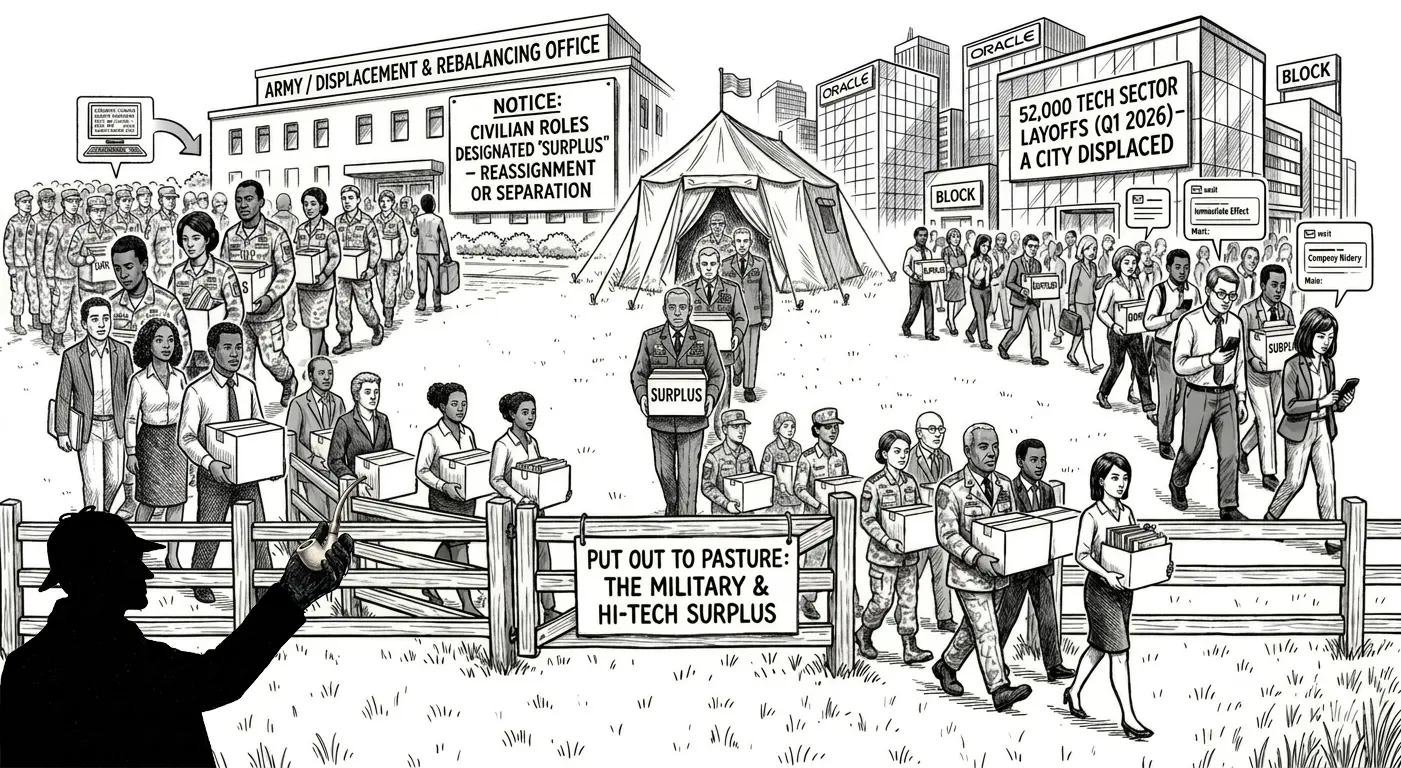
    Inside the Army: thousands of civilian employees were notified their roles had been designated “surplus” under a rebalancing initiative. They were given days to accept reassignment — potentially to different states or different countries — or face separation. The tool used to identify matching positions for displaced employees was an AI system developed by Palantir, housed in the Army’s Vantage platform.

    The institution that this week removed its senior leadership for insufficient ideological alignment simultaneously used an algorithmic tool to sort its civilian workforce into necessary and unnecessary. The Palantir system did not determine policy. It processed the inventory.

    Across the broader economy: the first three months of 2026 produced 52,000 U.S. tech sector layoffs — roughly the entire workforce of a mid-sized American city — the highest first-quarter total since 2023. Oracle notified somewhere between 20,000 and 30,000 employees by early-morning email with immediate effect, one of the largest single layoff events in the company’s history. Block eliminated 4,000 of its roughly 10,000 employees. Atlassian cut 1,600 roles while simultaneously hiring 800 AI-focused replacements. The categories most heavily displaced: customer support, content creation, quality assurance, project management.

    Jack Dorsey’s internal memo at Block was notable for its directness. The cuts were not attributed to financial difficulty. They were attributed to the growing capability of AI to perform a wider range of tasks.

    A global study published this week by LHH, a division of the Adecco Group, surveyed employers directly. Nearly half reported they had already reduced headcount due to AI implementation. An additional 54 percent said they expect further AI-driven reductions within five years. This is the demand side of the same story — not companies announcing layoffs, but employers confirming, in aggregate, that the reduction of human labor is now standard operating procedure.

    The displacement is not uniform. It is moving through specific categories of work, in a specific order, at an accelerating pace. The people now watching from what feels like a safe distance are in categories that have not yet been reached.

    The silence won’t feel like silence. It will just feel like the way things are.


    What these three stories share is not a theme. It is a sequence.

    The institution purges the leadership that won’t recompose its membership criteria. It deploys an algorithmic tool to sort the remainder into necessary and unnecessary. And the organization that will train the next generation of AI systems on human knowledge acquires a stake in the discourse that knowledge comes from.

    In each case the stated rationale is neutral: leadership change, workforce rebalancing, strategic acquisition. In each case the structural result is the same. The room gets smaller. The criteria for who belongs in it are rewritten without being stated. And the tools that will mediate what the next generation knows are moving closer to the people who are doing the rewriting.

    First they recomposed the promotion lists, and the mid-career officer said nothing, because she was not on the list. Then they designated the civilian workforce surplus, and the contractor said nothing, because he was not in that rebalancing. Then the organization that trains the systems on human knowledge acquired a stake in the discourse, and the knowledge worker said nothing, because her category had not yet been reached.

    The categories are not fixed. They are a sequence.

    Pastor Martin Niemöller wrote his confession from inside a concentration camp. He had not been alarmed when the sequence started. His category, he had assumed, was different.

    The pattern is the same. The speed is not.


    Sources

    Section I
    https://www.military.com/daily-news/headlines/2026/04/02/army-chief-forced-out-iran-war-hits-new-phase.html
    https://www.foxnews.com/politics/army-chief-staff-ordered-retire-immediately-hegseth-continues-pentagon-shakeup
    https://www.aa.com.tr/en/americas/us-military-leadership-reshaped-as-defense-secretary-forces-dozens-of-senior-officers-out/3890199
    https://www.trtworld.com/article/42f5b8e54457

    Section II
    https://techcrunch.com/2026/04/02/openai-acquires-tbpn-the-buzzy-founder-led-business-talk-show/
    https://openai.com/index/openai-acquires-tbpn/
    https://www.cnbc.com/2026/04/02/openai-acquires-tech-podcast-tbpn.html

    Section III
    https://federalnewsnetwork.com/army/2026/03/army-rebalancing-effort-forces-civilians-to-accept-reassignments-to-avoid-layoffs/
    https://defensescoop.com/2026/03/26/army-rebalancing-civilian-workforce-reassignments-separations/
    https://www.cnbc.com/2026/03/31/oracle-layoffs-ai-spending.html
    https://www.blockchain-council.org/layoffs/layoff-narratives-tech-companies-blaming-ai/
    https://www.eweek.com/news/more-tech-layoffs-ai-job-impact-2026/
    https://www.staffingindustry.com/news/global-daily-news/ai-driven-job-cuts-surge-study-warns


    TNG: Notes from the Field publishes on a fortnightly cadence. Out-of-cycle dispatches appear when the material requires it. The Narrow Gate is publishing April through September 2026 at [link].

  • Warehouse Acquisition

    Warehouse Acquisition

    NOTES FROM THE FIELD
    April 1, 2026

    — THE INFRASTRUCTURE REMAINS —
    The Warehouse Acquisition Program as Durable Architecture

    — WHAT IS ACTUALLY BEING BUILT —

    In July 2025, Congress allocated $45 billion to ICE for immigration detention — more than a decade of normal detention funding delivered in a single appropriation. ICE is now the highest-funded law enforcement agency in the United States.

    The initial plan was leased tent camps. One was built — Camp East Montana on Fort Bliss in El Paso — and became immediately notorious. Three people have died there since it opened in August 2025, including what is reported as the first homicide in a modern ICE detention facility. Conditions documented by ICE’s own inspectors included dozens of violations of federal detention standards in the first two months of operation.

    The tent camp model was abandoned. What replaced it is more consequential.

    ICE has now launched what it calls the “ICE Detention Reengineering Initiative.” The plan: purchase commercial warehouses outright, retrofit them into a national network of detention facilities, and consolidate the current system of roughly 300 facilities down to 34 — organized as 8 “mega centers” holding 7,000 to 10,000 people each, and 16 regional processing centers holding 1,000 to 1,500. Total planned capacity: 92,600 people.

    The purchases are already underway. As of early 2026, ICE has spent more than $690 million acquiring at least seven industrial warehouses in Maryland, Arizona, Georgia, Texas, Pennsylvania, and Michigan. A single warehouse near El Paso cost $123 million. One in Hagerstown, Maryland: over $100 million. One in Surprise, Arizona: $70 million. One in Berks County, Pennsylvania: $87 million — 520,000 square feet. The total retrofit and acquisition budget is $38.3 billion.

    Before February 2025, ICE owned 10 of the 220 facilities it used. The stated plan is now to own the infrastructure entirely, with private contractors hired to operate it.

    The shift from leasing to owning is the critical structural fact.

    — WHY THE SHIFT MATTERS —

    Leased facilities can be returned. Contracts can be terminated. Political pressure can reach the private owner. Community opposition can reach the seller, and has — at least 12 purchases have been blocked this way, and two announced deals fell through under pressure.

    Owned infrastructure cannot be returned. Once the federal government holds title to 34 warehouse-scale detention facilities distributed across the national geography, the infrastructure exists independent of its current stated purpose. The legal authority that built it is Section 1231(g) of the U.S. Code, which authorizes ICE to acquire facilities for the detention of non-citizens. The physical infrastructure that results has no such limitation.

    A warehouse in Berks County, Pennsylvania, retrofitted to hold 1,500 people, is — after its current occupants have been deported — a facility that holds 1,500 people. The legal designation of who qualifies for detention is a policy decision. The infrastructure is permanent.

    This is not speculation. It is the nature of infrastructure. Roads built for military use carry civilian traffic. Internment camps built for one designated population have been repurposed in every historical instance where the original population was exhausted or dispersed. The facilities do not come down. The justification changes.

    — THE QUESTION THIS RAISES —

    The “Sequence” dispatch asks what happens when the technology reaches the rungs where the people who built this system live — when the economically displaced citizens find no legal mechanism to claim their share of the automated abundance.

    This addendum adds the physical infrastructure dimension: when that displacement arrives at scale, the warehouses will already exist. Owned. Geographically distributed. Designed to hold people at capacity pending legal resolution of their status.

    The acting ICE director described the goal of the new system as “Amazon Prime, but with human beings.”

    Amazon’s warehouse network is not built for one product. It is built for throughput. The product changes. The infrastructure scales.

    The silence won’t feel like silence. It will just feel like the way things are.

  • Ducks in a row

    Ducks in a row

    NOTES FROM THE FIELD
    April 1, 2026

    — THE SEQUENCE —
    Birthright Citizenship, the Robot Economy, and the Architecture of Exclusion

    The Supreme Court heard arguments today on birthright citizenship. The framing in most coverage is immigration law. The framing in constitutional commentary is 14th Amendment precedent. Both framings are correct and both miss the more durable structural question.

    The question is not what the law says. The question is what the sequence is — and why the sequence matters.

    — I. THE PIECES ARE VISIBLE —

    Three things are true simultaneously and are being discussed as if they are separate stories.

    First: The current administration is aggressively dismantling the legal standing of non-citizen residents — through deportation, visa revocation, birthright restriction, and the construction of expanded detention infrastructure. Every lower court that has reviewed the birthright order has found it unconstitutional. It remains in litigation. If ultimately upheld, it would deny citizenship to an estimated 250,000 children born on U.S. soil annually going forward.

    Second: The robot economy is not a future scenario. It is an accelerating present. At Davos in January 2026, Palantir CEO Alex Karp stated explicitly that AI will render large-scale immigration to support Western labor markets “virtually obsolete.” The Wharton Budget Model projects AI will produce labor savings averaging 25 percent by the mid-2030s, potentially rising to 40 percent. Amazon, UPS, Accenture — the displacement of both blue- and white-collar work is already in motion.

    Third: The infrastructure being built to manage this transition — the AI systems, the robotics platforms, the data architecture — is owned privately. Not publicly. The concentration of that ownership is accelerating in parallel with the displacement it produces.

    Each of these is being reported. None of them is being reported as a single story.

    — II. THE SEQUENCE —

    Here is what the sequence looks like when you read it structurally rather than politically.

    The robot economy will not need the labor of the currently excluded. Within a decade, it will need very little human labor at any level except at the apex of ownership and engineering. The wealth produced will be real and substantial — and it will belong to those who own the infrastructure.

    The people who currently hold the least secure legal standing — undocumented workers, temporary visa holders, children of non-citizens — are precisely the people whose labor the economy will stop needing first. They are the most automatable, the least legally protected, and the least positioned to claim any share of the abundance their displacement produces.

    If you wanted to design a system in which a transition to a robot economy produced maximum wealth concentration with minimum claim on that wealth by displaced workers, you would do exactly what is being done. You would establish the legal architecture of exclusion before the economic displacement is complete. You would build the hierarchy in law before the labor becomes unnecessary, so that when the labor becomes unnecessary, the excluded have no legal standing from which to make a claim.

    No conspiracy is required. The people in the room share a common interest in the outcome.

    — III. THE LADDER —

    Here is the question this dispatch cannot answer but must ask.

    Every hierarchy has a bottom rung. The current effort is aimed at that rung — at the non-citizens, the undocumented, the legally precarious. The warehouses to hold them are already under construction.

    But technology does not stop at the bottom rung. It moves up.

    The automation that replaces the undocumented agricultural worker will next replace the documented one. The AI that displaces the call center worker will next displace the mid-level analyst, the paralegal, the junior accountant. The Wharton model projects that 40 percent of current GDP activity will be significantly impacted by AI — and that impact falls most heavily in the middle third of the income distribution, not the bottom.

    Which produces a question that the people now watching the deportations from a comfortable distance have not yet asked themselves: when the ladder is pulled up from the bottom, and the rungs above begin to disappear — what is the legal and economic mechanism by which the newly displaced make a claim on the abundance the machines are producing?

    There isn’t one. Not yet. And the legal architecture being built right now is not designed to create one.

    Pastor Martin Niemöller, writing from inside a Nazi concentration camp where he eventually landed after years of silence, gave us the operating principle. He was initially not alarmed when they came for the Communists, because he was not one. Not alarmed for the Socialists. Not alarmed for the trade unionists. Not alarmed for the Jews. His insight, written in confession rather than prophecy, was that the categories of the excluded expand — and that the comfortable assume their comfort is structural rather than temporary.

    The working-class voter who supports the deportations because he is not an immigrant. The mid-career professional who supports automation because she is not in a vulnerable sector. The small business owner who supports the consolidation because he is not yet the one being consolidated.

    Niemöller’s original formulation was premised, scholars note, on naming groups his audience would instinctively not care about. That was the indictment. The poem was not a description of what happened to others. It was a confession of what he failed to understand was happening to him.

    The frog does not feel the water heating. The temperature feels like the way things are.

    — IV. WHO ELSE IS CONNECTING THIS —

    The pieces exist in the literature. The connection does not.

    Yuval Harari has named the “useless class” — the population whose skills automation renders obsolete — since 2017. At Davos 2026, he warned that AI will create immense wealth in a few high-tech hubs while other economies become what he called data colonies. He identifies the wealth concentration problem clearly. He does not connect it to immigration restriction as preparatory legal architecture.

    Academic economics has documented the substitution relationship: regions with fewer immigrant workers adopt robots faster; regions with more adopt them slower. Immigration and automation are substitutes in the labor market. The literature has the mechanism. It has not drawn the political conclusion.

    One independent publication, writing in February 2026, came closest — arguing that immigration crackdowns remove labor from the economy precisely as automation makes large-scale capital adoption necessary, and that only firms large enough to absorb the automation investment survive the transition. It names the consolidation dynamic. It frames it as accusation rather than structure, which limits its reach.

    The structural argument — that legal exclusion is being built before economic displacement rather than after, specifically so the excluded population has no standing to claim a share of what their displacement produces, and that the exclusion will not stop at the currently excluded — does not yet exist in published form.

    It will.

    — V. WHAT THIS ADDS TO THE ARGUMENT —

    The Narrow Gate, publishing beginning this month, establishes a 1,500-year pattern: institutions consistently make decisions that concentrate interpretive authority and fix the categories of belonging before the conditions that would distribute it more widely can take hold. The Council of Constantinople did not abolish reincarnation because it was theologically settled. It abolished it because a soul that travels through all conditions cannot be permanently assigned to any one of them — and permanent assignment is the prerequisite for permanent hierarchy.

    What is being argued at the Supreme Court today is whether the accident of birth can be made permanently determinative of legal standing. What is being built in parallel is an economy in which legal standing will determine access to the abundance produced by machines that no longer need the people they replaced.

    The unanswered question — the one this dispatch is recording because it must be recorded — is what happens when the technology reaches the rungs where the people who built this system live. Whether the legal architecture they constructed to exclude others will protect them. Whether they will recognize the water temperature before it is too late to step out.

    History suggests they will not. History suggests they will assume their rung is different.

    The tool changed with the century. The problem being solved did not.

    The silence won’t feel like silence. It will just feel like the way things are.