NOTES FROM THE FIELD — Dispatch #8
April 2026
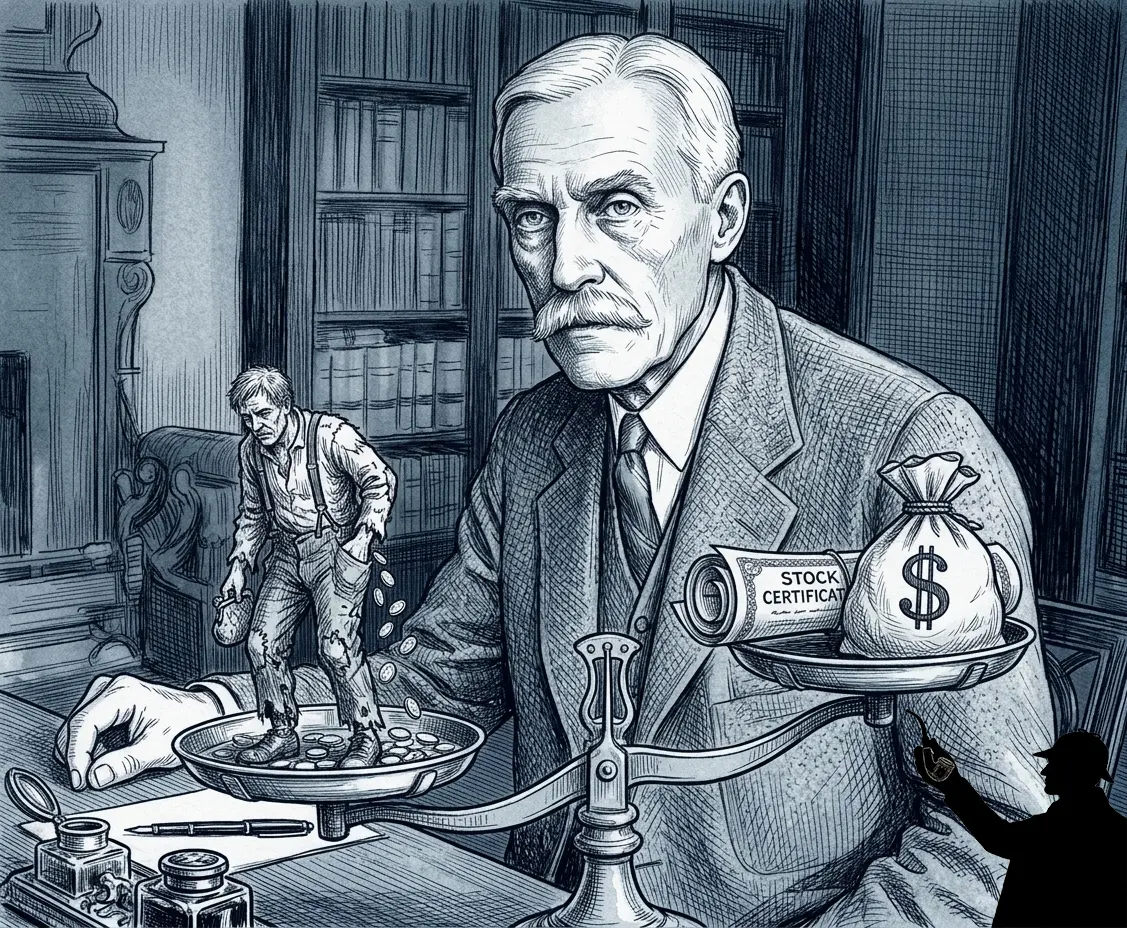
Mellon wrote in 1924 that taxing wage income more heavily than investment income was beyond question unfair. A century later the system runs exactly backward.
Three dispatches. One argument.
The first showed you the mechanism — how the ownership class built a parallel tax system inside the official one, how a surgeon pays 50 percent and a founder pays nothing, how the stepped-up basis at death erases a lifetime of untaxed appreciation before the government can touch it.
The second showed you why it stays. The complexity is the inventory. The reform proposals are the fundraising mechanism. The public anger is the product, not the malfunction. The people who would need to fix it are the people being paid to preserve it.
This dispatch asks what happens when the arithmetic stops being theoretical.
What a fair system would look like.
Before the reckoning, it’s worth a moment on the alternative. Not as fantasy, but as documented possibility.
Andrew Mellon — robber baron, Secretary of the Treasury under three presidents, hardly a figure of redistributive sympathy — wrote in 1924 that taxing wage income more lightly than investment income was beyond question as a matter of fairness. His reasoning: wages are uncertain, end at death, diminish with age. Investment income continues. It compounds. It descends to heirs. Mellon’s position was that the precarious should be protected and the durable should bear more.
A century later, the code runs exactly backward. The surgeon pays 50 percent on income that ends when she stops working. The founder pays nothing on wealth that compounds indefinitely, transfers at death with gains erased, and arrives in his children’s accounts untouched by any meaningful tax.
Mellon’s principle — tax the durable more than the precarious — is not radical. It was the founding logic of the system. Returning to something like it would mean taxing unrealized gains at death rather than erasing them, treating borrowed-against wealth as the income it functionally is, and applying the payroll tax consistently rather than capping it at $168,000. None of this requires invention. The 1986 Tax Reform Act showed that a broad-based system with fewer shelters actually works — revenues rise, avoidance shrinks, the people with the most genuine income pay the most genuine tax.
The mechanism exists. The precedent is documented. Reagan signed it.
The clock that is actually running.
The national debt crossed $39 trillion in March. The nonpartisan Congressional Budget Office projects it reaches $64 trillion by 2036. Interest payments this year exceed $1 trillion — more than the defense budget. By 2036, the CBO projects interest payments more than double, to $2.1 trillion, consuming nearly one-fifth of all federal spending.
The Federal Reserve chair said it plainly at Harvard in March: the debt level itself is survivable. The path is not. “It will not end well if we don’t do something fairly soon.”
The specific number economists are watching is fiscal year 2031. That is when, under current projections, the average interest rate on federal debt will exceed the rate of economic growth. When borrowing costs outpace the economy’s ability to generate revenue, debt accumulates faster than it can be addressed. The Committee for a Responsible Federal Budget calls this condition a debt spiral. Once entered, it is self-reinforcing: higher debt pushes rates up, higher rates slow growth, slower growth means less revenue, less revenue means more borrowing, more borrowing means higher debt.
The CBO’s relatively optimistic baseline — which assumes no additional tax cuts or spending increases — projects the debt reaching 175 percent of GDP by 2056. The less optimistic scenarios approach 379 percent.
Five years to the threshold. Under current law.
The population that will be standing there.
Here is where the three dispatches converge.
The tax base that would address this trajectory depends on taxing economic participation. Income. Wages. Transactions. The broad base of people working, earning, spending, contributing payroll taxes from the first dollar.
That base is contracting.
Automation is not a future condition. It is a current one, accelerating. The research on labor substitution is consistent: the displacement is not moving uniformly across the economy. It is moving through the jobs that the ownership class does not hold — logistics, service, administration, the work done by the people who were already paying payroll taxes on every dollar while the ownership class paid them on none.
The people being displaced are not moving into higher-productivity roles at the rate the standard reassurance requires. They are moving into reduced participation, contingent work, government dependency. They are leaving the tax base and entering the expenditure column.
And they are arriving there at the same moment the debt spiral is projected to tighten — with a federal budget increasingly consumed by interest payments, Social Security and Medicare shortfalls compounding, and the political will to broaden the tax base absent by design.
The warehouse question.
In dispatch five, we noted that the United States has built $38 billion in government-owned detention infrastructure. It was built for one population — immigrants, undocumented, legally excludable, with no standing to claim a share of what the economy produces.
The question dispatch five left open was about the next population.
When the debt math runs out — when the interest payments crowd out the programs, when the displaced workers find the safety net has been means-tested and time-limited and legislated into inadequacy, when the people who were removed from economic participation by automation have no legal mechanism to claim a share of the abundance that automation generates — they will need somewhere to go.
The infrastructure is already paid for.
Andrew Mellon understood that the precarious needed protection, that a system which taxed their uncertainty while sheltering durable wealth was not just economically inefficient but morally backward. The 1986 reformers understood that a broad base collected more revenue and distributed the burden more honestly. The CBO understands that the current trajectory ends badly. The Fed chair understands it. The economists who study labor substitution understand it.
The people who would need to act understand it too.
They are also the people who have spent thirty years making sure the complexity stays complex, the base stays narrow, and the displaced population has no legal standing to make a claim on what’s coming.
The silence on all of this won’t feel like silence.
It will just feel like the way things are.
Sources: Ray Madoff, “Our Tax System Should Make You Furious,” The Ezra Klein Show / New York Times, April 17, 2026. Andrew Mellon, “Taxation: The People’s Business,” 1924, as cited in Madoff. Congressional Budget Office, Budget and Economic Outlook 2026–2036, February 2026. Committee for a Responsible Federal Budget, “CBO Projects Possible Debt Spiral, as R Exceeds G,” March 9, 2026. Jerome Powell remarks at Harvard University, March 30, 2026. Peterson Foundation, interest cost projections, February 2026.
Leave a Reply