The Australian government’s admission came at Senate estimates on June 3, in the flat language of bureaucratic disclosure: the Department of Employment and Workplace Relations said that approximately 300,000 Centrelink payments had been illegally cancelled between 2020 and 2024, due to a glitch in the automated mutual obligations system. The system had cancelled payments before the legally required 28-day window had elapsed, cutting off benefits for people on JobSeeker, Youth Allowance, Disability Support, and Parenting Payment — the populations at the floor of the welfare system — without the legal notice required before cancellation.
This was not the first admission. The government had previously conceded 9,510 unlawful cancellations. Independent analysis by Economic Justice Australia identified the actual number as approximately 310,000. The government quietly paused new payment cancellations in July 2024. It did not announce the pause. It did not publicly acknowledge the gap between 9,510 and 310,000 until Senate estimates compelled it.
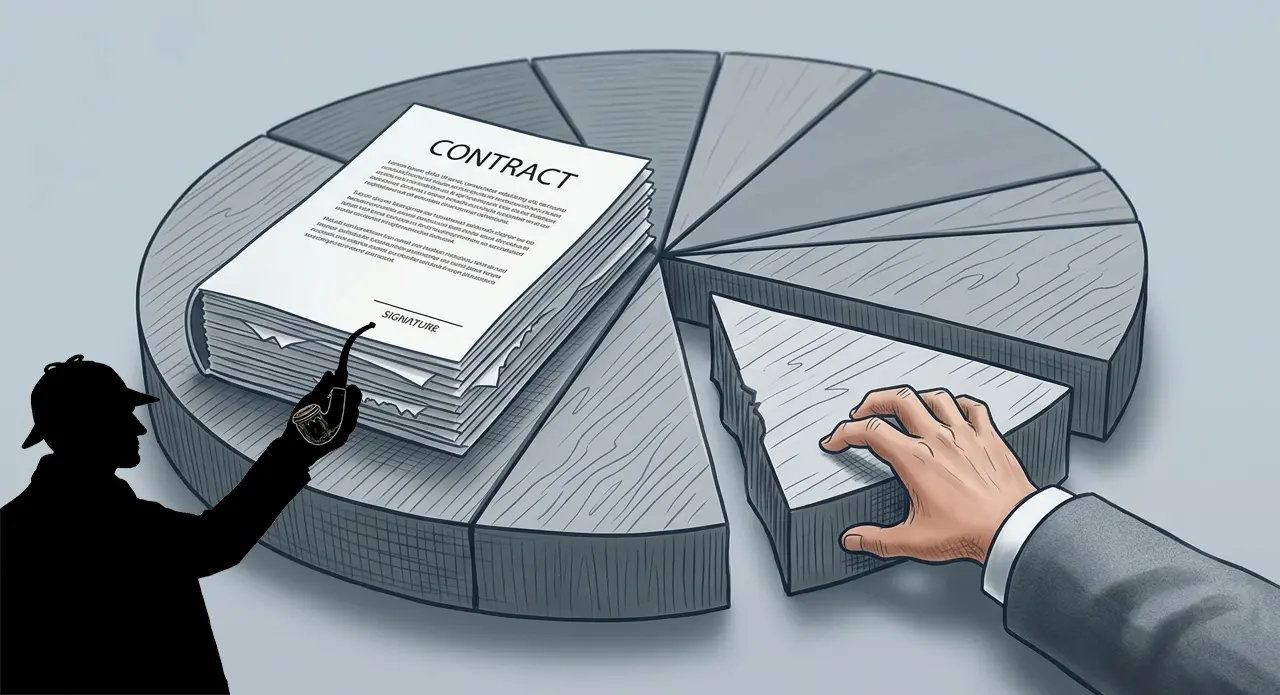
Australians of a certain age will read the phrase “automated Centrelink system” and feel a specific kind of recognition. The Robodebt scheme ran from 2016 to 2019 under the Liberal-National Coalition government, using automated income-averaging calculations to raise debt notices against welfare recipients — more than half a million inaccurate notices, pursuing people for money they did not owe, with the burden of proof reversed: the recipient had to prove the debt was wrong, not the government. The Federal Court ruled Robodebt unlawful in 2019. The subsequent royal commission produced 57 recommendations. The settlement cost over $1.8 billion. The commission’s final report described it as a “shameful chapter in the administration of the commonwealth.” Its 57 recommendations were made so the scheme’s mistakes would never be repeated.
The mutual obligations glitch is not Robodebt. The mechanism is different — a timing error in cancellation, not a fraudulent debt-calculation method. But the structural pattern is identical: an automated government system making administrative decisions about individual welfare entitlements at scale, without individual review, producing illegal outcomes that only became fully visible when external pressure forced disclosure. The government’s initial figure was 9,510. Economic Justice Australia’s independent analysis found 310,000. The ratio between what the government admitted and what actually happened is approximately 33 to 1.
There is an additional detail. The government commissioned a Deloitte review of the automated system. Large portions of that review, it emerged, were themselves generated using artificial intelligence. A government review of an automated system that illegally cancelled welfare payments was partially written by another automated system. Economic Justice Australia’s Kate Allingham said the organisation had “not seen anything that assures us” that reforms were actually happening. Meanwhile, between January and March 2026 alone — after the pause on cancellations was announced — nearly 300,000 suspension notices were issued. More than 3,300 per day.
The structural argument is not about the Albanese government’s intent or competence. It is about what automated administrative systems do at scale when human review is removed from decisions that affect individual legal entitlements. The Centrelink system’s function is to determine whether individual recipients have met their mutual obligations. That determination — whether a specific person in a specific circumstance did or did not comply with a requirement — is an individual judgment about an individual situation. Automating it at scale means replacing those individual judgments with a rule set applied uniformly. When the rule set has a timing error, 300,000 people lose payments they were legally entitled to keep, before anyone notices, and the government’s first disclosure puts the number at 9,510. The Robodebt royal commission made 57 recommendations to prevent this from happening again. The reforms, critics say, have largely recycled old ideas. The Deloitte report reviewing the system was partially written by AI. Cancellations were paused; suspensions were not. The silence won’t feel like silence. It will just feel like the way things are.
Essay 12 — The Converging Frames (See also: Essay 13 — The False Frame) Copyright 2026 — Steve Sagnotti Sources:
The Guardian, “Hundreds of Thousands of Centrelink Payments Cancelled Illegally, Albanese Government Admits,” June 3, 2026. YourLifeChoices, “The Government Just Admitted to 300,000 Illegal Centrelink Cancellations: What Happens Now?” June 2026. Victoria Legal Aid, “Learning from the Failures of Robodebt — Building a Fairer, Client-Centred Social Security System” (case history), 2026. Wikipedia, “Robodebt Scheme” (scheme history and outcomes), retrieved June 2026. Colitco / Economic Justice Australia, “Centrelink Debt Scandal: Automated Failures and Pattern of Review,” 2025–2026.
The Kennedy Center for the Performing Arts is named for President Kennedy by act of Congress. The statute establishing the center says so plainly: Congress gave the center its name, and only Congress can change it.
This was not, until recently, a point anyone needed to litigate.
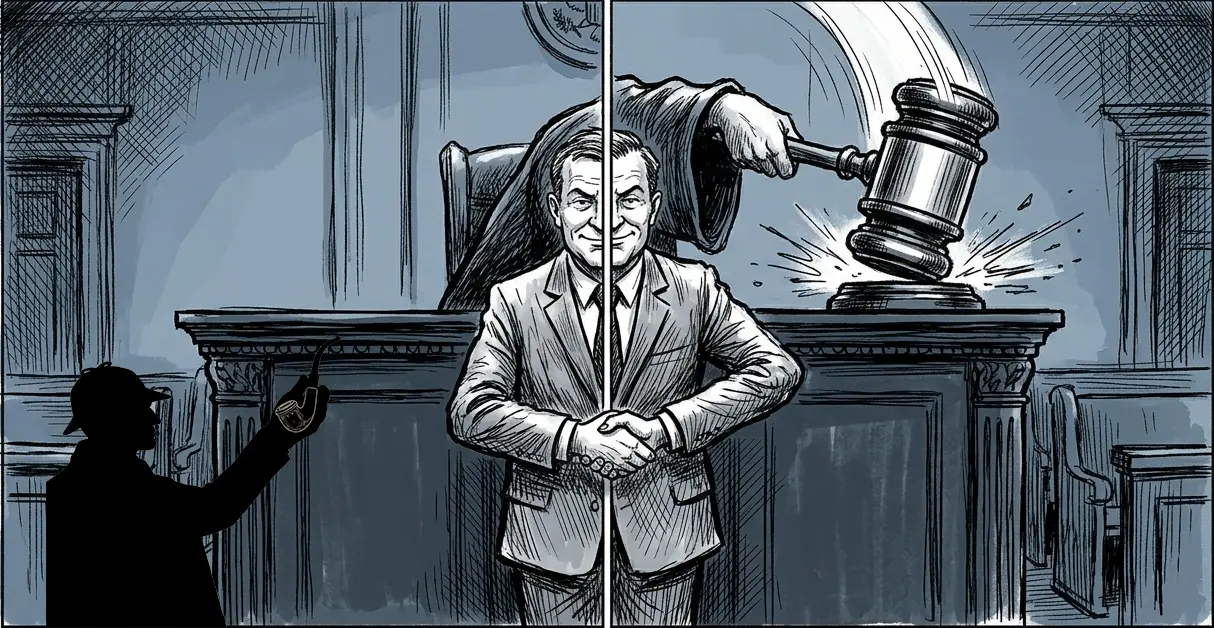
On December 18, 2025, the Kennedy Center’s board — reconstituted by Trump after he removed several trustees and appointed himself chairman the previous spring — voted to rename the facility the “Donald J. Trump and John F. Kennedy Memorial Center for the Performing Arts.” Workers began affixing the new letters to the building’s facade the following day. In February 2026, Trump announced the center would be closed for approximately two years for a major renovation, at an estimated cost of $257 million in congressionally appropriated funds. The board voted to ratify the closure at a March 16 meeting — the same meeting at which the board stripped Democratic Rep. Joyce Beatty, an ex officio member through her role in Congress, of her voting rights.
On May 29, U.S. District Judge Christopher Cooper ruled that the board had violated federal law on every count.
The renaming was illegal. “May the John F. Kennedy Center for the Performing Arts be renamed absent Congressional authorization?” Cooper wrote. “The answer, plain from the face of the statute, is no. Nor can any other individual be memorialized on the front portico of the building.” The closure was procedurally invalid. The board’s vote, Cooper found, was “ill-informed and seemingly preordained” — trustees had learned about the closure plan at the same time as the public, through a social media post, and “deprived of time and information, they had no meaningful opportunity to consider perhaps the most momentous decision in the Center’s lifetime since it opened in 1971.” Stripping Beatty of her vote was also ruled an overreach of the board’s authority. Cooper ordered Trump’s name removed from the facade and all signage within two weeks and restored Beatty’s voting rights.
Trump responded on social media, saying the judge “should be ashamed of himself,” and announced he would direct his administration to transfer control of the center to Congress — effectively withdrawing from the legal fight by converting the institution into something he no longer wanted to be responsible for.
The structural argument here is not about the Kennedy Center’s aesthetic or cultural significance. It is about the mechanism. The sequence is worth stating plainly:
The executive removes the existing board. The executive appoints a new board, installs himself as chairman. The new board votes to rename the institution after the executive — a vote the executive’s own appointees control. The new board votes to close the institution for renovation — a decision announced before the board was consulted, ratified afterward. A congressional ex officio member is stripped of her vote at the meeting where these decisions are ratified. When a court blocks the sequence, the executive announces he will transfer the institution to congressional control, framing a legal defeat as an administrative choice.
What the judge found is not that the executive acted with corrupt intent. What the judge found is that the board acted without statutory authority — that the law establishing the institution assigned naming authority to Congress, not to a board, and that a board appointed by the executive cannot confer on itself powers the statute doesn’t grant.
This is not unique to the Kennedy Center. Trump’s name or image has been added to the Justice Department headquarters and the U.S. Institute of Peace during the same period. He has proposed a triumphal arch overlooking the Potomac. The East Wing of the White House was demolished to build a ballroom. These are not the same as the Kennedy Center — some are discretionary executive actions, some are normal renovation decisions. But the Kennedy Center case establishes the outer limit: there is a category of institution that Congress created, named, and governs by statute, and the executive’s power over that institution’s governing board does not extend to powers the statute explicitly reserves to Congress.
The legal fight will continue. Alabama’s attorney general said of a different case: it’s not a matter of whether they win, only when. The Kennedy Center’s board spokeswoman said the center “remains committed to pursuing every lawful avenue” to see the Trump name restored.
The name is off the building. For now.
Essay 3 — The People in the Room Broken Frames — Block 9: The Darkened Room (not yet published — thebrokenframes.substack.com/s/broken-frames)
Copyright 2026 — Steve Sagnotti
Sources:
PBS NewsHour, “Judge Says Kennedy Center Board Violated Law Putting Trump’s Name on Building, Blocks Closure,” May 29, 2026. CNN, “Judge Says Trump Can’t Add His Name to Kennedy Center and Blocks Planned Closure,” May 29, 2026. NBC News, “Judge Temporarily Halts Kennedy Center Closure and Orders Removal of Trump’s Name,” May 29, 2026. CNBC, “Trump’s Name Must Be Removed from Kennedy Center, Judge Rules,” May 29, 2026. CBS News, “Judge Blocks Closure of Kennedy Center and Orders Removal of Trump’s Name,” May 29, 2026. Axios, “Trump’s Name Must Be Removed from Kennedy Center, Judge Orders,” May 30, 2026.
Redistricting in the United States is supposed to happen once a decade, after the census. The census counts people. The count determines how many House seats each state gets. Legislatures then draw the maps. The process has always been political — the party in power draws lines that favor itself. But the once-a-decade rule, however imperfect, established at minimum that voters get to live inside a known district for a predictable period of time.
That rule is now gone.
On the same day in May 2026 — Tuesday, May 26 — two things happened simultaneously in two Southern states that together define the new landscape. In South Carolina, the Republican-controlled state Senate voted down a new congressional map that would have eliminated the state’s only Democratic seat, a majority-Black district held for more than three decades by Rep. James Clyburn. In Alabama, a federal three-judge panel blocked a Republican-drawn congressional map that the court found had been designed to eliminate one of the state’s two majority-minority districts in violation of the Fourteenth Amendment. Two states. One day. One defeat by legislative defection, one defeat by federal court order.
The South Carolina story requires the full context. Trump had personally lobbied the Republican state Senate majority leader by phone — twice — and called into a private caucus meeting to pressure Republican senators into supporting the remap. The Republican-controlled House had already passed the new map. What stopped it was a coalition of twelve Republican senators who broke with the president, led by Senate Majority Leader Shane Massey, who gave a forty-five-minute floor speech about the dangers of antidemocratic gerrymandering. Among the quieter concerns: the new district lines would have redistributed Democratic voters into currently safe Republican seats, making those seats more competitive — a risk Republican incumbents weren’t willing to take on behalf of a national party strategy. The Senate adjourned without a vote, scheduling a return date of June 10 — the day after the state’s already-scheduled primary — effectively ending the redistricting push for the 2026 cycle in South Carolina.
The Alabama story is different in kind. Alabama’s redistricting fight did not start in 2026. In 2023, the same three-judge panel found that Alabama’s existing congressional map violated the Voting Rights Act and ordered the legislature to create a second district where Black voters could elect a representative of their choice. The legislature drew a new map — and the new map, the court found, still failed to comply. Alabama appealed. The Supreme Court, earlier in 2026, narrowed the Voting Rights Act in a Louisiana case that many states read as a green light to redraw maps without Black-majority districts. Alabama drew another map. The same three-judge panel — two of whom were Trump appointees — blocked it. The court found the map “intentionally discriminated based on race in violation of the Constitution,” specifically noting that the legislature “well knew that a plan without an additional Black-opportunity district would dilute Black Alabamians’ opportunity to participate in the political process, and it intentionally enacted that very plan.” Alabama’s attorney general announced immediate appeal to the Supreme Court.
Both cases are instances of the same mechanism at different stages of maturation. The South Carolina push was an attempt to use mid-cycle redistricting — outside the normal decennial process — to manufacture House seats before a midterm where the party holding the White House historically loses ground. The Alabama situation is further along: a legislature that has been in active defiance of federal court orders about its congressional map since 2023, drawing and redrawing lines until it finds a configuration a court will accept or the Supreme Court overrules the lower court.
What these two cases document, separately and together, is the use of the map-drawing function as an ongoing, continuously adjusted tool for managing electoral outcomes — not a one-time decennial process that constrains what a legislature can do, but a living instrument to be redrawn whenever the political calculus shifts. Trump’s mid-decade redistricting push has, according to reporting at the time of the South Carolina vote, already netted Republicans approximately nine net House seats through redrawn maps in states where the effort succeeded. The South Carolina defection and the Alabama court order are not a reversal of that trend. They are two speed bumps on a longer road.
The frozen House has 435 seats. It has had 435 seats since 1929. The party holding a slim majority in that chamber is now managing that majority in part by redrawing the districts from which its majority is elected, mid-decade, at the direction of the executive. South Carolina’s Senate Majority Leader gave a speech about antidemocratic gerrymandering and won the vote — this time. Alabama’s attorney general said it’s not a matter of whether they win, only when.
The silence won’t feel like silence. It will just feel like the way things are.
Essay 11 — Out of Frame Broken Frames — Block 3: The Map That Chooses (not yet published — thebrokenframes.substack.com/s/broken-frames) Broken Frames — Block 5: The Locked Door (not yet published)
Copyright 2026 — Steve Sagnotti
Sources:
Associated Press / Mississippi Today, “South Carolina Senate Rejects Trump’s Call to Redraw Congressional Maps,” May 26, 2026. MS NOW / NBC News, “South Carolina Senate Rejects Trump Push to Redraw Clyburn District,” May 26, 2026. MS NOW, “Why a Dozen South Carolina Senators Bucked Trump on Redistricting,” May 27, 2026. NPR, “Trump-Backed Redistricting Plan Is Rejected in South Carolina,” May 26, 2026. NBC News, “Federal Court Blocks Alabama from Using GOP-Drawn Congressional Map,” May 26, 2026. CNBC, “Judges Block Alabama Redistricting Maps That Would Dilute Black Vote in Midterms,” May 26, 2026. Washington Times, “Federal Court Blocks Alabama Republicans’ Congressional Map,” May 26, 2026. PBS NewsHour, “Federal Court Blocks Alabama Plan for New Congressional Districts,” May 26, 2026.
The “Broadview Six” case did not fall apart because the prosecutors were bad lawyers. It fell apart because a federal judge read the grand jury transcripts and saw what was in them — and then noticed that the version submitted to her by the prosecutors had pages missing.
The facts are not in dispute. On September 26, 2025, six people — a former congressional candidate, an Oak Park village trustee, a former Cook County Board candidate, a Democratic committeeperson, a musician, and a campaign worker — were among a crowd of protesters at a federal immigration facility in Broadview, Illinois. The crowd surrounded a federal agent’s SUV. Federal prosecutors selected these six from that crowd of hundreds and charged them with felony conspiracy carrying seven years.
What happened inside the grand jury was not visible until May 2026, when Judge April Perry ordered the unredacted transcripts and read them. The lead prosecutor had told the panel she had a “very interesting case” and urged the jurors to trust her — that she would never ask them to charge someone without probable cause. When the first group of jurors was skeptical — one called the case a “crock of sh–” — those jurors were excused. Prosecutors presented the case again to a reconstituted panel. When a juror asked whether prosecutors had “unlimited tries” to get an indictment, a second prosecutor replied: “I think the saying is the second time is the charm.”
Perry, a former federal prosecutor herself, told the courtroom she had read hundreds, if not thousands, of grand jury transcripts and had never seen what she found in these. The documented misconduct broke into nine categories: improper vouching, unauthorized contact with jurors outside proceedings, dismissing skeptical jurors, improperly testifying, failure to correctly instruct on the law, expressing personal opinions about guilt — and, in a separate detail, the U.S. Attorney himself appearing before the grand jury on the day of the indictment to ask jurors to identify themselves if they could not be impartial about immigration cases.
U.S. Attorney Andrew Boutros appeared in court personally on May 21 and dropped all charges with prejudice. He apologized. He also continued to describe the defendants’ conduct as “unacceptable in a civilized society.” Perry told him he was “significantly undercutting” his own apology.
The controlled unraveling that followed is now documented across multiple courtrooms. A second case collapsed in June: a COVID-19 testing fraud prosecution brought by the same prosecutor before the same grand jury. A second federal judge — U.S. District Judge Sharon Johnson Coleman — dismissed those charges and noted that Boutros was absent from her courtroom as he had not been from Perry’s. “Pandora’s Box has been opened,” Coleman said. “We have cases throughout this building that are all in turmoil.” More than 110 former federal prosecutors from the Northern District published an open letter describing a “failure of leadership” and a troubling exodus of staff from the office. Two U.S. senators called for Boutros’ resignation. House Judiciary’s ranking Democrat, Rep. Jamie Raskin, called for federal and state bar investigations. Defense attorneys filed for a special prosecutor with authority to bring criminal contempt charges, arguing the misconduct runs not to a single rogue assistant U.S. attorney but to “the highest levels of the Chicago U.S. Attorney’s Office and likely to the Department of Justice in Washington D.C.”
The defendants are seeking discovery of communications between Boutros’ office and the White House. The government has indicated it will not contest their Hyde Amendment claim for legal fees — a posture that carries its own meaning. The Hyde Amendment allows fee awards only where the government’s position was vexatious, frivolous, or in bad faith. By declining to contest it, the government has implicitly acknowledged the standard is met.
The Broadview Six case sits inside a larger record. The Chicago Sun-Times has tracked every prosecution arising from Operation Midway Blitz, the Trump administration’s immigration enforcement surge in Chicago. Of more than 30 cases filed: two produced guilty pleas, five ended in deferred prosecution agreements, two remain pending. Twenty-four others failed — twenty dismissed, at least three refused by grand juries that would not indict, one acquittal. In the most severe case, a federal agent shot a woman five times; the administration publicly called her a domestic terrorist and charged her with assault, then dismissed the case after body camera footage contradicted the government’s account.
The mechanism has a history. Grand juries were designed as a constitutional check on the executive — a citizen body standing between the government’s desire to prosecute and the machinery of a criminal trial. The formulation that a competent prosecutor can get a grand jury to indict a ham sandwich has circulated in federal courthouses for decades, because the pattern it describes is not new. The proceedings are secret. Defense counsel is absent. The prosecutor controls what the jury hears, how the law is explained, and — as these transcripts now show — which jurors are permitted to stay in the room.
The six people selected from a crowd of hundreds were all connected to local Democratic politics. When the first citizen panel was skeptical, skeptical citizens were removed.
One detail remains current as of this writing. The deputy attorney general who announced the original Broadview Six indictment — Todd Blanche — is now the Trump administration’s nominee to be Attorney General of the United States.
The sequence is stated plainly. The transcripts are public. A second case has collapsed. A judge has said Pandora’s Box is open. The U.S. Attorney has not appeared in that judge’s court. The man who announced the prosecution is nominated to lead the Department of Justice.
The silence won’t feel like silence. It will just feel like the way things are.
Essay 3 — The People in the Room Broken Frames — Block 9: The Darkened Room (not yet published — thebrokenframes.substack.com/s/broken-frames)
Sources:
Chicago Sun-Times, “Broadview Six Charges Dropped as Chicago’s Top Federal Prosecutor Admits Case Was Tainted by Misconduct,” May 21, 2026. Capitol News Illinois / Hannah Meisel, “Transcripts Show Grand Jurors Dismissed for Disagreeing with Government’s Case,” June 9, 2026. CBS Chicago, “Newly Released Grand Jury Transcript Shows Prosecutors Vouched for Case, Dismissed Skeptical Jurors,” June 9, 2026. WTTW Chicago Tonight, “‘Pandora’s Box Has Been Opened’: Judge Blasts U.S. Attorney Boutros as Another Case Falls Apart,” June 12, 2026. Chicago Sun-Times, “‘Is Mr. Boutros Here?’ Judge Drops Fraud Charges, Calls Out U.S. Attorney,” June 12, 2026. WTTW Chicago Tonight, “Former Federal Prosecutors Talk Andrew Boutros, Collapse of ‘Broadview Six’ Case,” June 11, 2026. Capitol News Illinois / Hannah Meisel, “‘No One Can Credibly Investigate Themselves’: Broadview Six Protesters Request Special Prosecutor,” June 17, 2026. Chicago Sun-Times, “‘Broadview Six’ Fallout Expands to Washington, as Raskin Calls for Probe,” June 17, 2026. CBS Chicago, “Cleared ‘Broadview Six’ Defendant Calls Prosecutors’ Grand Jury Actions ‘Shocking and Horrifying,’” June 18, 2026. David French / New York Times Opinion, “A Malicious Chapter in the History of American Justice,” June 21, 2026.
In the same week in May 2026, two opinion pieces appeared in two countries about the same problem — and neither author knew the other was writing it.
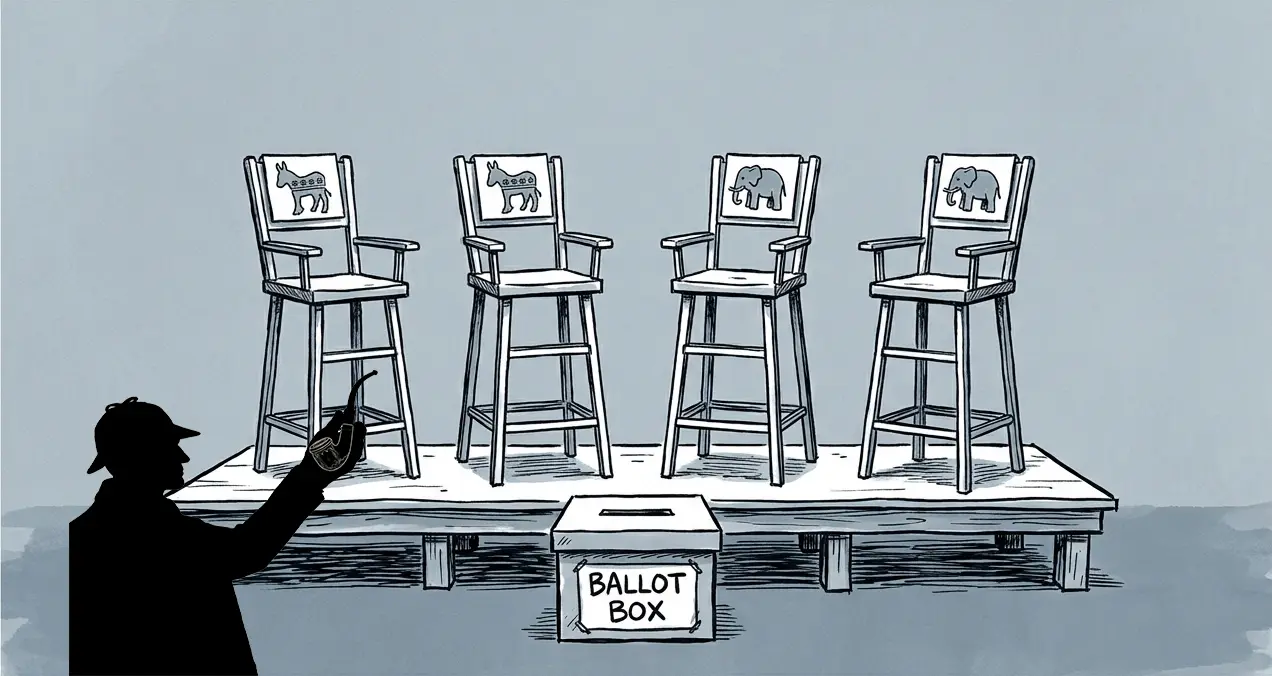
In the United States, political scientist Lee Drutman appeared in a New York Times opinion video with columnist Ezra Klein to make a point that has animated his work for years: America’s two-party system is not an organic outgrowth of civic culture or political preference. It is a direct result of electoral structure. Single-member districts with first-past-the-post voting mechanically produce two parties. Not because voters want two parties — survey after survey shows they don’t — but because the rules make any other outcome mathematically punishing. Drutman’s prescription: multi-member districts with proportional representation, the system used by most mature democracies and the one both John Adams and James Madison warned would be necessary to prevent the tyranny of faction.
In England, journalist Jason Okundaye wrote in The Guardian about the drama at Worcestershire county council, where Reform UK had won a plurality of seats in 2025 local elections and taken control — without a majority. What followed was, by Okundaye’s account, chaos: two different leaders, two different deputies, two cabinet members sacked, promised efficiencies never found, a council left £600 million in debt by its predecessor now being run by people who’d spent twenty minutes reviewing a billion pounds in spending. In May 2026, a rainbow coalition of Conservatives, Greens, Liberal Democrats, and independents removed Reform from power. The national Conservative Party promptly suspended the local Conservative leader who’d made it happen.
The Worcestershire situation is not primarily a story about Reform UK’s competence or incompetence. It is a story about what happens when a voting system built for two parties is used by an electorate that has fractured into five or six. Britain’s first-past-the-post system — identical in structure to the American single-member district system Drutman describes — produces distorted outcomes in a multiparty environment. A party that wins a plurality but not a majority governs with the full authority of a majority, and parties that don’t know how to form coalitions or share power are left with no legitimate mechanism for doing so. The Electoral Reform Society has been saying this since before the Brexit vote, Okundaye notes. Westminster has declined to listen.
Two countries. The same electoral architecture. The same structural consequence: a system designed for a two-party world, operating in a world that has moved on.
The American version of this problem has a specific origin. The single-member district system that produces the two-party doom loop — Drutman’s phrase — was not an inevitable feature of democratic governance. It was a choice, embedded in law and reinforced by decades of rules that make third-party ballot access expensive, primary structures that reward ideological purity over coalition-building, and a House of Representatives that stopped growing in 1929 and has remained frozen at 435 members ever since. The frozen House is not an accident of history. It is a constructed artifact — a room that stopped making room for new people precisely when the country began to look like something other than what the room had been built to represent.
Britain’s room was built differently but locked by the same logic: if the existing parties benefit from the existing rules, they have no incentive to change them. The Electoral Reform Society can publish reports. Local councils in Worcestershire can collapse. Westminster will govern like it’s 1950 until it can’t.
“The public wants a fairer, more honest, more cooperative politics,” the Electoral Reform Society wrote — three years after the Brexit vote, when two-party democracy looked fragile but still robust. In 2026, first-past-the-post is producing distorted outcomes in English local elections and an American electorate that wants more than two choices is being offered the same two it has always been offered, dressed in new packaging.
The silence won’t feel like silence. It will just feel like the way things are.
Essay 11 — Out of Frame Broken Frames — Block 4: The Private Government (Party) (not yet published — thebrokenframes.substack.com/s/broken-frames) Broken Frames — Block 5: The Locked Door (not yet published)
Sources: New York Times Opinion, “Breaking the Two-Party System” (video, Ezra Klein with Lee Drutman), May 19, 2026. The Guardian / Jason Okundaye, “To Understand Britain’s New Politics, Look No Further Than This Shakespearean Saga in Worcestershire,” May 25, 2026. British Brief, “Worcestershire Council Saga Shows UK Failing to Adapt to Multiparty Politics,” May 2026. Lee Drutman, Breaking the Two-Party Doom Loop, Oxford University Press, 2020. Electoral Reform Society, survey on public preferences for electoral reform (cited in Guardian piece).
The executives who announced the layoffs didn’t use the same words by accident. They used them because the words are accurate.
Standard Chartered CEO Bill Winters, at an investor briefing in Hong Kong on May 19, announced the elimination of approximately 7,800 back-office jobs — more than 15% of the bank’s support workforce — by 2030. The framing was deliberate: “It’s not cost cutting. It’s replacing, in some cases, lower-value human capital with the financial capital and the investment capital we’re putting in.” He added that the bank would have “job role reductions in favour of the machines, and that will accelerate as we go forward into AI.” Standard Chartered shares rose 2.4% the same day.
The same week, Meta began laying off 8,000 employees globally — roughly 10% of its worldwide workforce — as it redirected capital toward AI infrastructure spending projected at up to $145 billion in 2026. Meta’s chief people officer was explicit: headcount is being converted into compute.
In Australia, WiseTech Global — one of the country’s largest publicly listed technology companies — began informing the first wave of its 2,000 workers that their jobs were gone. The company had announced the restructure in February, describing it as a “deep AI transformation.” In emails sent to staff outside China, the subject line read: “Our AI Transformation — next steps.” The email sent to workers inside China read: “Our global transformation — next steps.” The word AI was removed. Under Chinese labor law, companies can face legal liability for citing AI as the reason for redundancy. The message was adjusted accordingly.
Three companies. Three countries. One week. The mechanism is identical across all three: economic returns from AI infrastructure flow upward to shareholders and owners while the costs — job loss, income disruption, career displacement — flow outward to workers. WiseTech’s founder Richard White told an investment conference earlier in May that “it doesn’t take much effort to convince people, in the end, that they’re stupid to be paying $100 for labor when you can pay $2 for the AI.” His own employees were apparently among the people who needed convincing. Over 590 of them — more than half of WiseTech’s Australian technical workforce — signed a petition calling for fair consultation and transparency on severance. According to their union, those concerns were largely ignored.
This is not new. The pattern of capital-intensive transformation that concentrates gains for owners while externalizing costs to workers has a history that predates every executive in every one of these boardrooms. The first Industrial Revolution produced factory conditions that required a century of labor organizing, workplace safety legislation, and eventually basic legal protections to partially correct. Those protections — severance requirements, wrongful termination standards, collective bargaining rights — were built piecemeal, unevenly, jurisdiction by jurisdiction, after the damage was already done.
What WiseTech’s two-email system reveals is that those protections are patchwork and unequal — and that large global firms know it. A company that can structure redundancy communications to avoid legal liability in one country while citing the true reason in another is operating inside a compliance map, not an ethical one. There is no global standard for severance when AI displaces workers. There is no international framework governing what a company owes the people it eliminates in favor of machines. The rules were written for a different era. The companies deploying AI in 2026 know that.
Morgan Stanley estimated in early 2026 that up to 200,000 jobs in European banking alone may disappear by 2030 — concentrated in risk, compliance, and back-office operations, precisely the functions Standard Chartered is now targeting. The tech industry cut 80,000 jobs in the first quarter of 2026 alone, with nearly half attributed to AI adoption. Standard Chartered’s announcement, investors have noted, creates pressure on every peer institution that hasn’t yet published its own AI headcount reduction plan. The market is now rewarding the announcement itself.
Power does not require conspiracy. It only requires that the people in the room share a common interest in the outcome.
The Standard Chartered shareholder briefing was that room. The outcome — 7,800 jobs converted to higher return on equity — produced a 2.4% share price gain the same day. No law was broken. No coordination was necessary. Every other major bank’s board is now asking its executives why their number isn’t at least as large.
The tool changed with the century. The problem being solved did not.
Sources: PYMNTS.com, “Standard Chartered Cutting 8,000 Jobs as AI Focus Accelerates,” May 19, 2026. European Business Magazine, “Standard Chartered Is Cutting 8,000 Jobs and Calling It ‘Replacing Lower-Value Human Capital,’” May 19, 2026. Human Resources Director Canada, “Major International Lender Targets ‘Lower-Value Human Capital,’” May 19, 2026. The Guardian / Josh Taylor, “WiseTech Begins Redundancies — But Omits ‘AI’ from Emails to Chinese Employees,” May 22, 2026. Information Age / ACS, “WiseTech’s ‘Damaging’ AI Layoffs Hit by Scandal,” May 2026. Human Resources Director Australia, “This CEO Announced Huge Job Cuts Because of AI,” May 2026. New York Times, “Meta Begins Laying Off 8,000 Employees Amid A.I. Transformation,” May 20, 2026. Reuters, “Meta Lays Out Details of May 20 Restructuring,” May 20, 2026.
— THE NEXT POPULATION —You already know someone in this story.
I. THE DESERT
Michelah has applied for thirty jobs in six months. She works customer service because that’s what’s there. She described the job market to a Times moderator this way: “It’s like a desert. There’s nothing really there. You can be out there, but you’re not being hydrated.”
She is twenty-something. She did what she was told. She got the education, built the resume, showed up. The desert was already there when she arrived.
Three economists just published forty years of federal labor data showing that workers today are half as likely to get a competing job offer as workers were in the 1980s. Half. The mechanism that used to let people climb — get a better offer, take it, move up — has been systematically dismantled. Employer consolidation eliminated the competing employers. Noncompete agreements, signed by over a third of the American workforce including hourly and part-time workers, made it illegal to take the offers that remained. The Federal Trade Commission banned noncompetes in 2024. Business groups sued. A court blocked the ban. Michelah’s ladder was pulled up before she got on it. That wasn’t an accident. That was a decision made by people who benefited from her staying where she was.
Now add AI. The same week this data published, Snap announced it was cutting a thousand workers — sixteen percent of its staff — because AI now writes more than sixty-five percent of its code. The same work. Fewer people. The CEO said so plainly.
Michelah is not in tech. Doesn’t matter. The displacement is moving through categories in order and her category is in the sequence. Customer support was in the first wave. She already knows this. That’s why the market feels like a desert. The water left before she got thirsty.
II. WHEN PEOPLE TAKE WHAT THEY NEED
Jia Tolentino stole four lemons from Whole Foods. She said so on a Times podcast this week, in a conversation about what the editors are calling microlooting — people taking small things from large corporations and feeling morally justified. Tolentino’s reasoning: she was doing mutual aid grocery runs for an elderly neighbor, forgot the lemons, went back and grabbed them rather than go through the line again. She felt no guilt. Whole Foods is owned by Jeff Bezos. Bezos paid 0.98 percent in taxes on his real wealth while Tolentino paid her full rate on every dollar she earned. The social contract, she figured, had already been broken. She took the lemons.
That’s a writer, financially comfortable, stealing four lemons as a gesture of mild political solidarity and personal convenience.
Now take Michelah. Same desert, two years further in. No job offer in eight months. Savings gone. Rent due. Kids need to eat.
Michelah takes something from Whole Foods. It is not four lemons. It is not a gesture. It is Tuesday and her kids are hungry.
Same action. Different designation. Tolentino gets a podcast. Michelah gets a record.
That asymmetry is not an accident of the justice system. It is the justice system working as designed. Wage theft — billions of dollars stolen annually from workers through unpaid overtime, illegal deductions, minimum wage violations — is a civil matter, handled quietly, rarely prosecuted. Michelah taking groceries is a crime. The asymmetry tells you everything about whose property the system exists to protect.
Political commentator Hasan Piker made the production side explicit: the corporations building automated checkout systems know the systems will increase shrinkage. It is factored into the bottom line. The lemons stolen are already accounted for, absorbed into margins that no longer require the cashiers who used to prevent the theft. The automation that eliminated the job also eliminated the deterrent. The corporation captured both efficiencies simultaneously.
What the podcast didn’t say — what its format couldn’t reach — is what happens when it isn’t Tolentino taking four lemons, and it isn’t Michelah taking groceries on a desperate Tuesday. What happens when it is a hundred thousand Michalahs, in a hundred cities, because the jobs are gone and the safety net has been means-tested and time-limited into something that runs out before the jobs come back.
Survival behavior at scale looks different than survival behavior alone. The designation of which one it is belongs to the people who own the buildings.
III. THE MATH AND THE MAP
Dispatch Nine put two clocks on the same page. The labor economists say the steepest displacement hits between 2029 and 2032. The fiscal economists say 2031 is the year interest rates on federal debt exceed economic growth — the threshold where the debt becomes self-reinforcing, where cutting is the only lever left, where the programs people depend on get sacrificed to the interest payments.
Same year. Different rooms. Nobody connecting them.
Here is the connection: the people being displaced are the tax base. Every worker who exits the labor force stops paying in and starts drawing out — less payroll tax, more program dependency — at the exact moment the fiscal system can least absorb the shift. The institutional reassurance is that new jobs will appear. That may be true across a long enough horizon. It is not true for Michelah in 2030. It is not true for the hundred thousand people who will quietly stop being counted by the unemployment statistics because they stopped looking — who will disappear from the dashboard while remaining entirely present in their lives, their hunger, their anger.
A city the size of Chicago will quietly leave the labor force by 2030. They will not show up as unemployed. They will just be gone from the count. Still eating. Still needing rent. Still there.
The broken job ladder is the missing piece that connects those two clocks to the street. When the displacement wave arrives, the workers it reaches will not be able to climb. The ladder was already broken. The noncompetes already filed. The employer concentration already established. The FTC rule that would have helped already blocked in court. The workers exiting the labor force will not retrain fast enough — because the speed variable is what breaks every historical analogy offered as reassurance. Previous technological transitions played out across decades. The gap between displacement and replacement was wide enough to cross on foot. The lag between 2029 and 2032 is not.
Those people will need to eat. They will need to feed their families. They will need to survive inside an economy that has automated their participation out of existence while ensuring, through three decades of purchased complexity in the tax code, that they have no ownership claim on what the machines produce in their place.
The microlooting will scale. Not as protest. As necessity.
And scaled survival behavior — visible, collective, threatening to the order the room depends on — has a legal designation waiting for it. It does not require new law. It requires a policy decision about who the existing infrastructure is for next.
IV. THE BUILDINGS ARE ALREADY THERE
The Trump administration said it was going after the worst of the worst. Murderers. MS-13. Rapists. That was the stated justification for building the largest immigration detention infrastructure in American history.
Here is what the data shows. As of April 4, 2026, 70.8 percent of the 60,311 people in ICE detention have no criminal conviction at all. A Cato Institute analysis found that only 5 percent had a violent conviction. More than one out of three people deported from detention in 2025 had no criminal record — no pending charges, no prior conviction. Just 2 percent were tagged as suspected gang members. For every one at-large arrest in the winter that involved someone with a serious prior criminal conviction, there were twelve arrests of people with no criminal record.
The worst of the worst turned out to be whoever was standing there.
The administration built the infrastructure to hold them on ground that already knows this story. Camp East Montana — the largest ICE detention facility in American history — sits at Fort Bliss in El Paso, Texas, on the same military base where the U.S. government imprisoned people of Japanese descent during World War II. The people held there then were labeled enemy aliens. Over 125,000 people of Japanese descent were forcibly removed and incarcerated during the war. More than half were American citizens. Born here. On American soil. Their citizenship did not protect them. The infrastructure held them anyway.
Mary Murakami was 14 years old when soldiers lined the streets of San Francisco’s Japantown with guns pointed at her neighborhood. She is 98 now. When the new detention center opened at Fort Bliss, she said: “I never thought these thoughts would so vividly come back with another group of people in the United States. They’re being taken without being able to communicate. It’s amazing that you see your life all over again.”
The government’s response to that comparison was: “Comparisons of illegal alien detention centers to internment camps used during World War II are deranged and lazy.”
The Japanese Americans at Fort Bliss in 1942 were told something similar. They were a national security threat. The worst of the worst, by the logic of the moment. The legal designation did not match the reality then either. It didn’t need to. The infrastructure held them anyway.
Now consider Michelah in 2031. No job for two years. No savings. Kids need to eat. She takes groceries from a Whole Foods self-checkout — the same automated system the corporation built knowing it would increase theft, that factored the loss into margins that no longer include the cashier who used to stand there. The corporation calls it shrinkage on a spreadsheet. The state calls it theft. Michelah gets a record.
Scale that across a hundred thousand people. Across a city the size of Chicago that has quietly left the labor force and stopped being counted. Across a safety net that has been means-tested and time-limited and legislated toward inadequacy at the exact moment the debt spiral is tightening. Across a population with no ownership claim on what the machines produce and no legal mechanism to make one — because the architecture being built right now is specifically designed not to create one.
Survival behavior at scale gets a different name. You don’t need new law to apply it. You need a policy decision about who the existing infrastructure is for next.
The United States owns — not leases, owns — a network of converted warehouses distributed across the national geography. Eight mega-centers designed to hold seven to ten thousand people each. Maryland. Arizona. Georgia. Texas. Pennsylvania. Michigan. Total planned capacity: 92,600. Total cost: $38 billion, paid. The acting ICE director described the goal as “Amazon Prime, but with human beings.” Amazon’s network is not built for one product. It is built for throughput. The product changes. The infrastructure scales.
The buildings are already there. The precedent for who fills them — and how the justification gets written afterward — is eighty years old and sitting in the historical record at Fort Bliss, Texas.
The worst of the worst turns out to be whoever the room decides it is.
Niemöller didn’t write about immigrants. He wrote about the categories that kept expanding until they reached him. His insight was not that the excluded suffer — everyone knows that. His insight was that the people who assume their category is structural rather than temporary do not recognize the water temperature until it is too late to step out.
The working-class voter who supports the deportations because he is not an immigrant. The mid-career professional who finds the microlooting trend mildly interesting, not yet personal. The knowledge worker whose category has not yet been reached.
Michelah’s desert was planted forty years ago. She just got there first.
The silence won’t feel like silence. It will just feel like the way things are.
Section I Jessica Grose, “Here’s Another Reason Gen Z Can’t Find Work,” New York Times, April 22, 2026 Engbom, Baksy, Caratelli, NBER Working Paper, April 2026 Snap layoff announcement, April 15, 2026 FTC noncompete rule / court block, 2024
Section II Spiegelman, Tolentino, Piker, “The Rich Don’t Play by the Rules. So Why Should I?” New York Times Opinion, April 22, 2026
Section III Randstad Workmonitor 2026; WEF Future of Jobs Report 2025; Dario Amodei via Tom’s Hardware, April 8, 2026; CBO Budget and Economic Outlook 2026–2036; CRFB March 9, 2026; Powell, Harvard, March 30, 2026; AImultiple labor force participation projections; Engbom et al., NBER, April 2026
Section IV TRAC Immigration, April 4, 2026; Cato Institute ICE detention analysis, FY2026; American Immigration Council, “New ICE Arrest Statistics,” April 2026; Deportation Data Project, March 2026 Fort Bliss / Japanese internment: NBC News, August 20, 2025; JACL statement, September 5, 2025; NPR / Mary Murakami interview, September 23, 2025 ICE Detention Reengineering Initiative: Brennan Center for Justice, February 2026; American Immigration Council, February 2026 Martin Niemöller, 1946
— TWO CLOCKS — Nobody has put them on the same page. They arrive at the same year.
—They had made themselves replaceable. Meta owned what they’d built. They owned nothing.
I. THE CONVERGENCE
Two separate conversations are happening in two separate rooms. The people in each room are not talking to the people in the other. Nobody has put what they’re saying on the same page.
In the first room, labor economists and workforce researchers are tracking what employers say they intend to do over the next five years. The numbers are not speculative — they come directly from employers. The Randstad Workmonitor survey, published this month, asked them directly: 76 percent predict that at least half of all entry-level roles will disappear within five years. The World Economic Forum found that 41 percent of employers worldwide intend to reduce their workforces as AI automates tasks — by 2030. Dario Amodei, the CEO of Anthropic, has said AI will eliminate half of entry-level white-collar jobs within one to four years. These are not fringe projections. They are the mainstream. And they share a timestamp: the steepest part of the displacement curve arrives between 2029 and 2032.
In the second room, fiscal economists are watching a different clock. The Congressional Budget Office projects that by fiscal year 2031, the average interest rate on federal debt will exceed the rate of economic growth. When that happens, the debt accumulates faster than the economy can address it. The Committee for a Responsible Federal Budget has a name for what follows: a debt spiral. Self-reinforcing. Higher debt pushes rates up. Higher rates slow growth. Slower growth means less revenue. Less revenue means more borrowing. The Federal Reserve chair said it plainly at Harvard in March: “It will not end well if we don’t do something fairly soon.”
Two rooms. Two clocks. One year: 2031.
Five years. If you’re 35 now, you’ll be 40. If you’re 50, you’ll be 55. The threshold isn’t abstract. It arrives on a specific Tuesday morning, in a specific fiscal year, in the middle of whatever your life looks like then.
Nobody is connecting these two rooms. And the reason nobody is connecting them is that the people being displaced are the same people the fiscal system runs on — and when they exit the economy, they don’t just stop contributing. They start drawing. The tax base contracts and the safety net expands at the same moment, in the same system, right when the math can least afford it.
II. WHY THE TWO CLOCKS ARE THE SAME CLOCK
The federal fiscal system is funded by taxing economic participation. Wages. Payroll contributions from the first dollar. The tax base that services the debt, funds Social Security and Medicare, and keeps the spiral from becoming self-reinforcing is built on people working.
If you work for a salary, you are in the revenue column. The question this dispatch is recording is how long that column holds.
When workers exit participation, they don’t just stop contributing. They start drawing. Each person who leaves the labor force moves from the revenue column to the expenditure column simultaneously. Less payroll tax in. More program dependency out. The safety net expands in demand at the exact moment its funding base is contracting.
The institutional reassurance — delivered consistently by Goldman Sachs, the IMF, the WEF, the Bureau of Labor Statistics — is that net job creation will absorb the displacement. New roles will emerge. Workers will retrain. The analogy offered is always the same: the transition from agricultural to industrial labor, or from manufacturing to services. People adapted before. They will adapt again.
The analogy fails on one variable: speed. Those transitions played out across decades. The gap between displacement and replacement was wide enough to cross on foot. What no institutional projection models adequately is what happens in the lag — the years between when the displacement arrives and when the replacement jobs appear. If that lag is five years, those five years are precisely the years in which the tax base is contracting and the debt spiral threshold is arriving. The reassurance is true at the macro level across a long enough horizon. It is not true for the people in the lag. And the lag is 2029 to 2032.
The workers exiting the labor force are the same workers who paid payroll taxes on every dollar they earned, while the ownership class paid themselves token salaries and called the rest investment income. The previous dispatches documented the mechanism. This one records the timing. The contraction of the tax base and the arrival of the fiscal threshold are not parallel stories. They are the same event, in the same system, arriving at the same moment.
III. WHAT IS ACTUALLY HAPPENING TO PEOPLE
Henry Ford paid his workers enough to buy the cars they built. Not because he was generous. Because he understood that workers who couldn’t afford his product weren’t the consumers he needed. There is a cartoon that captures the moment before that realization lands: an executive looking out a window at the workers below says to a colleague, they will soon be too poor to buy our products. The colleague’s reaction is pure shock. The executive at the window has already done the math. The one at the desk hasn’t yet.
That math is being done right now, in boardrooms that are not sharing the results.
This month, Snap announced it was cutting 1,000 workers — 16 percent of its full-time employees. The CEO’s explanation was unusually direct: AI now generates more than 65 percent of new code at the company. The same work is being done. There are just fewer people doing it.
The same week, Sama — a firm based in Nairobi that employed people to label images, review content, and tag data — issued redundancy notices to 1,108 workers. Their employer was Meta. For years, they had been doing exactly what Meta needed: adding judgment capability to the AI. Teaching it to see what was harmful, what was human, what was real. When the system had learned enough, the contracts ended. They had made themselves replaceable. Meta owned what they’d built. They owned nothing.
This is not a story about workers in Nairobi. Judgment is what most of the economy runs on. If your job is to assess, evaluate, triage, decide, or discern — the Sama workers were doing the same work, one label at a time, that you do every day. The question is not whether your industry will face this. The question is where it is in the sequence.
Nearly 80,000 technology workers were laid off globally in the first three months of 2026. Of those, 47.9 percent were attributed by the companies themselves — not by critics, not by analysts, by the companies — to reduced need for human workers because of AI. Oracle cut between 20,000 and 30,000 people by early-morning email, the same week it announced $58 billion in new debt to fund a $50 billion AI data center buildout. The workers and the infrastructure are moving in opposite directions. The pace of each is accelerating.
The Bloomberg projection for 2026 alone: AI-related displacement affecting up to 502,000 roles. The MIT simulation for the broader trajectory: AI capable of replacing nearly 12 percent of the entire U.S. workforce — approximately $1.2 trillion in lost salaries, and the tax revenue that would have come with them.
And here is the number the standard unemployment figure will not show. The labor force participation rate is projected to fall by 2030, removing roughly 2.6 million people from the books — a city the size of Chicago quietly leaving the labor force. They won’t show up as unemployed. They will simply stop being counted. They are moving from the revenue column to the expenditure column, one exit at a time, and the dashboard that measures the economy’s health will not register the migration until long after the fiscal math has already moved.
IV. WHY NOBODY IS CONNECTING THEM
The institutions producing the labor projections are the same institutions whose clients are executing the displacement. The reassurance that net job creation will eventually absorb the disruption is not necessarily false — across a long enough time horizon it may be correct. But it is functioning as a reason not to act in the window when action would matter. By the time the net positive job creation materializes, the fiscal math will have already moved through the threshold.
The AI buildout is happening in private. Anthropic and OpenAI together raised over $150 billion, largely from venture capital, private equity, and foreign sovereign wealth funds. They employ a combined few thousand people. Amazon employs 1.5 million. The productivity gains are real. The distribution is not.
The fiscal mechanism that would catch the displaced — a broader tax base, consistent treatment of ownership wealth alongside wage income — has been systematically defunded as a political possibility through three decades of organized effort by the people it would affect most. The reform proposals exist. The precedent exists: Reagan signed the 1986 Tax Reform Act. The complexity is not an accident. It is the inventory. Every loophole is a protection that was purchased. Every reform proposal that went nowhere was supposed to go nowhere.
The question sitting in the center of the room has no lobbyist, no PAC, no campaign check attached to it. The people who would need to act are the same people whose clients are doing the displacing, whose portfolios are capturing the gains, and whose accountants have already made sure they won’t be standing closest to the edge when the math runs out.
Nobody in the room is asking the question. And nobody outside the room has been given the mechanism to ask it effectively — because the legal and political architecture being built around this moment is not designed to create one.
V. THE SEQUENCE
Here is what this dispatch is recording, and why the timestamp matters.
In the first quarter of 2026, the displacement is moving through specific categories in a specific order: content raters first — the people who trained the systems, who added judgment capability to the AI so they could be replaced — then customer support, then project managers, SaaS administrators, junior programmers. The Randstad survey says employers intend to continue. The Bloomberg projection says the full-year number is 502,000 roles. The employer surveys put the steepest curve between 2029 and 2032.
2031 is the year the CBO projects the interest rate on federal debt exceeds economic growth. After that point the spiral becomes self-reinforcing. Economists have a name for what comes next. There is no gentle version of that phrase.
Two things happen to a person when automation takes their job. The first is visible: they stop paying in. The second is invisible: the unemployment statistics are designed to stop counting them once they stop looking for work. A city the size of Chicago will quietly leave the labor force by 2030. They won’t show up as unemployed. The dashboard will not register them. They will simply disappear from the count.
But there is a third thing, and it is the one nobody is saying plainly.
Whether they are employed, unemployed, or no longer counted — wage workers have no ownership claim on what the machines produce. They never did. They were paid for their labor while someone else captured the surplus their labor created. Automation doesn’t change that arrangement. It just makes it permanent. The machines now hold the judgment capability the workers transferred into them. The workers hold nothing. And the legal and political architecture being built around this moment is not designed to change that.
This is not about takers and makers. It is about who owns the machine.
First they came for the content raters, and the mid-career programmer said nothing, because he was not one. Then for the customer support workers, and the project manager said nothing, because she was not one. Then for the SaaS administrators, and the junior engineer said nothing, because his category had not yet been reached.
Niemöller wrote his confession from inside a camp. He had not been alarmed when the sequence started. He had assumed his category was different. His insight was not that the excluded suffer — everyone knows that. His insight was that the categories expand, and that the people who assume their rung is structural rather than temporary do not recognize the water temperature until it is too late to step out.
The displacement is not waiting for the reassurance to be disproven.
And when it arrives at scale — when the debt math has run out, when the safety net has been means-tested and time-limited and legislated toward inadequacy, when the people automation displaced have no legal mechanism to claim a share of what the machines are producing — there is one more question this dispatch cannot answer but must ask.
The United States has spent $38 billion building a network of government-owned warehouses, converted and purchased to hold surplus populations pending resolution of their legal status. They were built for immigrants. The immigrants are being deported.
What will the warehouses be used for next?
The silence won’t feel like silence. It will just feel like the way things are.
Notes from the Field is the real-time record. The Narrow Gate traces the same pattern back more than fifteen hundred years. It’s publishing now at The Narrow Gate.
Sources
Section I — The Convergence
Randstad Workmonitor 2026, via Staffing Industry Analysts, April 13, 2026 World Economic Forum, Future of Jobs Report 2025, January 2025 Dario Amodei / Anthropic, via Tom’s Hardware / Nikkei Asia, April 8, 2026 Committee for a Responsible Federal Budget, “CBO Projects Possible Debt Spiral, as R Exceeds G,” March 9, 2026 Congressional Budget Office, Budget and Economic Outlook 2026–2036, February 2026 Jerome Powell remarks, Harvard University, March 30, 2026
Section II — Why the Two Clocks Are the Same Clock
Goldman Sachs, “How Will AI Affect the Global Workforce?” August 2025 IMF, Global Economic and Financial Implications of Artificial Intelligence, 2026 CBO / CRFB / Powell (as Section I) ProPublica, “The Secret IRS Files,” 2021
Section III — What Is Actually Happening to People
Snap Inc. layoff announcement / SEC filing, April 15, 2026 Sama / Meta Nairobi redundancy notices, April 16, 2026 RationalFX / Nikkei Asia Q1 aggregate, via Tom’s Hardware, April 8, 2026 Oracle layoffs / debt announcement, CNBC, March 31, 2026 Bloomberg AI displacement projection, via Tech Insider MIT workforce simulation, via Tom’s Hardware / Nikkei Asia Labor force participation rate projections, AImultiple
Section IV — Why Nobody Is Connecting Them
Jennifer Harris, New York Times, April 8, 2026 Ray Madoff, “Our Tax System Should Make You Furious,” New York Times / Ezra Klein Show, April 17, 2026
Section V — The Sequence
Challenger, Gray & Christmas, Q1 2026 report, April 2026 ICE detention infrastructure: Brennan Center for Justice, February 2026; American Immigration Council, February 2026 Martin Niemöller, 1946
Mellon wrote in 1924 that taxing wage income more heavily than investment income was beyond question unfair. A century later the system runs exactly backward.
Three dispatches. One argument.
The first showed you the mechanism — how the ownership class built a parallel tax system inside the official one, how a surgeon pays 50 percent and a founder pays nothing, how the stepped-up basis at death erases a lifetime of untaxed appreciation before the government can touch it.
The second showed you why it stays. The complexity is the inventory. The reform proposals are the fundraising mechanism. The public anger is the product, not the malfunction. The people who would need to fix it are the people being paid to preserve it.
This dispatch asks what happens when the arithmetic stops being theoretical.
What a fair system would look like.
Before the reckoning, it’s worth a moment on the alternative. Not as fantasy, but as documented possibility.
Andrew Mellon — robber baron, Secretary of the Treasury under three presidents, hardly a figure of redistributive sympathy — wrote in 1924 that taxing wage income more lightly than investment income was beyond question as a matter of fairness. His reasoning: wages are uncertain, end at death, diminish with age. Investment income continues. It compounds. It descends to heirs. Mellon’s position was that the precarious should be protected and the durable should bear more.
A century later, the code runs exactly backward. The surgeon pays 50 percent on income that ends when she stops working. The founder pays nothing on wealth that compounds indefinitely, transfers at death with gains erased, and arrives in his children’s accounts untouched by any meaningful tax.
Mellon’s principle — tax the durable more than the precarious — is not radical. It was the founding logic of the system. Returning to something like it would mean taxing unrealized gains at death rather than erasing them, treating borrowed-against wealth as the income it functionally is, and applying the payroll tax consistently rather than capping it at $168,000. None of this requires invention. The 1986 Tax Reform Act showed that a broad-based system with fewer shelters actually works — revenues rise, avoidance shrinks, the people with the most genuine income pay the most genuine tax.
The mechanism exists. The precedent is documented. Reagan signed it.
The clock that is actually running.
The national debt crossed $39 trillion in March. The nonpartisan Congressional Budget Office projects it reaches $64 trillion by 2036. Interest payments this year exceed $1 trillion — more than the defense budget. By 2036, the CBO projects interest payments more than double, to $2.1 trillion, consuming nearly one-fifth of all federal spending.
The Federal Reserve chair said it plainly at Harvard in March: the debt level itself is survivable. The path is not. “It will not end well if we don’t do something fairly soon.”
The specific number economists are watching is fiscal year 2031. That is when, under current projections, the average interest rate on federal debt will exceed the rate of economic growth. When borrowing costs outpace the economy’s ability to generate revenue, debt accumulates faster than it can be addressed. The Committee for a Responsible Federal Budget calls this condition a debt spiral. Once entered, it is self-reinforcing: higher debt pushes rates up, higher rates slow growth, slower growth means less revenue, less revenue means more borrowing, more borrowing means higher debt.
The CBO’s relatively optimistic baseline — which assumes no additional tax cuts or spending increases — projects the debt reaching 175 percent of GDP by 2056. The less optimistic scenarios approach 379 percent.
Five years to the threshold. Under current law.
The population that will be standing there.
Here is where the three dispatches converge.
The tax base that would address this trajectory depends on taxing economic participation. Income. Wages. Transactions. The broad base of people working, earning, spending, contributing payroll taxes from the first dollar.
That base is contracting.
Automation is not a future condition. It is a current one, accelerating. The research on labor substitution is consistent: the displacement is not moving uniformly across the economy. It is moving through the jobs that the ownership class does not hold — logistics, service, administration, the work done by the people who were already paying payroll taxes on every dollar while the ownership class paid them on none.
The people being displaced are not moving into higher-productivity roles at the rate the standard reassurance requires. They are moving into reduced participation, contingent work, government dependency. They are leaving the tax base and entering the expenditure column.
And they are arriving there at the same moment the debt spiral is projected to tighten — with a federal budget increasingly consumed by interest payments, Social Security and Medicare shortfalls compounding, and the political will to broaden the tax base absent by design.
The warehouse question.
In dispatch five, we noted that the United States has built $38 billion in government-owned detention infrastructure. It was built for one population — immigrants, undocumented, legally excludable, with no standing to claim a share of what the economy produces.
The question dispatch five left open was about the next population.
When the debt math runs out — when the interest payments crowd out the programs, when the displaced workers find the safety net has been means-tested and time-limited and legislated into inadequacy, when the people who were removed from economic participation by automation have no legal mechanism to claim a share of the abundance that automation generates — they will need somewhere to go.
The infrastructure is already paid for.
Andrew Mellon understood that the precarious needed protection, that a system which taxed their uncertainty while sheltering durable wealth was not just economically inefficient but morally backward. The 1986 reformers understood that a broad base collected more revenue and distributed the burden more honestly. The CBO understands that the current trajectory ends badly. The Fed chair understands it. The economists who study labor substitution understand it.
The people who would need to act understand it too.
They are also the people who have spent thirty years making sure the complexity stays complex, the base stays narrow, and the displaced population has no legal standing to make a claim on what’s coming.
The silence on all of this won’t feel like silence.
It will just feel like the way things are.
Sources: Ray Madoff, “Our Tax System Should Make You Furious,” The Ezra Klein Show / New York Times, April 17, 2026. Andrew Mellon, “Taxation: The People’s Business,” 1924, as cited in Madoff. Congressional Budget Office, Budget and Economic Outlook 2026–2036, February 2026. Committee for a Responsible Federal Budget, “CBO Projects Possible Debt Spiral, as R Exceeds G,” March 9, 2026. Jerome Powell remarks at Harvard University, March 30, 2026. Peterson Foundation, interest cost projections, February 2026.
If you read the last dispatch, you now understand the mechanism. The buy-borrow-die sequence. Stepped-up basis. The payroll cap. The estate tax that collects $30 billion against $50 trillion.
You probably also came away with a reasonable question: how is this still the system? If it’s this documented, this understood, this lopsided — why hasn’t it been fixed?
The answer is that it has been fixed. Once. In 1986. And then it was carefully, methodically, profitably unfixed.
Understanding why tells you something important — not just about taxes, but about how the machine actually runs.
Every provision is a negotiation.
The tax code is not a document. It is an ongoing transaction.
Every exemption, every carve-out, every loophole represents a moment when someone with money and access sat down with someone who writes legislation, and they reached an agreement. The provision got inserted. The money flowed — in campaign contributions, in speaking fees, in PAC donations, in the soft currency of access and gratitude that doesn’t always have a number attached to it.
This is not a conspiracy. It doesn’t require secret meetings or explicit deals. It requires only that the people writing the tax code are the same people who need to raise money from the people the tax code affects. That structural overlap does the rest.
The complexity of the code is not an accident of competing priorities and historical accretion. The complexity is the inventory. Every carve-out is a product that was sold. Every loophole is a protection that was purchased. A simple, broad-based tax system — one that taxed all forms of wealth accumulation at roughly equivalent rates — would eliminate thousands of those products overnight. The people whose income depends on selling those products have a very clear interest in the code staying exactly as complicated as it is.
That includes the members of Congress who depend on donations from the people who benefit from the provisions. It includes the lobbyists who charge to defend existing provisions and insert new ones. It includes the estate planners, the tax attorneys, the financial advisers whose entire business model is navigating a system that no ordinary person can navigate alone.
The complexity isn’t the problem to be solved. The complexity is the point.
The reform that worked, and what happened to it.
In 1986, the system was interrupted. A bipartisan coalition in Congress, working across party lines with the Reagan administration, passed the Tax Reform Act. It broadened the base. It eliminated the tax shelter industry. It closed the mechanisms that had allowed high-income earners to paper their income into nothing.
It worked. The shelters are gone. They have not come back. High-earning professionals — the surgeons, the lawyers, the finance people — genuinely do pay high taxes today because of what happened in 1986.
What 1986 didn’t close was the buy-borrow-die loop, the stepped-up basis at death, the estate tax machinery. Those remained. And in the decades since, they have been the focus of sustained, organized, funded effort by the people they protect.
The anti-estate tax campaign of the 1990s — funded by 18 of the wealthiest families in America, the Mars family, the Kochs, the Waltons — rebranded the estate tax as the “death tax,” made it sound like something that came for family farms and small businesses, and drove public opinion against a mechanism that affected almost no one outside the very wealthy. It worked. The exemption rose. The rates fell. The loopholes multiplied. The tax that once collected meaningful revenue against dynastic wealth now collects almost nothing.
This didn’t happen by accident. It happened because organized money, applied consistently over decades to the people who write the rules, produces predictable results. The people with the most to gain from the current arrangement spent what was, for them, a rounding error to protect arrangements worth tens of billions. That is not corruption in the cinematic sense. That is rational resource allocation by people who understand exactly how the machine works.
The public angst is part of the product.
Here is where the design becomes visible.
Every few years, the tax system surfaces as a political issue. Politicians on both sides make speeches about fairness. Reform proposals are introduced. Hearings are held. Economists testify. The public gets angry.
And then nothing happens.
What the public doesn’t see — what the speeches are designed to prevent them from seeing — is that the anger is useful. An angry public is a donating public. A donating public is a public that can be managed. The reform proposal isn’t meant to pass. It’s meant to generate the response that generates the counter-donation that funds the campaign that returns the incumbent who introduced the proposal.
The people introducing reform proposals and the people funding opposition to those proposals are often in sustained, mutually beneficial relationship with each other. The proposal creates the threat. The threat unlocks the money. The money maintains the access. The access ensures the proposal never quite makes it to a vote, or arrives at a vote in a form that can’t pass, or passes in a form that’s been hollowed of substance before it gets there.
This is not cynicism. This is the documented operational history of tax legislation in the United States for the last thirty years. The estate tax campaign is the clearest case study, but it is not the only one. Every major reform effort of the last three decades has followed a version of the same arc: introduction, alarm, fundraising, dilution, failure, repeat.
The public’s frustration with a system that feels rigged is accurate. What the public tends to misread is the purpose of that frustration. It isn’t a flaw in the system. It’s a feature. An angry but confused electorate is exactly what the system needs to keep running.
The alarm that nobody is racing to answer.
This year, the federal government spends more than $1 trillion on interest payments — more than on the military, more than on any discretionary program. The Congressional Budget Office projects that figure more than doubles by 2036. The nonpartisan scorekeepers have said explicitly: the fiscal trajectory is not sustainable.
The Federal Reserve chair, speaking at Harvard in March, said the debt level itself isn’t the crisis. The path is. “It will not end well,” he said, “if we don’t do something fairly soon.”
The math for addressing that path runs in one direction: a broader tax base. More revenue from the wealth that has accumulated untaxed for decades. The 1986 precedent shows it can be done. The mechanism for doing it is understood.
The people who would need to act to do it are the same people who are paid, reliably and continuously, to prevent it.
The alarm is ringing. The building is full of people who profit from the fire.
The next dispatch will look at what happens when the can has no more road to be kicked down — and who will be standing closest to the edge when the math runs out.
Sources: Ray Madoff, “Our Tax System Should Make You Furious,” The Ezra Klein Show / New York Times, April 17, 2026. Congressional Budget Office, Budget and Economic Outlook 2026–2036, February 2026. Jerome Powell remarks at Harvard University, March 30, 2026. Committee for a Responsible Federal Budget, March 2026.