Notes from the Field — September 13, 2026
The coverage out of Utah this week arrives as a story about gender — women’s groups on one side, a patriarchal political establishment on the other, tradwife imagery flipped inside out. That framing is accurate as far as it goes, and the women who built it deserve the credit. But it isn’t the whole mechanism, and the part it leaves out matters more. Every tool the Utah Legislature has built over the past eighteen months would work exactly the same way if the judges ruling against it were men. The target was never the justices’ gender. It was the fact of a ruling the room didn’t like.
Start with what the room lost, repeatedly. In 2018, Utah voters passed a ballot initiative — Proposition 4 — creating an independent commission to draw congressional maps and banning the kind of partisan gerrymandering that had split Salt Lake County, the state’s biggest and bluest county, across all four districts. Before the law could take effect, the Legislature repealed it and passed its own map, splitting Salt Lake County again. Mormon Women for Ethical Government and the League of Women Voters sued. In 2024, Utah’s Supreme Court ruled unanimously that the people’s legislative power is equal to the Legislature’s, and that lawmakers can’t simply undo a citizen-passed reform. The Legislature’s answer was a special session and a proposed constitutional amendment giving itself the power to repeal citizen initiatives outright. The court struck that down too.
The case went back to the trial court, where Judge Dianna Gibson found that the Legislature’s map — and a companion law calibrating a statistical test to favor Republicans — violated the 2018 initiative, and she adopted the map the plaintiffs had proposed instead. Lawmakers had impeachment papers drawn up within twenty minutes of her ninety-one-page ruling. Anonymous callers threatened to kill or rape her; she now has a security escort.
None of that stopped the map from standing. So the room built a different kind of answer — not an argument against the ruling, but a second courthouse.
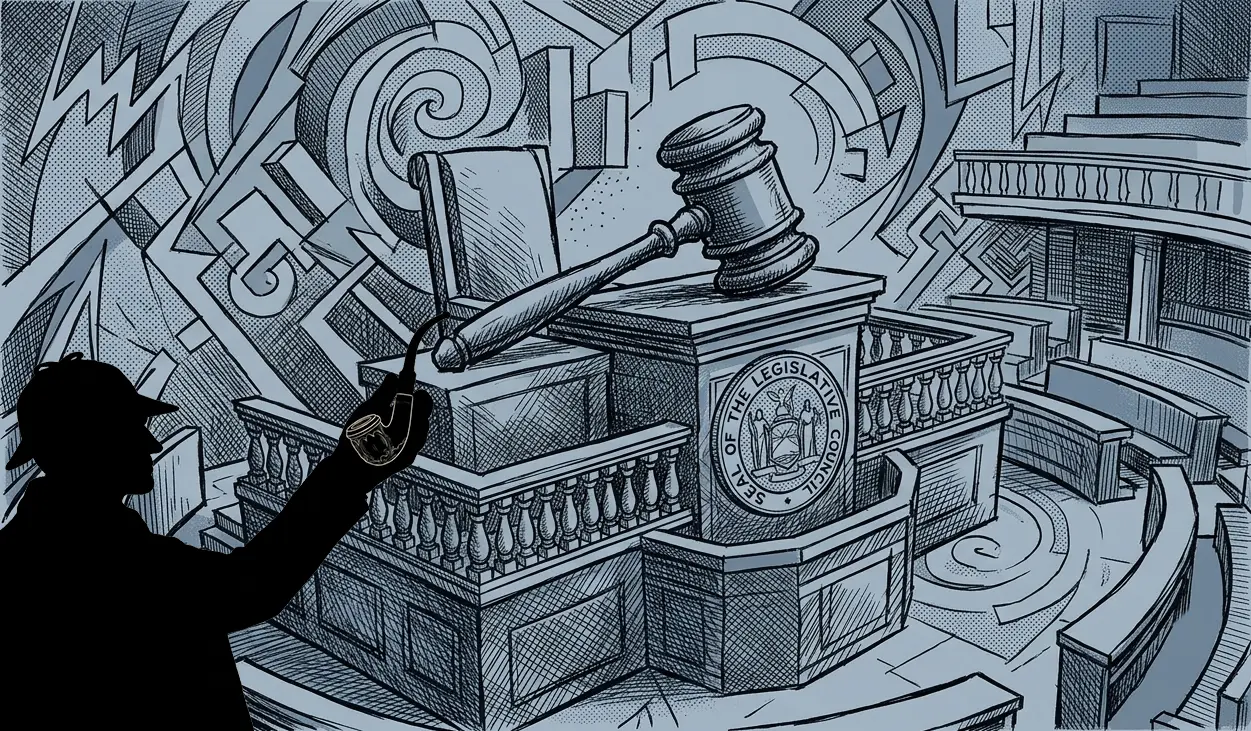
This year the Legislature and Governor Cox created a “constitutional court”: a three-judge panel, assembled under a new law and court rule, with sole jurisdiction over any lawsuit challenging the constitutionality of a state law — including the still-active redistricting case sitting in front of Judge Gibson. The state’s attorney general moved almost immediately to route that case into the new panel. Separately, the Legislature expanded the Supreme Court by two seats, chosen from a nominee list of twelve men, stripped the judicial nominating commission of its partisan-balance requirement, and gave the governor sole authority to appoint that commission’s members. State Republicans then campaigned — for what they say is the first time — against the retention of two sitting female justices, and after clearing one of them, Diana Hagen, of a misconduct allegation her own ex-husband made, the Legislature called for a second investigation into the same claim. She resigned. And the backstop is already written: if the Supreme Court someday rules the constitutional court itself unconstitutional, a second version of it automatically takes effect — one where the Legislature doesn’t just pick the venue. It names the judges directly.
State Senator Todd Weiler, who leads the committee behind the changes, was unusually direct about the goal when asked. “Is there a court-packing element? Yes and no,” he said, before allowing that the decision was partially politically motivated. His distinction is that this isn’t packing to flip a court from one party to another — every sitting justice was already appointed by a Republican governor and confirmed by a Republican-supermajority Senate. That’s true, and it’s also beside the point the mechanism is built to solve. The problem the room needed to fix wasn’t which party held the bench. It was that a handful of the judges on it — regardless of who appointed them — had ruled against the Legislature more than once.
Power does not require conspiracy. It only requires that the people in the room share a common interest in the outcome. Nobody had to coordinate to build a second courthouse, pack a nominating commission, campaign against two justices, and write a fallback law that names judges directly. Each step was its own vote, its own bill, its own press conference — separately defensible, separately explainable, and all pointed the same direction. That’s what makes the self-dealing hard to name in the moment. No single piece of it looks, by itself, like a room ruling on its own case. It’s only once every piece is standing that you can see what was built: a Legislature that lost in front of a court it didn’t build, and then built one it did.
The women who brought the original lawsuit are still in the fight — the case now heads back to whichever court gets to hear it, and that jurisdictional question is itself now before the Utah Supreme Court, the same court the Legislature just finished reshaping. Nothing about this required removing a single sitting justice from power by force. It only required building a room the challenge could no longer reach.
The Bench They Built to Hear Their Own Case — Broken Frames (The Self-Dealing Room — candidate new discriminator; no existing BF member instantiates the judicial-venue variant of this mechanism)
Origin case: TNG Essay 3 — The People in the Room
Copyright 2026 — Steve Sagnotti
Sources: Kate Zernike, “A Gender War Explodes in Utah Over the Courts, Abortion and Representation,” The New York Times, Sept. 13, 2026. Utah News Dispatch reporting on HB392/SJR5 and the “constitutional court” filing, Feb. 23, 2026. Utah News Dispatch and Democracy Docket reporting on Judge Gibson’s Nov. 2025 ruling and the Legislature’s response. Fox 13 (Salt Lake City) reporting on the 2024 Utah Supreme Court ruling and the 2025 special session.
Leave a Reply