Block 5, Article 1
© 2026 Steve Sagnotti.
Why are there only two choices?
Not two candidates. Two parties. Two options so thoroughly institutionalized that a third — no matter how many people want it, how many states it wins, how many debates it survives — has never broken through in over a century of trying. This didn’t happen because Americans chose two parties and stuck with them. It happened because the two parties built a system that makes any other choice nearly impossible to exercise — and then called that system democracy.
The friction was designed
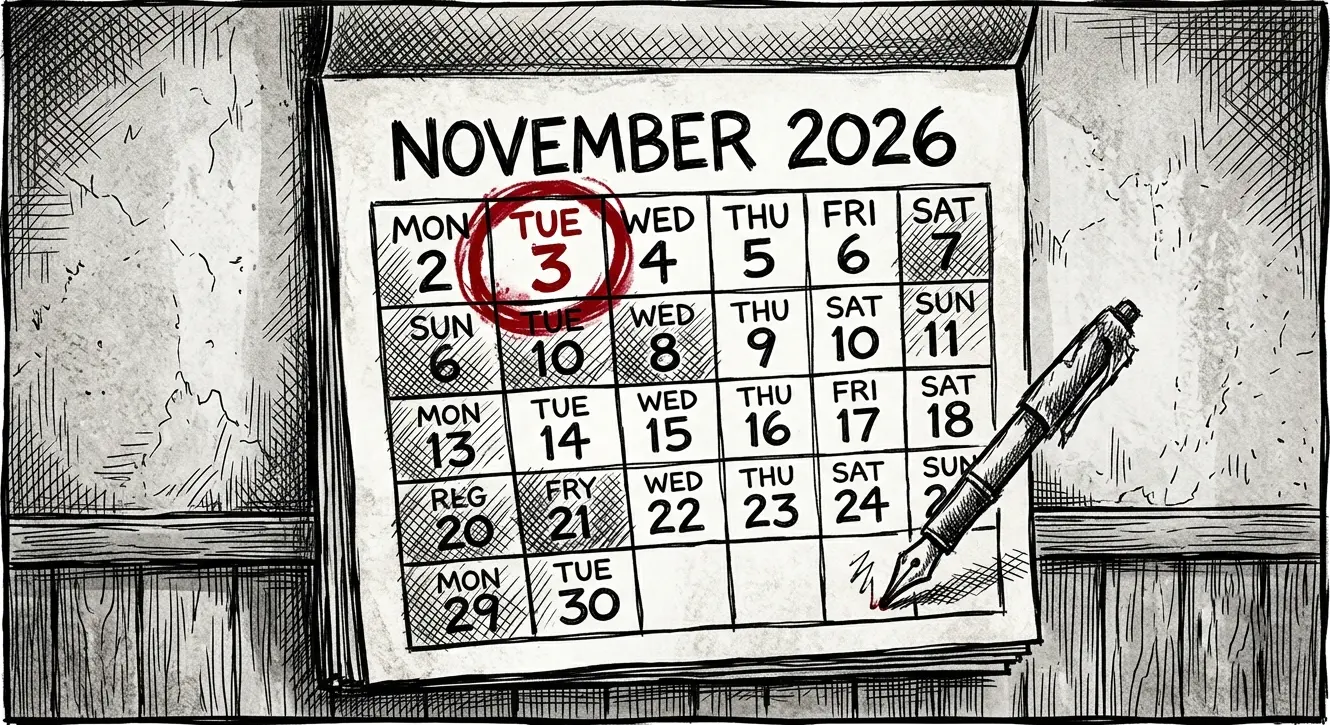
Election Day in the United States falls on a Tuesday. It has since 1845. Congress wrote the statute for a country of farmers who needed Monday to travel to the county seat by horse and couldn’t vote on Sunday for religious reasons. The horse is gone. The Tuesday is not. Over the past decade alone, bills to move it — as a holiday, as a weekend shift, in bipartisan form and partisan form — failed in Congress six times. The people who would pass the fix are the people whose electoral position is protected by the friction that fix would remove.
Every comparable democracy looked at its voting infrastructure and updated it. France votes on Sundays. Canada runs four days of advance polling. New Zealand offers three weeks. Australia made voting compulsory on a Saturday and produces turnout above 90 percent as a matter of routine. The United States, in a high-stakes midterm with control of Congress at issue, produces 47 percent. The gap is not cultural. It is not a fixed feature of American civic life. It is the output of a system that other countries looked at, found wanting, and changed — and that the United States looked at, found useful, and kept.
Registration compounds the problem. Most states require voters to initiate registration weeks before Election Day, meet a deadline set before the campaign reaches its peak, and navigate rules that vary by state and change by cycle. Only 25 states and the District of Columbia have adopted automatic voter registration. Twenty-nine million voting-age Americans move every year, and each move can invalidate a prior registration — meaning the burden falls hardest on younger voters, lower-income voters, and Black Americans, who move at higher rates than any other group. Germany automatically registers every citizen at voting age and updates the roll when they move. Canada, Australia, and Germany each register more than 90 percent of eligible voters. The United States registered 73 percent in the last presidential election.
Between 2012 and 2022, the United States closed 27,000 polling places — more than one in five. The closures accelerated after the Supreme Court’s 2013 Shelby County decision removed the preclearance requirements that had blocked discriminatory changes before they took effect. Texas closed 750 locations. Georgia consolidated some counties to a single polling place serving hundreds of square miles. The documented turnout consequence: one additional mile of distance reduces turnout in majority-minority districts by 19 percent, compared to 5 percent in majority-white districts. The racial participation gap, which had been narrowing since the Voting Rights Act passed in 1965, widened for the first time in the decade following Shelby. The voter who cannot reach the polls does not need to be turned away at the door. They simply do not arrive.
Each barrier carries its own justification — tradition, fraud prevention, cost savings, election security. Framed individually, each looks like administration. Taken together, across every point in the process — when you vote, how you register, where you vote — they constitute a system in which every friction point was built and defended by the people whose position depends on a narrower electorate. Other democracies saw these same problems and solved them. The United States saw them and kept them. The friction was framed as tradition. What the frame excluded was the intent: not to administer an election, but to determine who shows up to one.
A selection process that produces what it selects for
The largest political bloc in the United States is not Democrats. It is not Republicans. It is the 45 percent of Americans who identify as independent — the plurality, and structurally the least powerful group in American politics. To understand why requires one fact about how candidates are actually chosen.
In 26 states, the primary that selects the general election candidate is closed to independent voters. The primary is a publicly funded election — administered by state governments, paid for by taxpayers — run under rules written by the two private organizations whose candidates it produces. Between 10 and 20 percent of eligible voters participate — skewing older, more ideologically committed, and more reliably partisan than the general electorate. The 45 percent are excluded. They fund the process through their taxes. They cannot vote in it. The candidates it produces face each other in November, where independents are finally permitted to participate — but only to choose between two options selected without them.
The closed primary doesn’t just exclude the 45 percent. It manufactures the polarization that makes their exclusion feel inevitable. A candidate competing for the votes of the most ideologically committed fraction of their party cannot signal openness to the other side — that’s a weapon handed to a primary opponent. So they don’t. They signal tribe. They perform the us-versus-them that 15 percent of partisan voters rewards and the other 85 percent of the electorate exhausts itself absorbing. Multiply that across 435 House races and 33 Senate seats and what emerges is a legislature that looks maximally divided because it was selected by a process that punishes anything less. The polarization visible in Washington is not a failure of the people who were elected. It is the accurate output of a system calibrated to produce it.
The voter who wanted a representative willing to govern arrives in November to find that candidate was eliminated in a primary they weren’t allowed to vote in. The closed primary was framed as a party’s right to choose its own candidate. What the frame excluded was the voter who wanted a legislature capable of doing its job — and what the process delivered, by design, was one that cannot.
The 45 percent are not merely underrepresented. They are the constituency large enough to have sustained a challenge to the extraction economics the locked door protects. A political vehicle built on fair extraction terms and commons stewardship would have needed exactly this coalition — voters with no party loyalty to protect, no incumbent arrangement to defend. Their structural homelessness is the condition the system was built to maintain. The ballot access laws that produce it were written by the parties the door protects. Changing them requires the legislatures those parties control. The 45 percent cannot vote their way out of the exclusion that governs how they vote.
The pressure that has nowhere to go
When a pressure system builds without a release valve, the discharge happens anyway. The direction is unpredictable.
Every major realignment in American history began with a displaced constituency larger than the existing architecture could contain. The Republican Party itself is the proof of concept — six years from founding to the presidency, emerging from a crisis the existing parties could not address. Each realignment found a channel: a new party, a reshuffled coalition, a movement that broke through. Each time, the architecture survived.
What is different now is not the scale of displacement. It is that the two parties have hardened the architecture at precisely the points where prior realignments found entry. Ballot access thresholds require tens of thousands of signatures in compressed windows. The Commission on Presidential Debates set a 15 percent polling threshold by internal rule — not by legislation, not by court order, by the commission the two parties founded and operate. The closed primary ensures that even inside the existing parties, the most ideologically committed fraction controls the terms of entry. The channels that produced every prior realignment have been identified, studied, and sealed.
The 45 percent are not waiting for a party. They are waiting for a door that has been engineered not to open. The architecture that built that door — the specific hardware of exclusion — is what the next article examines.
Check the public record
The Election Assistance Commission’s election administration and voting survey documents polling place counts by jurisdiction for every federal election cycle. Your county’s 2012 number and its current number are both in that data. The gap between them is your local instance of the 27,000.
| Polling place counts by county, every federal election cycle — your county’s 2012 baseline and today | https://www.eac.gov/research-and-data/election-administration-and-voting-survey |
| Whether your state uses automatic voter registration | https://responsivegov.org/automatic-voter-registration/ |
| Whether your state’s primary is open or closed | https://ballotpedia.org/Primary_election_types_by_state |
Sources
1. Tuesday voting statute. 2 U.S.C. § 7 (1845). https://uscode.house.gov/view.xhtml?req=granuleid:USC-prelim-title2-section7&num=0&edition=prelim — Six failed reform bills: CRS R41990: https://crsreports.congress.gov/product/pdf/R/R41990
2. International voting infrastructure — France, Canada, New Zealand, Australia. IDEA International Database. https://www.idea.int/data-tools/data/voter-turnout
3. Australia compulsory voting / Saturday / 90%+ turnout. Australian Electoral Commission. https://www.aec.gov.au/voting/compulsory_voting.htm
4. U.S. 2022 midterm 47% turnout. United States Elections Project. https://www.electproject.org/2022g
5. Automatic voter registration — 25 states and DC. Institute for Responsive Government. https://responsivegov.org/automatic-voter-registration/
6. Voter registration rates — Germany, Australia, Canada 90%+, U.S. 73%. Institute for Responsive Government, 2024. https://responsivegov.org/research/comparative-voter-registration-lessons-from-abroad-for-improving-access-and-accuracy-in-the-united-states/
7. 29 million Americans move annually. Brennan Center, “When Voters Move,” 2009. https://www.brennancenter.org/our-work/research-reports/when-voters-move
8. 27,000 polling places lost 2012–2022. ABC News, October 2024. https://abcnews.go.com/US/protecting-vote-1-5-election-day-polling-places/story?id=114990347 — Texas 750 closures: Leadership Conference Education Fund, “Democracy Diverted,” 2019. https://civilrights.org/democracy-diverted/
9. 19% per mile turnout suppression in majority-minority districts. Catoni, Enrico. American Economic Journal: Applied Economics, 2020. https://doi.org/10.1257/app.20190207 Racial participation gap widened post-Shelby: Brennan Center, 2024. https://www.brennancenter.org/our-work/research-reports/voting-rights-act-turns-59-what-has-changed
10. Shelby County v. Holder, 570 U.S. 529 (2013). https://supreme.justia.com/cases/federal/us/570/529/
11. Gallup 45% independent, 2025. https://news.gallup.com/poll/700499/new-high-identify-political-independents.aspx
12. Closed primary states — 26. Ballotpedia. https://ballotpedia.org/Primary_election_types_by_state
13. CPD 15% threshold — set by internal rule 2000. Commission on Presidential Debates. https://debates.org/about-cpd/
14. Election Administration and Voting Survey. U.S. EAC. https://www.eac.gov/research-and-data/election-administration-and-voting-survey
Block 5, Article 1. © 2026 Steve Sagnotti.
Leave a Reply