Block 3, Article 3 — Three Decisions, Thirteen Years, One Outcome
© 2026 Steve Sagnotti.
Who decides whether your district is fair?
For fifty years after Reynolds v. Sims, the federal courts were theoretically available as a check on gerrymandering. The theory was never fully tested. The Supreme Court acknowledged the problem repeatedly and declined to solve it repeatedly — agreeing that extreme partisan maps might be constitutionally problematic, then ruling that the Court lacked a workable standard for measuring the problem. The case would be sent back. The map would stand. The next challenge would begin.
In 2019, the Court stopped pretending.
Door one: the partisan challenge
Rucho v. Common Cause arrived at the Supreme Court with two maps — one drawn to disadvantage Democrats in North Carolina, one drawn to disadvantage Republicans in Maryland. Both were egregious. Both were documented. The majority opinion acknowledged as much. Chief Justice Roberts, writing for five justices, held that partisan gerrymandering claims “present political questions beyond the reach of the federal courts.” Federal judges, he wrote, have no license to reallocate political power between the two parties.
The maps were sent back without remedy.
Roberts acknowledged in the same opinion that partisan gerrymandering “may be incompatible with democratic principles” and “leads to results that reasonably seem unjust.” Then held that the federal courts could do nothing about it.
The Rucho majority framed the question as one of judicial manageability — not whether the maps were wrong, but whether courts had a workable standard for saying so. That framing meant the acknowledged injustice required no remedy.
Justice Kagan’s dissent named what the majority had done: it was “permitting politicians to entrench themselves in power against the people’s will.” The 2020 redistricting round proceeded with that ruling in place. State legislatures redrew maps that courts had previously found unconstitutional, with partisan intent openly stated, because there was no longer a federal remedy to worry about.
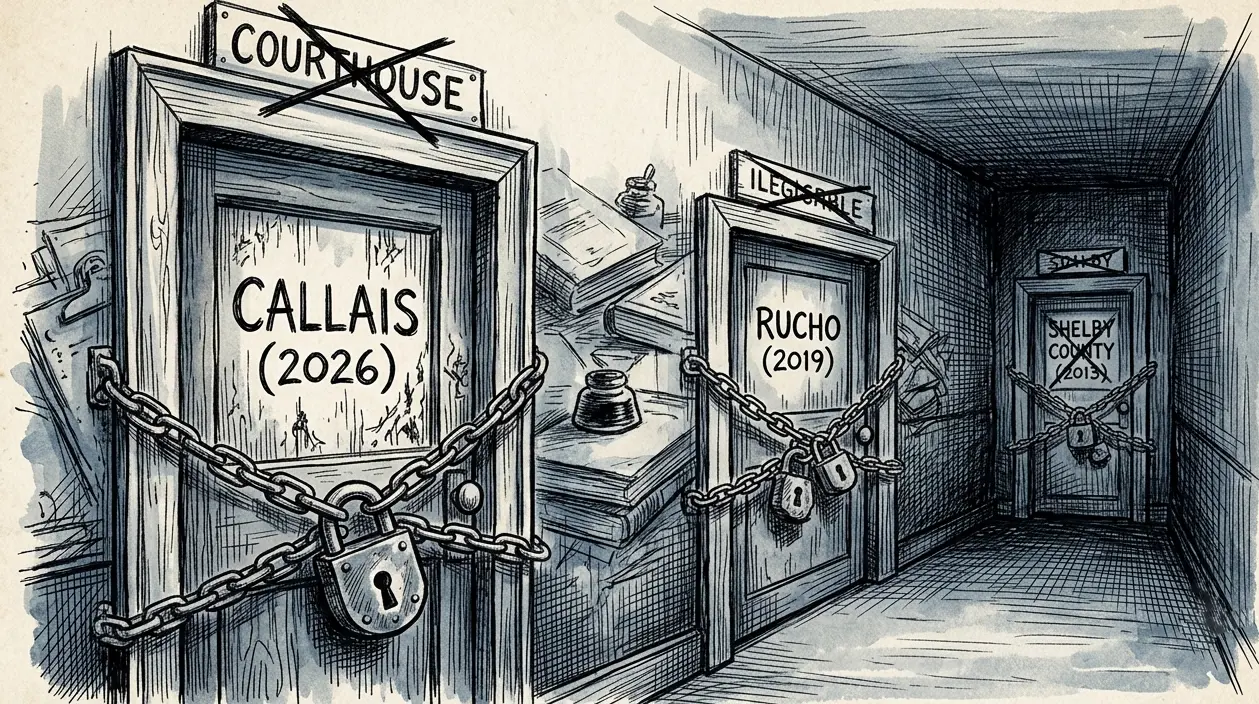
Federal courthouse door on partisan gerrymandering: closed.
Door two: the racial remedy
The Voting Rights Act of 1965 had two primary tools. Section 5 required jurisdictions with a history of discriminatory voting practices to obtain federal approval before changing their voting laws — preclearance. Section 2 prohibited voting practices that dilute minority representation. Congress reauthorized both in 2006 with near-unanimous majorities and a 15,000-page evidentiary record of ongoing discrimination. President George W. Bush signed the reauthorization.
Shelby County v. Holder (2013) struck down Section 4(b) — the formula that determined which jurisdictions were subject to preclearance. Without the formula, Section 5 became unenforceable. Texas implemented a voter ID law that had been blocked under preclearance within hours of the decision. North Carolina passed sweeping voting restrictions within days.
Section 2 remained. It was the backstop.
Brnovich v. DNC (2021) began closing it — establishing a list of extra factors a plaintiff now had to prove, factors the statute itself never required, making Section 2 cases far harder to win without formally narrowing the statute’s language.
Louisiana v. Callais, decided April 29, 2026, finished the job. The Court did not formally strike Section 2. It rewrote it — requiring proof of intentional discrimination, a threshold the statute had never required and that the evidence standard makes nearly impossible to meet. Justice Kagan in dissent: “Today’s decision renders Section 2 all but a dead letter.”
Rucho removed the partisan remedy. Shelby gutted preclearance. Brnovich raised the Section 2 bar. Callais closed the backstop.
Federal courthouse door on redistricting challenges: closed.
These are not remedies lost in the abstract. Shelby gutted the tool built specifically to protect Black and Latino voters from dilution. Callais closed the backstop for the same communities. The next article shows those are the same communities the census had already undercounted before a single line was drawn — the remedy closed for the people who needed it most specifically.
What remains
State courts. Some state constitutions contain independent redistricting protections that go beyond federal minimums. Pennsylvania’s Supreme Court struck down its congressional map in 2018 on state constitutional grounds — a decision Rucho explicitly could not have prevented because it was grounded in state law. California’s independent redistricting commission operates outside the legislature entirely. A handful of other states have moved in similar directions.
In May 2026, the Virginia Supreme Court demonstrated how narrow those venues are. Its Republican-appointed majority, voting 4-3, struck down a redistricting reform amendment that 3 million Virginia voters had approved at the ballot — declared it “null and void.” Virginia Democrats appealed to the Supreme Court of the United States. The Court denied the emergency application in a one-sentence unsigned order. No justices noted a dissent. The maps drawn by the party that controls the court system stand.
The remedy that survived is the remedy that requires everything to go right at the state level — the right constitutional language, the right judicial appointments, the right political will — in a system shaped by the same maps being challenged. Virginia had the constitutional language. Virginia had the voter approval. Virginia had the appeal. The door closed anyway.
The bench that closed them
Three decisions. Thirteen years. Each one shutting a specific door: Rucho closed the federal partisan challenge. Shelby gutted preclearance. Callais closed the racial remedy.
The same Supreme Court issued all three.
That Court did not decline jurisdiction across the board. It found money in politics justiciable in Buckley v. Valeo and Citizens United. It found a presidential election justiciable in Bush v. Gore. It found partisan map-drawing — the mechanism that determines who controls the rooms where the commons is priced — beyond judicial management. The political question doctrine — the label the Court uses to say a dispute is for elected officials, not judges, to settle — is not a neutral principle. The Court applies it selectively. The pattern of selection is legible.
The same apparatus that drew the maps also shaped the institution that ruled the maps couldn’t be reviewed. Block 7 examines how that Court was built — the forty-year project that produced the bench capable of these decisions.
That is not a coincidence. It is a system.
The next article shows what was wrong with the map before anyone drew a single line.
Do you know whether your state has an independent redistricting commission — and whether it has survived legal challenge?
| Whether your state uses an independent redistricting commission or legislature-controlled mapmaking, and the current legal status of your map | https://redistricting.lls.edu |
| Your state’s current congressional map and its legislative and court history | https://ballotpedia.org/Redistricting |
| Virginia redistricting amendment case — Democracy Docket coverage | https://democracydocket.com |
Sources
1. Rucho v. Common Cause, 588 U.S. 684 (2019). Roberts majority / Kagan dissent. https://supreme.justia.com/cases/federal/us/588/18-422
2. Davis v. Bandemer, 478 U.S. 109 (1986). https://supreme.justia.com/cases/federal/us/478/109/
3. Vieth v. Jubelirer, 541 U.S. 267 (2004). https://supreme.justia.com/cases/federal/us/541/267/
4. Shelby County v. Holder, 570 U.S. 529 (2013). https://supreme.justia.com/cases/federal/us/570/529/ — Texas voter ID within hours: Texas Tribune, June 25, 2013. https://www.texastribune.org/2013/06/25/texas-immediately-enacts-voter-id-law-after-ruling/
5. Brnovich v. Democratic National Committee, 594 U.S. 647 (2021). https://supreme.justia.com/cases/federal/us/594/647/
6. Louisiana v. Callais, 608 U.S. ___ (2026). Decided April 29, 2026. https://www.supremecourt.gov/opinions/25pdf/23-978_4g15.pdf
7. VRA reauthorization 2006 — 98-0 Senate, 390-33 House, Bush signature. https://www.congress.gov/bill/109th-congress/senate-bill/2703
8. Pennsylvania Supreme Court map strike 2018. League of Women Voters of Pennsylvania v. Commonwealth of Pennsylvania, 178 A.3d 737 (Pa. 2018). https://www.pacourts.us/courts/supreme-court/supreme-court-opinions
9. California redistricting commission. California Constitution, Article XXI, § 2. https://leginfo.legislature.ca.gov/faces/codes_displaySection.xhtml?sectionNum=2.&lawCode=CONS&article=XXI
10. Virginia Supreme Court redistricting amendment, May 2026. Virginia Mercury. https://virginiamercury.com/2026/05/08/supreme-court-of-virginia-strikes-down-redistricting-amendment-keeps-current-maps-in-place/
11. SCOTUS emergency application denied, May 2026. Democracy Docket. https://democracydocket.com/news-alerts/supreme-court-refuses-to-restore-virginia-redistricting-plan-approved-by-voters/
12. Buckley v. Valeo, 424 U.S. 1 (1976). https://supreme.justia.com/cases/federal/us/424/1/ — Citizens United v. FEC, 558 U.S. 310 (2010). https://supreme.justia.com/cases/federal/us/558/310/ — Bush v. Gore, 531 U.S. 98 (2000). https://supreme.justia.com/cases/federal/us/531/98/
Block 3, Article 3. © 2026 Steve Sagnotti..
Leave a Reply