Block 3, Article 2 —The Precision Instrument Deployed
© 2026 Steve Sagnotti
In early 2010, Republican strategist Karl Rove published a column in the Wall Street Journal stating the case plainly: “He who controls redistricting can control Congress.” The column was not a warning. It was a blueprint.
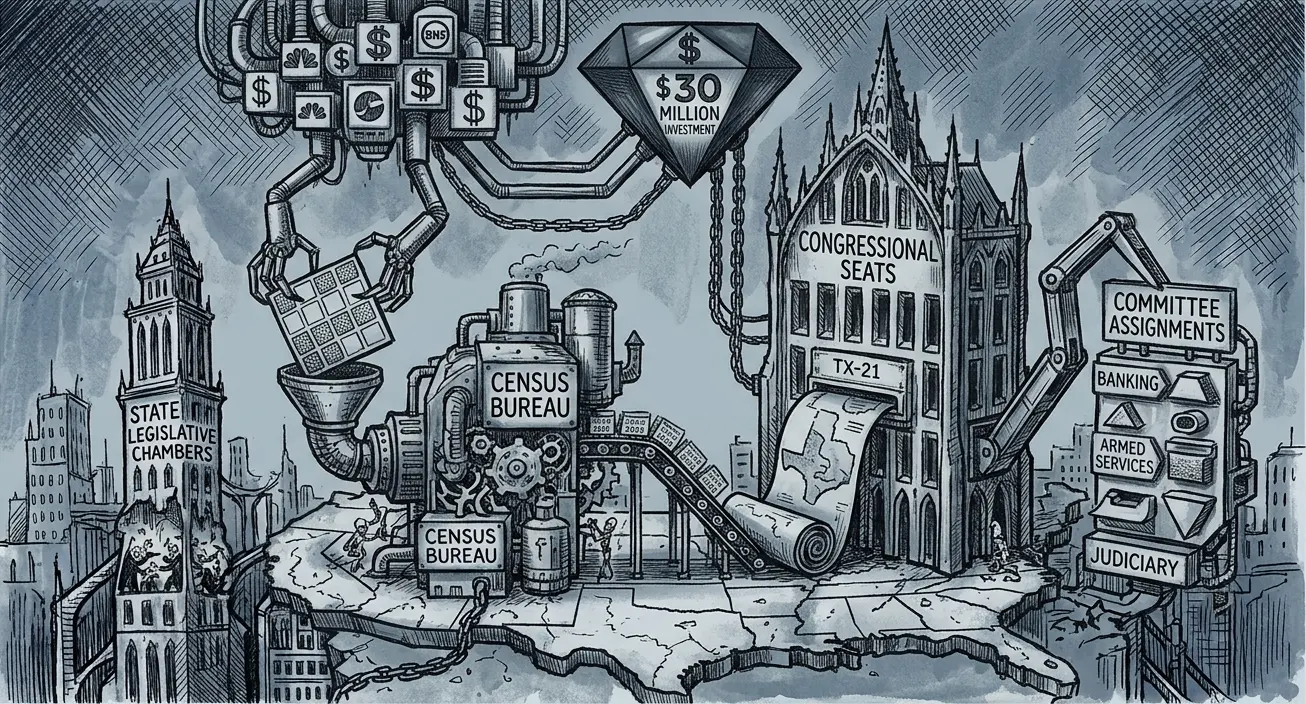
The project that followed had a name: REDMAP — the Redistricting Majority Project. The Republican State Leadership Committee ran it, funded with $30 million from donors including Reynolds American, Altria, and Walmart. The strategy was straightforward. State legislatures draw congressional maps after every census. Win the state legislatures in 2010 — a census year — and you control the maps for a decade.
REDMAP targeted swing-state chambers where a handful of races could flip the balance. By winning 117 targeted state legislative races, Republicans gained control of the map-drawing process in Pennsylvania, Michigan, Wisconsin, Ohio, North Carolina, and Florida. Then they drew the maps.
What the maps produced
The results were structural, not electoral. In 2012, Democratic House candidates received 1.4 million more votes than Republican candidates nationally. Republicans won a 33-seat majority in the House.
1.4 million more votes. 33 fewer seats.
A House majority is not an abstraction. It is a specific set of committee assignments, committee chairs, and the legislative agenda those chairs control. The 33-seat majority REDMAP produced controlled the House Natural Resources Committee, the Agriculture Committee, the Energy and Commerce Committee, and the Interior appropriations subcommittee — the four bodies that set royalty rates on federal minerals, write farm bills, approve extraction permits, and fund or defund the agencies that manage public land.
For a decade, the map drawn in a Wisconsin law firm determined who chaired the rooms where the commons was priced.
The 2010 election was framed as a wave. The majority it produced was an extraction instrument.
What the committee produced
In March 2025, Representative Bruce Westerman of Arkansas — Chair of the House Natural Resources Committee — made his first stock purchases since entering Congress in 2015. Ten years in office. No individual stock trades on record. Then, in a single month, he bought approximately $1.6 million in shares across BP, ConocoPhillips, ExxonMobil, Shell, and a dozen mining companies including Freeport-McMoRan and BHP.
His committee regulates all of them.
When confronted at markup by Rep. Yassamin Ansari, Westerman told reporters the purchases had been made by an investment adviser without his knowledge and that he was in the process of divesting. He added: “There was nothing wrong with what happened.”
Two months after the purchases, his committee advanced the budget bill — passed via reconciliation, the fast-track process that avoids a Senate filibuster — that became the One Big Beautiful Bill Act, signed July 4, 2025. The bill did three distinct things. It cut coal royalty rates from 12.5 percent to 7 percent through 2034. It rolled back oil and gas royalty rates from 16.67 percent back to 12.5 percent — the rate set in 1920. And it mandated quarterly oil and gas lease sales across more than 200 million acres of federal land in nine western states, while simultaneously eliminating the anti-speculation rules that had been the only check on what those leases could be used for.
Under the mandate, when an energy company nominates a parcel, the Bureau of Land Management must make at least half available within three months and the remainder within eighteen months. The agency has no discretion to decline. Previously, BLM could weigh competing uses — wildlife habitat, water protection, grazing, recreation — before deciding whether to lease. That discretion is gone.
What the mandate doesn’t require is that any of the leased land actually get developed. Companies currently hold more than 24 million acres under federal onshore lease. Historically, close to half sits idle — neither producing nor under active exploration. In Nevada, the government has issued 22,000 leases; 70 have ever reached production. Of leases issued between 1996 and 2003 — all now past their initial ten-year exploration window — only 10 percent of competitively issued leases ever entered production. Three percent of noncompetitively issued leases did. Companies acquire leases not only to extract but to hold — banking public acreage as a corporate balance sheet asset, inflating reserve figures for investors, positioning for when prices rise. The land is committed. The public is locked out. The royalty clock doesn’t start until production begins.
The same bill eliminated the anti-speculation reforms the Biden-era BLM had put in place — the first comprehensive update to federal onshore leasing rules since 1988, specifically designed to prevent idle land-banking. Gone.
The STOCK Act requires members of Congress to disclose stock trades. The fine for late disclosure: $200.
What Wyoming did about it
Wyoming produces the majority of the nation’s federal coal and receives approximately half of federal coal royalty payments. A week before the bill was signed, the co-chairs of Wyoming’s Joint Appropriations Committee wrote to the state’s congressional delegation asking them to amend the bill or bring future legislation to avoid a $50 million annual revenue loss.
All three of Wyoming’s Washington representatives voted for the bill anyway, without seeking revisions.
Wyoming lawmakers then proposed a workaround: shift the royalty revenue split from its traditional 50-50 division between state and federal government to 87.5 percent for Wyoming and 12.5 percent for the federal government. Make the state whole by having the federal government surrender nearly all of its remaining share.
The proposal is still floating. If extended to every coal, oil, gas, and mineral-producing state with the same grievance, the federal government will have cut the royalty rate, lost the state revenue, and absorbed the loss entirely — while the extraction industry books the difference.
Fixing any part of this requires simultaneous action in three places at once: in the courts, which closed the door on partisan gerrymandering challenges in Rucho v. Common Cause; in Congress, which the map controls; and in state legislatures, where the same REDMAP-drawn majorities will draw the next map. Each lock was installed by the body it protects.
This is how the commons gets priced — not by the public that owns it, but by the industry that wants it, at a rate the public’s representatives set while holding the industry’s stock. The map produced the majority. The majority produced the committee. The committee cut the rate, mandated the leases, and eliminated the rules that prevented speculation. The same members who built that outcome will stand at the same podium and cite the federal deficit as the reason there is no money left for anything else.
The deficit is not something that happened to them. It is something they built.
Block 10 carries the full accounting — what 150 years of below-market extraction, idle land-banking, and surrendered royalties have cost the commons.The next article shows what happened when someone tried to challenge the map in court — and which doors were closed, one by one, to make sure it couldn’t happen again.
Do you know who funds your representative — and what public land sits idle in your state?
| Your representative’s financial disclosures, including all stock trades and holdings | https://disclosures.house.gov |
| Your representative’s top donors by industry, and their committee assignments | https://www.opensecrets.org |
| Federal oil and gas leases in your state — active vs. idle acreage | https://www.blm.gov/programs/energy-and-minerals/oil-and-gas/leasing |
Sources
1. Karl Rove. “He Who Controls Redistricting Can Control Congress.” Wall Street Journal, 2010 (paywall). Cited in David Daley, Ratf**ked (2016).
2. David Daley. Ratf**ked: The True Story Behind the Secret Plan to Steal America’s Democracy. Liveright, 2016. WorldCat: https://search.worldcat.org/title/923794434
3. REDMAP funding / state outcomes. National Democratic Redistricting Committee. https://democraticredistricting.com/resources/project-redmap/
4. 2012 House vote totals vs. seat count. Cook Political Report. https://www.cookpolitical.com
5. Westerman stock purchases. Arkansas Times, May 9, 2025 (paywall). HuffPost/Public Domain, May 12, 2025. https://publicdomain.media/p/bruce-westerman-stocks
6. One Big Beautiful Bill Act. H.R. 1, P.L. 119-21. Signed July 4, 2025. BLM press release July 22, 2025: https://www.blm.gov/press-release/interior-department-announces-actions-implement-one-big-beautiful-bill
7. 200+ million acres / 50% within 3 months / 18-month remainder. Deseret News, September 22, 2025 (paywall).
8. 24 million acres under lease / Nevada 22,000 leases / 70 in production. Missoula Current, February 14, 2025. https://missoulacurrent.com
9. 10% competitive / 3% noncompetitive ever reached production (1996–2003 cohort). Center for American Progress, August 2018. https://www.americanprogress.org/article/idle-federal-oil-gas-leases/
10. Speculative leasing / balance sheet / investor inflation. Taxpayers for Common Sense, “Locked Out,” October 2018. https://www.taxpayer.net/energy-natural-resources/locked-out/
11. OBBBA rolled back Biden-era BLM leasing rule (first update since 1988). NRDC, August 6, 2025. https://www.nrdc.org/bio/bobby-magill/big-beautiful-bill-hands-public-lands-fossil-fuel-industry — Taxpayers for Common Sense, July 8, 2025: https://www.taxpayer.net
12. STOCK Act disclosure fine $200. 5 U.S.C. app. § 101 et seq. https://www.congress.gov/bill/112th-congress/senate-bill/2038
13. Wyoming $50M annual revenue loss / Joint Appropriations letter, June 25, 2025. WyoFile, August 9, 2025. https://wyofile.com
14. Wyoming representatives voted without seeking revisions. Wyoming News, September 16, 2025. https://wyomingnews.com
15. Wyoming 87.5/12.5 split proposal. Wyoming Public Media, August 15, 2025. https://www.wyomingpublicmedia.org
16. [S-18] Rucho v. Common Cause, 588 U.S. 684 (2019). https://supreme.justia.com/cases/federal/us/588/18-422
17. Rep. Ansari statement. Arkansas Times — https://publicdomain.media/p/bruce-westerman-stocks.
Block 3, Article 2. © 2026 Steve Sagnotti.
Leave a Reply