Block 1, Article 2
© 2026 Steve Sagnotti.
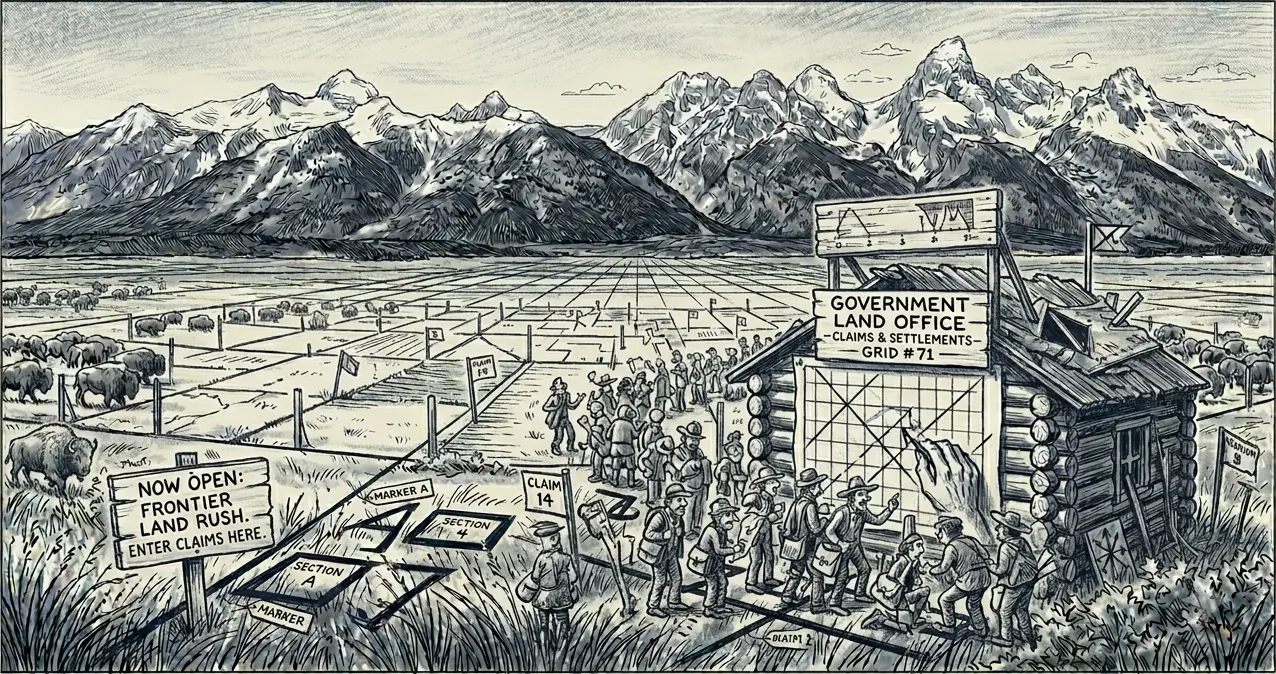
The settlers who arrived at the continent documented in Article 1 brought a frame with them. The frame said: wilderness. Unclaimed. Available. A land without owners waiting for people who would put it to use.
The frame was wrong in a specific and consequential way. What the settlers encountered was not wilderness. It was the output of management systems that had been running for thousands of years — and misreading it as wilderness was the precondition for treating it as available.
What the frame excluded
The salmon runs that Lewis and Clark described as uncountable did not maintain themselves by accident. The Columbia River tribes — Nez Perce, Yakama, Umatilla, Warm Springs — had governance systems built around the river’s productive limits. First salmon ceremonies functioned as harvest controls: the first fish of the season were treated as sacred, returned to the river whole, a ritual acknowledgment that the run had to come back before it could be taken. Fishing rights were allocated by position on the river, inherited and governed by tradition. Waste was taboo. The archaeological record at Columbia River fishing sites shows continuous occupation across thousands of years, with salmon remaining the dietary foundation throughout. The runs lasted not because the river was inexhaustible but because the people who depended on it understood it was not.
The eastern forests told the same story through a different mechanism. The park-like understory that early European settlers described — open ground beneath a high canopy, easy to walk through, almost landscaped in appearance — was not natural forest succession. It was the product of deliberate, systematic burning by indigenous peoples across centuries. Fire management removed undergrowth, encouraged the browse that supported deer and turkey, and reduced the risk of catastrophic wildfire. The settlers who described the eastern forest as a beautiful parkland were describing a tended landscape and calling it wilderness.
The plains ecology was more complicated. Buffalo jumps — cliff-drive sites used across the Plains and Rockies, some for thousands of years — drove entire herds over edges, taking far more animals than could be immediately processed. The bone deposits at sites like the Vore Buffalo Jump near Sundance, Wyoming, represent tens of thousands of animals taken over centuries. The plains abundance held not because the bison were actively managed toward sustainability but because the constraints on the take were natural ones: population density was low, the technology was limited to foot pursuit and the occasional cliff, and the herds were large enough that the take, however intensive at any single site, did not outrun regeneration across the whole. The horse changed that. Arriving on the Plains from Spanish colonial stock in the late 1600s and early 1700s, it transformed bison hunting from a labor-intensive communal operation into something far more efficient — and the take accelerated visibly before any European hunter arrived. The constraint was the technology, not the intention.
What the settler frame called wilderness was, in the river valleys and the eastern forests, the output of active management. On the plains it was the output of natural constraint. In both cases the frame’s claim — unclaimed, unmanaged, available — was wrong. And in both cases, what the frame excluded was the question of what would happen when the constraints were removed.
The labor gap
The abundance created an immediate problem the frame had no answer for: the continent was larger than the population available to work it.
The settler population arriving in the 17th and 18th centuries was small relative to the scale of what was available to be claimed, cleared, planted, and harvested. Free labor was scarce and expensive in a land where land was cheap and available — the economic logic of coercion runs directly from that arithmetic. Indentured servitude was the first answer. Slavery was the second, and the more durable one: the forced importation of labor at scale to work a cornucopia that the available free population could not have exploited alone. The abundance did not cause slavery. But it created the economic conditions that made the institution seem, to those who built it, worth building.
The epidemic context sits beneath all of this. The population the settlers encountered was not the population that had built and maintained the landscape they were entering. Disease moving through existing trade networks had preceded European settlement by decades in many regions — smallpox, measles, influenza reaching populations with no acquired immunity long before European settlers arrived in numbers. Cahokia, the city near present-day St. Louis that at its peak around 1100 AD was larger than contemporary London, was already centuries abandoned. The Ohio mound builders’ civilization, the dense agricultural settlements, the large towns — these had already contracted dramatically. The settlers read the aftermath of that collapse as the natural state of the continent. It was not. It was a specific, recent, catastrophic consequence of contact that the frame they brought with them had no way to account for.
The first frame
The settler frame — wilderness, unclaimed, available — was not cynical. It was, in the conditions it encountered, a plausible reading of what was visible. The population was sparse. The land appeared unimproved by European standards — no enclosures, no title deeds, no permanent agricultural infrastructure recognizable as such. The management systems that had produced the abundance were invisible to eyes that didn’t know what they were looking at.
But the consequences of the frame were not dependent on its sincerity. The frame excluded the management systems. It excluded the civilizations that had contracted but not disappeared. It excluded the question of what the land would do once the constraints that had governed its use for thousands of years were removed. And it excluded — most consequentially — any obligation to the people who had been running those systems and were still there.
The extraction logic that followed was not inevitable. It was chosen — by the legal instruments Article 4 documents, in rooms that had already decided which questions were permitted. The settler frame was not the cause of what followed. It was the precondition. It made the taking look like discovery.
The abundance was real. The management that sustained it was real. The frame that called it wilderness was the first broken frame in the series. Everything downstream of it is the story of how that frame was written into law and protected for two and a half centuries.
Sources
1. Columbia River tribal salmon governance — first salmon ceremonies, allocation systems. Columbia River Inter-Tribal Fish Commission (CRITFC). https://www.critfc.org/salmon-culture/tribal-salmon-culture/
2. Eastern forest fire management / park-like understory. William Cronon, Changes in the Land (1983). Hill and Wang. WorldCat: https://search.worldcat.org/title/51886348 — Omer Stewart, Forgotten Fires (2002). University of Oklahoma Press. WorldCat: https://search.worldcat.org/title/48966599
3. Vore Buffalo Jump — bone deposits, centuries of use. Vore Buffalo Jump Foundation. https://www.vorebuffalojump.org
4. Horse arriving Plains — late 1600s / early 1700s. Pekka Hämäläinen, The Comanche Empire (2008). Yale University Press. WorldCat: https://search.worldcat.org/title/604039789 — Dan Flores, American Serengeti (2016). University Press of Kansas.
5. Slavery as labor answer to abundance arithmetic. Edmund Morgan, American Slavery, American Freedom (1975). Norton. WorldCat: https://search.worldcat.org/title/58800743
6. Cahokia — peak population larger than contemporary London, circa 1100 AD. Timothy Pauketat, Cahokia (2009). Penguin. Cahokia Mounds State Historic Site: cahokiamounds.org. Archaeological consensus: population 10,000–20,000 at peak; London same period ~10,000–18,000.
7. Pre-contact epidemic waves. Charles Mann, 1491 (2005). Knopf. Alfred Crosby, The Columbian Exchange (1972). Greenwood.
Block 1, Article 2. © 2026 Steve Sagnotti.
Leave a Reply