Essay 11 — What the frame excluded from consideration
Steve Sagnotti · steves-head.space
“They covet fields and seize them, and houses, and take them away. They oppress a man and his house, a man and his inheritance.”
Micah 2:2
“Woe to those who add house to house and join field to field, until there is no more room, and you alone are left in the land.”
Isaiah 5:8
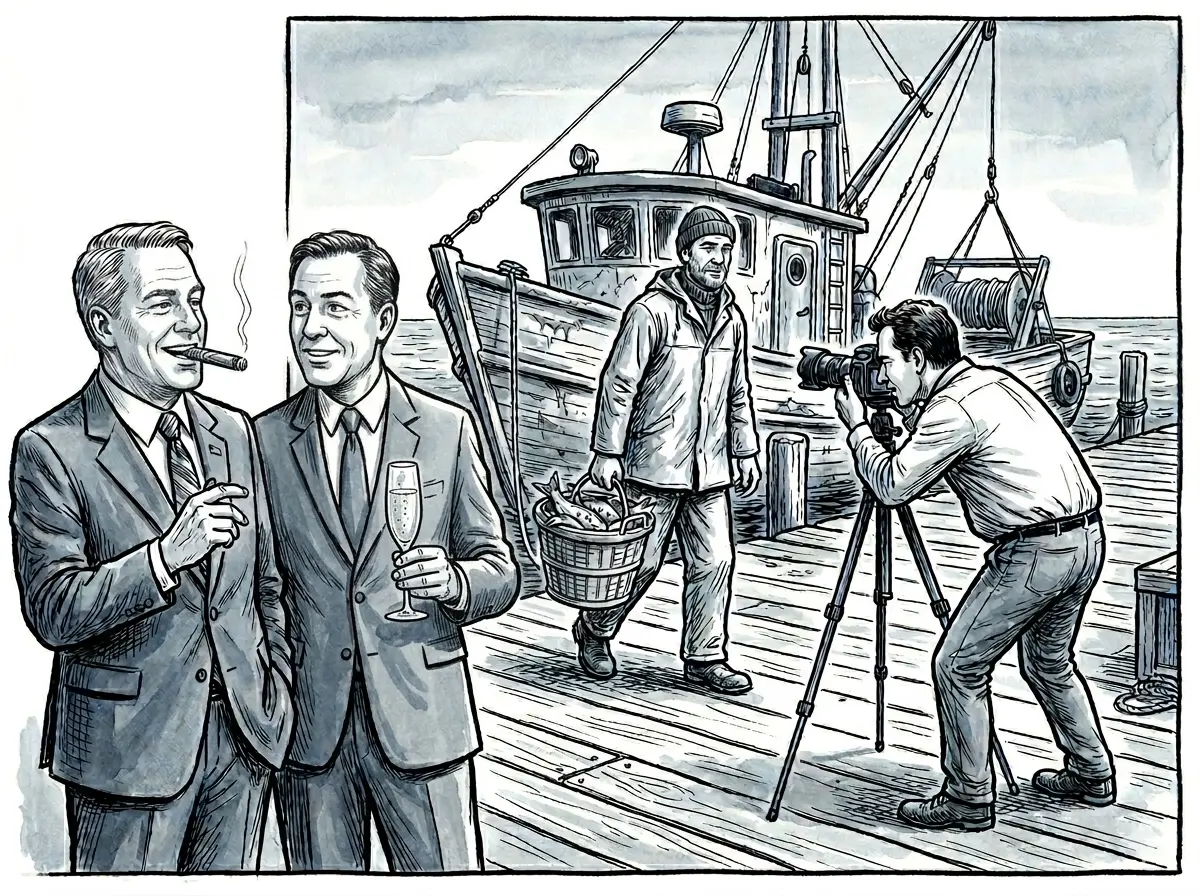
Arthur Pigou, the Cambridge economist, identified the mechanism in 1920. He called it the divergence between private gain and social cost. The concept is not complicated: when the person who profits from an activity does not pay the full cost of that activity, the difference is a subsidy extracted from everyone else. The polluter who dumps into the river profits from not paying for cleanup. The cleanup cost is borne by everyone downstream. In Pigou’s framework — and in the foundational logic of market economics that followed him — this is not capitalism working. It is capitalism failing. The technical term for the difference — the cost created by the transaction that the transaction does not pay for — is an externality. The concept is not controversial. It is foundational to market economics. What is controversial is applying it honestly to the industries that prefer it remain theoretical. The free market, properly understood, requires that costs be borne by those who create them. You earn what you create. You pay for what you damage. That is the bargain.
The bargain has not been honored. What has been built instead is a system that keeps the gains private and sends the costs downstream — to the taxpayer, to the community, to the watershed, to the next generation — and then calls the accounting honest and the arrangement capitalism. It is not capitalism. It is extraction wearing capitalism’s vocabulary, protected at every point by purchased legislation, and sustained by the claim that anyone who objects to it is the enemy of the free market.
This essay is the accounting. Industry by industry, the specific costs that were supposed to be priced into the system and were not. The people who were supposed to pay them and did not. The legislation that was supposed to enforce the bargain and was purchased into uselessness. And the communities that absorbed the costs and were told the market was working as intended.
I. The Pattern Across Industries
The same structure runs across seven industries spanning nearly a century. Public investment in, private yield captured, costs externalized onto the public, oversight purchased into uselessness. The sequence does not change with the industry. The instrument does.
Mining
Since the Comprehensive Environmental Response, Compensation, and Liability Act passed in 1980, total federal Superfund appropriations have exceeded thirty-two billion dollars — cumulative since 1981 — cleaning up sites polluted by companies that paid little to nothing, in many cases companies that no longer exist, having extracted the profit and arranged the bankruptcy to leave the liability for whoever came next. The estimate for reclaiming abandoned mine sites when the law was written in 1977 was thirty-three billion dollars. The fund created to pay for it has collected six billion dollars as of the most recent assessment. The gap between those two numbers is not an oversight. The evidence suggests it is the result of four decades of mining industry money finding the rooms where bond requirements get written and ensuring the requirements stayed below the actual cost of the damage. Kentucky’s coal industry runs a net drain on the state budget of over a hundred million dollars annually before you count the health costs, the poisoned water, the shortened lives. The mountain was flattened. The company is bankrupt. The executives retired. The bill is yours.
Grazing
The Taylor Grazing Act of 1934 set fees for ranching on federal land — land that belongs to every American — at rates that have not been updated in any meaningful way in ninety years. The Bureau of Land Management’s 2025 rate is $1.35 per animal unit per month for grazing rights on public land. The 2024 USDA National Agricultural Statistics Service survey of private grazing land across seventeen comparable western states puts the average at $23.40 per animal unit per month. The difference is a direct, ongoing public subsidy to an industry that has spent ninety years funding the congressional delegations that set the fee. The land appreciated. The public infrastructure around it improved. The fee did not move. That is not the market working. That is the extraction keeping the price of public assets permanently below their value through the people paid to set the price.
Finance
The 2008 financial crisis is the cleanest example of the sequence running at systemic scale. The instruments — mortgage-backed securities, collateralized debt obligations, credit default swaps written against positions the same firms were recommending to clients — were built to fail. Documentation now exists showing that the people building them knew this while they were building them. The public absorbed the losses through the bailout, through the recession that followed, through the decade of austerity presented as the inevitable response to a natural disaster rather than the bill for specific decisions made by specific people in specific rooms. The bonuses were paid. The executives kept them. No senior executive at a major financial institution went to prison for conduct that destroyed eight million American jobs and eliminated trillions in household wealth. Dodd-Frank passed in 2010 with provisions that would have constrained the behavior that caused the crisis. The industry then spent a decade quietly restoring the exemptions it had lost, one committee hearing at a time, through the same committees that had passed the original legislation. The form of accountability was created. The substance was preserved elsewhere.
Pharmaceuticals
The National Institutes of Health has invested more than nine hundred billion dollars cumulatively in biomedical research since 1938. That investment underlies virtually every drug currently on the market. The public paid for the science. The Bayh-Dole Act of 1980 gave private companies the right to patent discoveries from that publicly funded research and charge what the market would bear. Built into the same law were march-in rights: the explicit legal authority for the federal government to license a patent to other manufacturers when the patent holder is not making the drug reasonably available.
Those rights have never been exercised. Not once in forty-five years. Not when insulin — invented in 1921, with its patent sold to the University of Toronto for one dollar explicitly so the drug would be available to everyone who needed it — became a drug that Americans were rationing a century later, with documented deaths from people stretching doses they could not afford. The legal authority has been confirmed by the Government Accountability Office. The political will has been purchased away every time a senator introduced legislation to use it. The pharmaceutical industry spends more on lobbying than any other sector in the American economy. The march-in rights are in the statute. They have simply never been used, because the people who would need to use them have been consistently, specifically, and expensively persuaded not to.
Telecommunications
The electromagnetic spectrum belongs to the public. The original broadcast and telecommunications licenses were issued at below-market prices to carriers who then built services the public pays to access. The internet — the infrastructure the entire digital economy runs on — came directly from ARPANET, a publicly funded Defense Department project. GPS, which enables the logistics infrastructure that underlies modern commerce, is a publicly funded military technology made available to the private sector at no charge. The appreciation of the spectrum from a technical resource to the infrastructure of the entire digital economy was captured entirely by the license holders. The fees were not updated. The licenses were renewed. The broadband prices in the United States are among the highest in the developed world for service that independent rankings consistently place among the lowest in quality among peer nations.
Artificial Intelligence
The AI companies building the most valuable productive infrastructure in human history would like to be understood as self-made. The record does not support this. DARPA funded foundational AI research from the 1960s forward, establishing the centers of excellence at MIT, Carnegie Mellon, and Stanford that became today’s major AI research institutions. The National Academies of Sciences has documented how virtually every step of the foundational work was federally funded or supported by public universities.
The training data is the same story at a larger scale. The accumulated written output of human civilization — books, articles, research papers, creative work, the recorded conversation of billions of people across decades — was scraped, ingested, and productized. One major AI company agreed to pay a confirmed $1.5 billion to settle the lawsuit over the portion it took from pirate libraries: approximately three thousand dollars per book, for work whose authors spent years or decades producing it, that trained a system now valued in the hundreds of billions of dollars. As of April 2026, 166 active federal copyright cases are working through the courts. The companies claim fair use for ingestion — the legal doctrine that permits limited use of copyrighted material without permission — and simultaneously claim copyright protection for output. These positions are in direct legal tension — and the courts will determine which framing holds. The window for designing a legislative framework that converts individual copyright claims into collective public equity — a shared stake in the infrastructure the public’s creative output helped build — is closing as the consolidation completes. While the infrastructure is still being built, asserting the public claim looks like design. After the consolidation is complete, it looks like confiscation. Every quarter that passes without acting on that distinction is a quarter in which the window narrows.
The technology industry spent over sixty million dollars on federal lobbying in 2024. The committee chairs who would hold the hearings on a public equity framework received some of it. The money found the room. It always finds the room.
II. The Five Steps: Forests and Fisheries
The seven-industry survey above documents the pattern in aggregate. What follows is the same pattern examined at the scale where it is felt — two communities, two industries, the sequence run to completion, in places that never compared notes. The five-step framework that structures these cases is not specific to forests and fisheries. It is the mechanism by which every item in Section I proceeded.
There is a mill town in the Pacific Northwest. There is a fishing village on the New England coast. They have never compared notes. They share no geography, no industry, no political representation, no common history. What they share is a sequence — five steps, run in the same order, producing the same result, by the same mechanism operating in both places simultaneously.
Step One: The Below-Market Extraction Right
The timber company arrived in the Pacific Northwest with a contract to log federal land — land owned by the public — at rates set by the congressional delegation the timber industry had been funding for a decade. The rates did not reflect the market value of the timber. They reflected what the industry had paid to make them. The fishing fleet arrived in the North Atlantic with catch quotas set by the same process: the relevant senators, the relevant committees, the relevant campaign contributions, the rates arriving below what honest accounting of the resource’s value would have produced.
This is the first extraction: the subsidy built into the price. The public owns the forest. The public owns the fishery. The extraction is permitted on terms that do not reflect that ownership. The difference between what was paid and what the resource was worth is a transfer from the public to the operator, arranged by the politician the operator funded, and described at the ribbon cutting as economic development.
Step Two: The Unsustainable Extraction
The science was not hidden. The Forest Service’s own researchers documented that old-growth forests do not recover on a commercial logging cycle. The trees that took four hundred years to grow cannot be replaced in forty. NOAA’s fisheries biologists published the Atlantic cod stock assessments showing the population collapsing in real time through the 1980s. The Grand Banks, which had supported continuous human fishing since the fifteenth century, were being emptied in a decade.
The industry knew the science. The industry extracted at the rate that maximized the return in the available window, which is the rational behavior of an institution that does not own what it is extracting and has no obligation to return it in the condition it was found. The mill ran three shifts. The trawlers went out in weather that would have kept previous generations of fishermen in port, because the boats were bigger and the margins required it and the quota system rewarded the fleet that got there first.
The old-growth forests of the Pacific Northwest were largely gone by the 1990s. The Atlantic cod population collapsed in 1992. Canada declared a moratorium on cod fishing that year — the largest industrial closure in Canadian history, affecting forty thousand workers and their communities overnight. The northern cod has not recovered to commercial levels in thirty years. The Sitka spruce and Douglas fir that took centuries to grow will not return in any human lifetime currently living. This is the second extraction: the yield taken, the collapse left behind.
Step Three: The Community That Organized Itself Around a Lie
The mill town built itself around the assumption that the resource would last. Not because the residents were naive. Because the industry told them it would last, the politicians told them it would last, and the alternative — that the entire economic foundation of their community was being extracted at a rate that guaranteed its collapse within a generation — was not something anyone with an interest in the extraction had a reason to say out loud.
The mill workers bought houses. Their children went to schools funded by the mill’s property taxes. The hardware stores, the diners, the equipment suppliers, the mechanics, the doctors and dentists and teachers whose livelihoods depended on the payroll of people who depended on the mill — all of them organized their lives around an economic base whose architects knew was temporary and said nothing. The fishing village was the same. The boat builders. The net makers. The fish processors and their workers. The schools and the churches and the families three generations deep in the same harbor. When the moratorium came, it did not come to an industry. It came to a community that had no other economic identity, no cushion, no alternative, and no warning that the people managing the resource had seen this coming for twenty years.
This is the third extraction: the community paying the cost of the industry’s exit with everything it had built around the assumption of continuity.
Step Four: The Public Pays to Repair What Private Interest Destroyed
The federal government stepped in. Economic development grants. Retraining programs. Infrastructure investment to try to attract new industry to a place that had lost the thing that made it a place. Watershed restoration funding for the hillsides now eroding into the streams because the root systems were gone. Marine biology programs to study the recovery of fish stocks that were not recovering. All of it new public debt, added to the national tab, to try to rebuild what the industry destroyed and was never required to remediate.
The retraining programs deserve a specific paragraph. A mill worker in his fifties, whose entire skill set was built around an industry that no longer existed in his region, was offered a computer class at the community college. The program’s function was not to retrain the worker. Its function was to allow the politician to say something was being done. The worker knew the difference. The politician knew the worker knew the difference. This is the fourth extraction: the public paying again, in new debt, for the damage the industry caused and was never required to remediate.
Step Five: The Accountability Taken Along With Everything Else
The congressman who set the below-market timber rates that enabled the extraction was at both ribbon cuttings — the first when the mill opened, the second when the federal economic development center arrived to address the crisis his votes had helped create. He kept the timber industry’s donations. The story of what happened between the two events — the below-market rates, the unsustainable extraction, the science ignored, the community built on a foundation everyone in the room knew was temporary — was not the story that circulated.
The fishing senator who had blocked the stronger catch limits that fisheries biologists had recommended — limits that would have preserved the stock, the industry, and the community — stood at the dock when the moratorium came and called it a tragedy. He introduced emergency assistance legislation. He was photographed with fishing families. OpenSecrets data shows that commercial fishing industry PACs directed more campaign funding to Senate fisheries committee members in the decade before the 1992 collapse than to any comparable committee in a non-coastal state. That data was in the public record. It was not in any story that ran in the regional papers that week.
This is the fifth extraction: the accountability taken along with everything else. The community ends up with no villain to name and no story that accurately explains what happened to it. It has a monument to the man who arranged its gutting, because the industry that funded him also funded the narrative about what he did.
The mill town didn’t just lose the mill. It paid for the mill five times and never owned it once.
There is a concept that connects every item in the ledger above, and it is older than any of the industries it describes.
A commons is a productive resource whose value was created by collective investment — public land, public research, public spectrum, public infrastructure, the accumulated creative and intellectual output of a civilization. It belongs to everyone who contributed to its creation, which is to say: everyone. The rules of a functioning market economy are clear on this point. What the public built, the public owns a share of. What is extracted from it should return something to the account it was drawn from.
The accounts have not been replenished. The mill town’s timber is gone and the federal cleanup fund is twenty-six billion dollars short of what it needs. The fishing village’s cod has not recovered in thirty years. The NIH has invested nine hundred billion dollars cumulatively in the science that produced the pharmaceutical patents; the march-in rights that would let the public collect on that investment have never been exercised once. The electromagnetic spectrum — built into a trillion-dollar industry on a public license — generates broadband prices among the highest in the developed world for service ranked among the lowest in quality. The AI infrastructure now valued in the hundreds of billions was trained on the accumulated written output of human civilization, and the public’s claim on what it built has not been established before the consolidation completes.
The mill town and the fishing village never compared notes. Neither did the mining community and the watershed downstream. Neither did the patient rationing insulin and the researcher whose NIH grant produced the patent. The rancher paying $1.35 on public land and the broadband subscriber and the writer whose life’s work trained a system worth more than most nations have never been in the same room. They are not in the same room because the arrangement that drew down their commons depends on their remaining separate. Communities that can see each other can name what they share. Communities that cannot see each other cannot reclaim it.
The enclosure movement ran in England for three hundred and fifty years. Parliament converted common land into private property. The people who depended on the commons were left with only their labor to sell — to the same lords who had just enclosed it. The lords who enclosed the commons were the same lords in Parliament passing the Enclosure Acts. The circle was complete.
The word that fits the arrangement described above — productive resource captured, public account drawn down without replenishment, political mechanism of recourse controlled by the people doing the capturing — is feudalism. The lords changed. The commons did not.
III. What This Is, and What It Is Not
This is not an argument against capitalism. It is capitalism’s own argument, applied honestly. The foundational logic of market economics requires that costs be borne by those who create them. The polluter pays. The cost of production includes the cost of cleanup. The return on an investment includes the systemic risk that investment exports onto the public. This is not a left-wing position. It is the position of the discipline whose vocabulary the extraction apparatus has been borrowing for fifty years to defend the precise opposite of what the discipline requires.
The auto industry said mandatory seat belts would make cars unaffordable and destroy American competitiveness. They fought it for twenty years. The regulation passed. Employment in the auto industry did not collapse. The cars remained affordable. The roads got safer. The Clean Air Act of 1970 was described by the industries it regulated as an existential threat to the American economy. GDP grew after the Act passed. The industries adapted. The air got cleaner. Dodd-Frank was described by the financial industry as an assault on the credit system that would freeze lending and kill growth. Lending continued. The industry then spent a decade buying back the provisions that made the legislation meaningful. The argument that accountability kills innovation and growth is zero for the twentieth century.
The specific version of this argument currently being made about AI regulation deserves particular attention. The companies warning that public equity requirements would stifle innovation are the same companies that have already demonstrated, by their own actions, that they will eliminate human workers as rapidly as the technology permits regardless of any public accountability framework. Amazon has cut tens of thousands of corporate roles, citing AI efficiency. Snap announced in April 2026 that AI now writes over sixty-five percent of its new code, the same week it cut sixteen percent of its human workforce. The jobs are already gone. What remains to be protected is the profit margin on infrastructure built on sixty years of public investment — and the political environment in which they are not asked to pay for it.
IV. The Standard Arguments, and Who Is Making Them
The arguments that follow are not hypothetical. They are the specific claims that have been made, repeatedly and consistently, by the industries and politicians whose financial interests appear in the ledger above. They will be made again in response to the proposals that follow in this movement. They are presented here, with the evidence that addresses them, so that when they arrive in their next form they can be recognized.
‘This is socialism.’
Requiring the mining company to clean up the mine is not socialism. It is the free market working as its own architects said it should work. Requiring the pharmaceutical company to share returns on publicly funded research with the public that funded it is not socialism. It is a royalty arrangement of the kind that governs every other licensing relationship in a market economy. Requiring the AI company to negotiate terms for using the public’s accumulated creative output is not socialism. Norway did it with oil. Alaska did it with oil. Both are operating market economies. Neither has collapsed into state-controlled production. The label is not an argument. It is a way of preventing one.
‘It will kill jobs and destroy innovation.’
The auto industry made this argument against seat belts for twenty years. The coal industry made it against the Clean Air Act. The financial industry made it against Dodd-Frank. The pharmaceutical industry makes it against drug pricing reform. In each case the prediction was wrong. In each case the industry adapted, continued operating, and in most cases continued growing. The track record of this argument is unbroken: it has never once been correct about the consequences of the accountability measure it was deployed against, and it has never once been made by a party that did not have a direct financial interest in preventing the accountability measure.
‘The market will self-correct.’
The Atlantic cod fishery has not self-corrected in thirty years. The abandoned mine sites that Superfund has been cleaning up since 1980 did not self-correct. The communities gutted by the five-step extraction sequence did not self-correct. The 2008 financial system did not self-correct — it collapsed, the public paid to restart it, and the same institutions resumed the same practices under a partially dismantled regulatory framework. The self-correction argument has a specific structural problem: it is always made after the extraction and before the accounting, in the window when the private gains are being collected and the public costs have not yet materialized in a form that makes the causal chain visible.
‘We can’t afford it.’
This argument is made about the cost of the remedy while the cost of the damage is not counted. The federal government cannot afford to exercise the march-in rights on a pharmaceutical patent, we are told, because it would disrupt the innovation ecosystem. The federal government has invested nine hundred billion dollars cumulatively in the research that created the patents in question. The cost of exercising rights already paid for is a rounding error against the investment already made. The fiscal responsibility argument is made with particular consistency by legislators whose votes created the fiscal condition they are citing.
‘It’s always been this way.’
It has not always been this way. From 1945 to 1975, the architecture produced a different outcome. Wages and productivity tracked each other. The top marginal tax rate on the highest incomes ran above ninety percent through most of the Eisenhower administration and the economy grew. The GI Bill sent a generation of working-class men to college. The Marshall Plan rebuilt Western Europe and Japan. The commons was being built, not extracted. The point is not that those decades were a golden age. The point is that a different outcome was produced by a different architecture — and that architecture was deliberately dismantled, by specific people, for specific reasons, at specific moments that are on the record. The current arrangement was chosen. It was not inevitable.
V. Who Will Be Making These Arguments Tomorrow
The arguments in the previous section are not made in the abstract. They are made by specific people with documented financial relationships to the industries whose extraction they are defending. They will be made again — in floor speeches, in committee testimony, in op-eds placed in newspapers whose largest advertisers are the industries in question, in think tank reports produced by institutions whose operating budgets flow from the same sources.
There is a senator who will stand up tomorrow and explain, with complete sincerity, why the march-in rights on pharmaceutical patents cannot be exercised, why a public equity stake in AI infrastructure is socialism, why the grazing fee increase would devastate rural communities, why the mining cleanup bond requirements would destroy jobs. He is not lying. He is not a cartoonish villain. He is a person whose campaigns have been funded, whose staff has been recruited, whose colleagues have been employed, by the industries whose accounting appears above — a vested interest maintained long enough that the alternatives have moved outside the boundary of what his frame permits to be true. They are not visible to him as suppressed options. In his frame, they do not exist.
Tomorrow he will stand up and explain, with complete sincerity, why none of them are possible.
The items in the ledger above were never in the same column. The mill town didn’t know about the fishing village. The patient rationing insulin didn’t know about the rancher on public land. Each was a local story, a sector problem, a specific failure that the people responsible for it could mourn at a ribbon cutting and call a tragedy. Placed in the same column, they describe something else: a commons drawn down across an entire economy, simultaneously, in communities kept too separate to compare notes. The public’s account has been running a deficit for fifty years. The next essay documents two separate conversations happening right now — in two rooms that are not talking to each other — and what happens when they meet.
— — —
Steve Sagnotti
is a serious amateur photographer, writer, and technologist based in Oregon. With his camera he tries to capture common images not often seen, leading to common questions not often asked.
steves-head.space
© 2026 Steve Sagnotti
— — —
Sources
Pigou, Arthur. The Economics of Welfare. Macmillan, 1920. Divergence between private gain and social cost; foundational externality doctrine.
Section I — The Pattern Across Industries
Mining — Superfund / CERCLA (1980): GAO-08-841R; EPA CERCLA Overview; CRS Report R41039. Cumulative federal Superfund appropriations since 1981: $32B+. Surface Mining Control and Reclamation Act of 1977: Office of Surface Mining Reclamation and Enforcement, Abandoned Mine Land Program data ($6B collected / $33B estimated need, most recent assessment). Kentucky coal net fiscal drain: University of Kentucky Center for Business and Economic Research, 2023.
Grazing — Taylor Grazing Act of 1934: BLM 2025 Grazing Fee Announcement ($1.35/AUM, 2025 annual rate); USDA NASS Grazing Fees ($23.40/AUM average across 17 western states, 2024); Taxpayers for Common Sense.
Finance — Financial Crisis Inquiry Commission, Final Report, 2011. TARP Special Inspector General reports. Dodd-Frank Wall Street Reform and Consumer Protection Act, 2010. Volcker Rule implementation history: GAO-17-855, 2017.
Pharmaceuticals — NIH cumulative investment ($900B+, 1938–2024): NIH Office of Budget historical tables. Bayh-Dole Act: Pub.L. 96-517, 1980; march-in rights: 35 U.S.C. § 203; never exercised: GAO-09-742 (2009); CRS IF12582; 2026 GAO analysis (Jones Day summary). Insulin patent: University of Toronto, 1923; Banting and Best correspondence.
Telecommunications — FCC spectrum history and license fees. ARPANET: DARPA, 1969–1977. GPS public availability: U.S. Air Force Space Command, 1995. Broadband price and quality rankings: OECD Broadband Portal, 2024; Ookla Speedtest Global Index, 2026.
Artificial Intelligence — DARPA/public research foundation: National Academies of Sciences, Funding a Revolution, 1999. AI copyright litigation: AI Lawsuit Tracker (166 active cases, April 2026); Norton Rose Fulbright case update, March 2026. Technology industry lobbying ($60M+, 2024): OpenSecrets.org. Amazon, Snap workforce reductions: company SEC filings and earnings calls, 2025–2026; Snap layoffs, Engadget, April 2026.
Section II — The Five Steps: Forests and Fisheries
Pacific Northwest old-growth logging: U.S. Forest Service timber sale records. Atlantic cod collapse: NOAA Fisheries, “Atlantic Cod Stock Assessment,” 1992 and subsequent; Department of Fisheries and Oceans Canada, 1992 moratorium declaration; 40,000 worker figure: DFO economic impact assessment, 1992. Commercial fishing industry PAC spending to Senate fisheries committee members: OpenSecrets.org, commercial fishing sector, 1982–1992.
Sections III–V — The Standard Arguments
Seat belt mandate history: NHTSA, “History of the Automotive Safety Regulations,” 2019. Clean Air Act economic impact: EPA, “The Benefits and Costs of the Clean Air Act,” 1997 and 2011. GI Bill: Servicemen’s Readjustment Act of 1944. Marshall Plan: European Recovery Program, 1948–1952. Amazon, Snap workforce reductions: company SEC filings and earnings calls, 2025–2026.
Leave a Reply