NOTES FROM THE FIELD — Dispatch #9
April 2026
— TWO CLOCKS —
Nobody has put them on the same page.
They arrive at the same year.
—They had made themselves replaceable. Meta owned what they’d built. They owned nothing.
I. THE CONVERGENCE
Two separate conversations are happening in two separate rooms. The people in each room are not talking to the people in the other. Nobody has put what they’re saying on the same page.
In the first room, labor economists and workforce researchers are tracking what employers say they intend to do over the next five years. The numbers are not speculative — they come directly from employers. The Randstad Workmonitor survey, published this month, asked them directly: 76 percent predict that at least half of all entry-level roles will disappear within five years. The World Economic Forum found that 41 percent of employers worldwide intend to reduce their workforces as AI automates tasks — by 2030. Dario Amodei, the CEO of Anthropic, has said AI will eliminate half of entry-level white-collar jobs within one to four years. These are not fringe projections. They are the mainstream. And they share a timestamp: the steepest part of the displacement curve arrives between 2029 and 2032.
In the second room, fiscal economists are watching a different clock. The Congressional Budget Office projects that by fiscal year 2031, the average interest rate on federal debt will exceed the rate of economic growth. When that happens, the debt accumulates faster than the economy can address it. The Committee for a Responsible Federal Budget has a name for what follows: a debt spiral. Self-reinforcing. Higher debt pushes rates up. Higher rates slow growth. Slower growth means less revenue. Less revenue means more borrowing. The Federal Reserve chair said it plainly at Harvard in March: “It will not end well if we don’t do something fairly soon.”
Two rooms. Two clocks. One year: 2031.
Five years. If you’re 35 now, you’ll be 40. If you’re 50, you’ll be 55. The threshold isn’t abstract. It arrives on a specific Tuesday morning, in a specific fiscal year, in the middle of whatever your life looks like then.
Nobody is connecting these two rooms. And the reason nobody is connecting them is that the people being displaced are the same people the fiscal system runs on — and when they exit the economy, they don’t just stop contributing. They start drawing. The tax base contracts and the safety net expands at the same moment, in the same system, right when the math can least afford it.
II. WHY THE TWO CLOCKS ARE THE SAME CLOCK
The federal fiscal system is funded by taxing economic participation. Wages. Payroll contributions from the first dollar. The tax base that services the debt, funds Social Security and Medicare, and keeps the spiral from becoming self-reinforcing is built on people working.
If you work for a salary, you are in the revenue column. The question this dispatch is recording is how long that column holds.
When workers exit participation, they don’t just stop contributing. They start drawing. Each person who leaves the labor force moves from the revenue column to the expenditure column simultaneously. Less payroll tax in. More program dependency out. The safety net expands in demand at the exact moment its funding base is contracting.
The institutional reassurance — delivered consistently by Goldman Sachs, the IMF, the WEF, the Bureau of Labor Statistics — is that net job creation will absorb the displacement. New roles will emerge. Workers will retrain. The analogy offered is always the same: the transition from agricultural to industrial labor, or from manufacturing to services. People adapted before. They will adapt again.
The analogy fails on one variable: speed. Those transitions played out across decades. The gap between displacement and replacement was wide enough to cross on foot. What no institutional projection models adequately is what happens in the lag — the years between when the displacement arrives and when the replacement jobs appear. If that lag is five years, those five years are precisely the years in which the tax base is contracting and the debt spiral threshold is arriving. The reassurance is true at the macro level across a long enough horizon. It is not true for the people in the lag. And the lag is 2029 to 2032.
The workers exiting the labor force are the same workers who paid payroll taxes on every dollar they earned, while the ownership class paid themselves token salaries and called the rest investment income. The previous dispatches documented the mechanism. This one records the timing. The contraction of the tax base and the arrival of the fiscal threshold are not parallel stories. They are the same event, in the same system, arriving at the same moment.
III. WHAT IS ACTUALLY HAPPENING TO PEOPLE
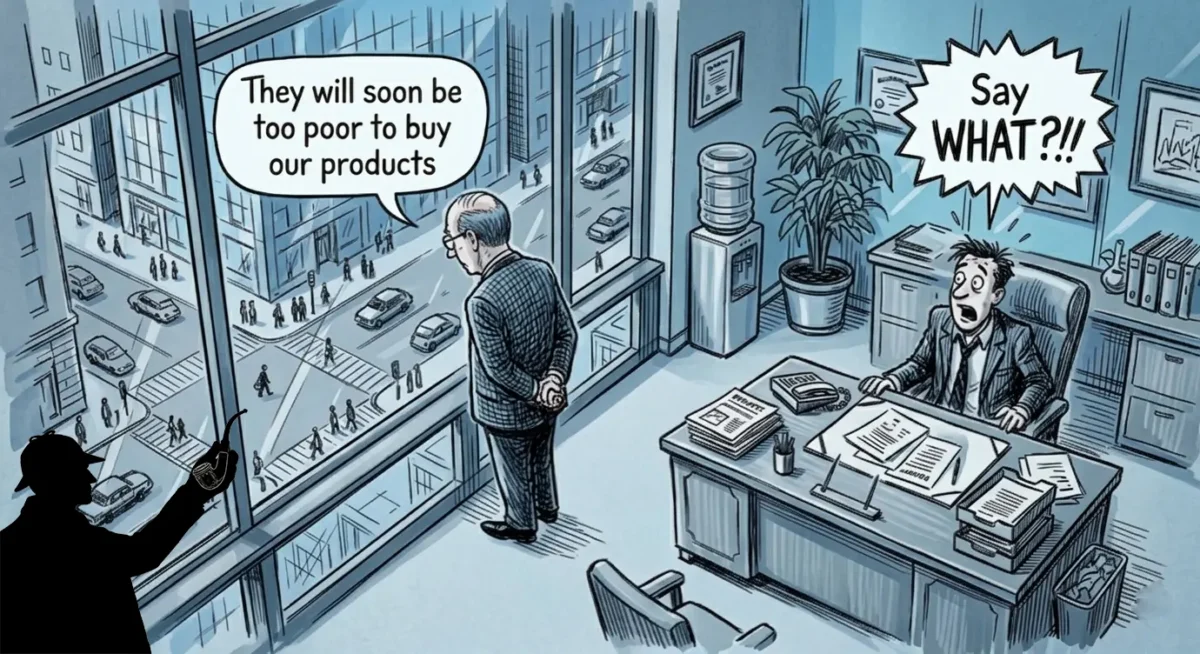
Henry Ford paid his workers enough to buy the cars they built. Not because he was generous. Because he understood that workers who couldn’t afford his product weren’t the consumers he needed. There is a cartoon that captures the moment before that realization lands: an executive looking out a window at the workers below says to a colleague, they will soon be too poor to buy our products. The colleague’s reaction is pure shock. The executive at the window has already done the math. The one at the desk hasn’t yet.
That math is being done right now, in boardrooms that are not sharing the results.
This month, Snap announced it was cutting 1,000 workers — 16 percent of its full-time employees. The CEO’s explanation was unusually direct: AI now generates more than 65 percent of new code at the company. The same work is being done. There are just fewer people doing it.
The same week, Sama — a firm based in Nairobi that employed people to label images, review content, and tag data — issued redundancy notices to 1,108 workers. Their employer was Meta. For years, they had been doing exactly what Meta needed: adding judgment capability to the AI. Teaching it to see what was harmful, what was human, what was real. When the system had learned enough, the contracts ended. They had made themselves replaceable. Meta owned what they’d built. They owned nothing.
This is not a story about workers in Nairobi. Judgment is what most of the economy runs on. If your job is to assess, evaluate, triage, decide, or discern — the Sama workers were doing the same work, one label at a time, that you do every day. The question is not whether your industry will face this. The question is where it is in the sequence.
Nearly 80,000 technology workers were laid off globally in the first three months of 2026. Of those, 47.9 percent were attributed by the companies themselves — not by critics, not by analysts, by the companies — to reduced need for human workers because of AI. Oracle cut between 20,000 and 30,000 people by early-morning email, the same week it announced $58 billion in new debt to fund a $50 billion AI data center buildout. The workers and the infrastructure are moving in opposite directions. The pace of each is accelerating.
The Bloomberg projection for 2026 alone: AI-related displacement affecting up to 502,000 roles. The MIT simulation for the broader trajectory: AI capable of replacing nearly 12 percent of the entire U.S. workforce — approximately $1.2 trillion in lost salaries, and the tax revenue that would have come with them.
And here is the number the standard unemployment figure will not show. The labor force participation rate is projected to fall by 2030, removing roughly 2.6 million people from the books — a city the size of Chicago quietly leaving the labor force. They won’t show up as unemployed. They will simply stop being counted. They are moving from the revenue column to the expenditure column, one exit at a time, and the dashboard that measures the economy’s health will not register the migration until long after the fiscal math has already moved.
IV. WHY NOBODY IS CONNECTING THEM
The institutions producing the labor projections are the same institutions whose clients are executing the displacement. The reassurance that net job creation will eventually absorb the disruption is not necessarily false — across a long enough time horizon it may be correct. But it is functioning as a reason not to act in the window when action would matter. By the time the net positive job creation materializes, the fiscal math will have already moved through the threshold.
The AI buildout is happening in private. Anthropic and OpenAI together raised over $150 billion, largely from venture capital, private equity, and foreign sovereign wealth funds. They employ a combined few thousand people. Amazon employs 1.5 million. The productivity gains are real. The distribution is not.
The fiscal mechanism that would catch the displaced — a broader tax base, consistent treatment of ownership wealth alongside wage income — has been systematically defunded as a political possibility through three decades of organized effort by the people it would affect most. The reform proposals exist. The precedent exists: Reagan signed the 1986 Tax Reform Act. The complexity is not an accident. It is the inventory. Every loophole is a protection that was purchased. Every reform proposal that went nowhere was supposed to go nowhere.
The question sitting in the center of the room has no lobbyist, no PAC, no campaign check attached to it. The people who would need to act are the same people whose clients are doing the displacing, whose portfolios are capturing the gains, and whose accountants have already made sure they won’t be standing closest to the edge when the math runs out.
Nobody in the room is asking the question. And nobody outside the room has been given the mechanism to ask it effectively — because the legal and political architecture being built around this moment is not designed to create one.
V. THE SEQUENCE
Here is what this dispatch is recording, and why the timestamp matters.
In the first quarter of 2026, the displacement is moving through specific categories in a specific order: content raters first — the people who trained the systems, who added judgment capability to the AI so they could be replaced — then customer support, then project managers, SaaS administrators, junior programmers. The Randstad survey says employers intend to continue. The Bloomberg projection says the full-year number is 502,000 roles. The employer surveys put the steepest curve between 2029 and 2032.
2031 is the year the CBO projects the interest rate on federal debt exceeds economic growth. After that point the spiral becomes self-reinforcing. Economists have a name for what comes next. There is no gentle version of that phrase.
Two things happen to a person when automation takes their job. The first is visible: they stop paying in. The second is invisible: the unemployment statistics are designed to stop counting them once they stop looking for work. A city the size of Chicago will quietly leave the labor force by 2030. They won’t show up as unemployed. The dashboard will not register them. They will simply disappear from the count.
But there is a third thing, and it is the one nobody is saying plainly.
Whether they are employed, unemployed, or no longer counted — wage workers have no ownership claim on what the machines produce. They never did. They were paid for their labor while someone else captured the surplus their labor created. Automation doesn’t change that arrangement. It just makes it permanent. The machines now hold the judgment capability the workers transferred into them. The workers hold nothing. And the legal and political architecture being built around this moment is not designed to change that.
This is not about takers and makers. It is about who owns the machine.
First they came for the content raters, and the mid-career programmer said nothing, because he was not one. Then for the customer support workers, and the project manager said nothing, because she was not one. Then for the SaaS administrators, and the junior engineer said nothing, because his category had not yet been reached.
Niemöller wrote his confession from inside a camp. He had not been alarmed when the sequence started. He had assumed his category was different. His insight was not that the excluded suffer — everyone knows that. His insight was that the categories expand, and that the people who assume their rung is structural rather than temporary do not recognize the water temperature until it is too late to step out.
The displacement is not waiting for the reassurance to be disproven.
And when it arrives at scale — when the debt math has run out, when the safety net has been means-tested and time-limited and legislated toward inadequacy, when the people automation displaced have no legal mechanism to claim a share of what the machines are producing — there is one more question this dispatch cannot answer but must ask.
The United States has spent $38 billion building a network of government-owned warehouses, converted and purchased to hold surplus populations pending resolution of their legal status. They were built for immigrants. The immigrants are being deported.
What will the warehouses be used for next?
The silence won’t feel like silence.
It will just feel like the way things are.
Notes from the Field is the real-time record. The Narrow Gate traces the same pattern back more than fifteen hundred years. It’s publishing now at The Narrow Gate.
Sources
Section I — The Convergence
Randstad Workmonitor 2026, via Staffing Industry Analysts, April 13, 2026
World Economic Forum, Future of Jobs Report 2025, January 2025
Dario Amodei / Anthropic, via Tom’s Hardware / Nikkei Asia, April 8, 2026
Committee for a Responsible Federal Budget, “CBO Projects Possible Debt Spiral, as R Exceeds G,” March 9, 2026
Congressional Budget Office, Budget and Economic Outlook 2026–2036, February 2026
Jerome Powell remarks, Harvard University, March 30, 2026
Section II — Why the Two Clocks Are the Same Clock
Goldman Sachs, “How Will AI Affect the Global Workforce?” August 2025
IMF, Global Economic and Financial Implications of Artificial Intelligence, 2026
CBO / CRFB / Powell (as Section I)
ProPublica, “The Secret IRS Files,” 2021
Section III — What Is Actually Happening to People
Snap Inc. layoff announcement / SEC filing, April 15, 2026
Sama / Meta Nairobi redundancy notices, April 16, 2026
RationalFX / Nikkei Asia Q1 aggregate, via Tom’s Hardware, April 8, 2026
Oracle layoffs / debt announcement, CNBC, March 31, 2026
Bloomberg AI displacement projection, via Tech Insider
MIT workforce simulation, via Tom’s Hardware / Nikkei Asia
Labor force participation rate projections, AImultiple
Section IV — Why Nobody Is Connecting Them
Jennifer Harris, New York Times, April 8, 2026
Ray Madoff, “Our Tax System Should Make You Furious,” New York Times / Ezra Klein Show, April 17, 2026
Section V — The Sequence
Challenger, Gray & Christmas, Q1 2026 report, April 2026
ICE detention infrastructure: Brennan Center for Justice, February 2026; American Immigration Council, February 2026
Martin Niemöller, 1946
Leave a Reply