NOTES FROM THE FIELD
April 5, 2026
— THE ROOM DECIDES WHO STAYS —
Three movements, one week
The past seven days produced three distinct structural developments. They are being reported as separate stories. They are not.
I. THE PROMOTION PROBLEM
On April 2, Defense Secretary Pete Hegseth removed Army Chief of Staff Gen. Randy George, along with Gen. David Hodne and Maj. Gen. William Green Jr., the Army’s chief of chaplains. No official reason was given. The Pentagon stated it was “time for a leadership change.”
The context that did not make the official statement: reporting from nine U.S. officials confirmed that Hegseth had personally intervened to block four officers from a vetted promotion list after Army Secretary Dan Driscoll declined to do so. The officers were not under investigation. No misconduct was alleged. The broader pattern — steps taken to delay or block promotions for more than a dozen Black and female senior officers across all four branches — was confirmed by NBC News.
The Army was not the only branch affected. Adm. Lisa Franchetti, Chief of Naval Operations, was removed. Lt. Gen. Jeffrey Kruse, Director of the Defense Intelligence Agency, was removed. Gen. Jennifer Short, Senior Military Adviser to the Vice President, was removed. Across the branches, the common thread was not performance. It was perceived alignment with previous administration priorities.
The structural observation is not about the individuals removed. It is about the mechanism. A vetted list — produced by a professional process designed to evaluate competence — was overridden by the people in the room. The Army Secretary who declined to override it was bypassed. The generals who had operated within the professional framework were removed. The replacements are people the room already trusts.
The institution is being recomposed. The criteria for who belongs in it are being rewritten without being stated.
The people in the room share a common interest in the outcome.
II. THE CORPUS ACQUIRES A VOICE
On April 2, OpenAI acquired TBPN, a daily live business and technology talk show, in a deal reported in the low hundreds of millions. It is OpenAI’s first acquisition of a media company. TBPN will report to OpenAI’s Chief Global Affairs Officer. Its advertising business will be wound down on acquisition.
The structural fact is straightforward: the organization that trains its models on content now owns a content producer. The organization that shapes what the next generation of AI systems will know has acquired a direct stake in what gets said about AI, about technology, and about the people building both.
The advertising business being wound down is worth noting. TBPN’s prior obligation was to its advertisers and its audience. Its new obligation is to its owner.
This is not an argument about intent. It is an observation about structure. When the same institution controls both the training data and a portion of the discourse that will become training data, the boundary between the map and the territory begins to move.
The tool changed with the century. The problem being solved did not.
III. THE ARITHMETIC OF SURPLUS
Two displacement stories ran simultaneously this week, in the same institution and across the broader economy.
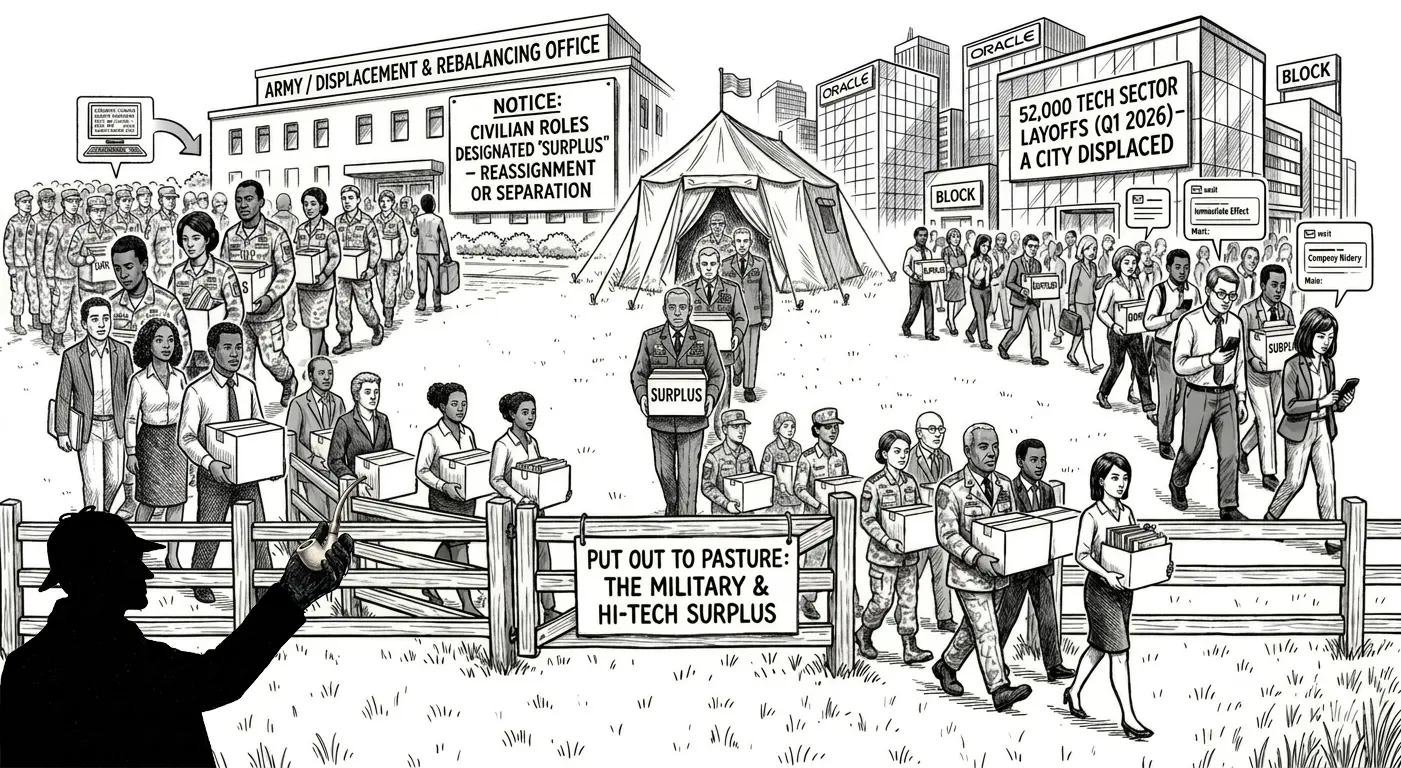
Inside the Army: thousands of civilian employees were notified their roles had been designated “surplus” under a rebalancing initiative. They were given days to accept reassignment — potentially to different states or different countries — or face separation. The tool used to identify matching positions for displaced employees was an AI system developed by Palantir, housed in the Army’s Vantage platform.
The institution that this week removed its senior leadership for insufficient ideological alignment simultaneously used an algorithmic tool to sort its civilian workforce into necessary and unnecessary. The Palantir system did not determine policy. It processed the inventory.
Across the broader economy: the first three months of 2026 produced 52,000 U.S. tech sector layoffs — roughly the entire workforce of a mid-sized American city — the highest first-quarter total since 2023. Oracle notified somewhere between 20,000 and 30,000 employees by early-morning email with immediate effect, one of the largest single layoff events in the company’s history. Block eliminated 4,000 of its roughly 10,000 employees. Atlassian cut 1,600 roles while simultaneously hiring 800 AI-focused replacements. The categories most heavily displaced: customer support, content creation, quality assurance, project management.
Jack Dorsey’s internal memo at Block was notable for its directness. The cuts were not attributed to financial difficulty. They were attributed to the growing capability of AI to perform a wider range of tasks.
A global study published this week by LHH, a division of the Adecco Group, surveyed employers directly. Nearly half reported they had already reduced headcount due to AI implementation. An additional 54 percent said they expect further AI-driven reductions within five years. This is the demand side of the same story — not companies announcing layoffs, but employers confirming, in aggregate, that the reduction of human labor is now standard operating procedure.
The displacement is not uniform. It is moving through specific categories of work, in a specific order, at an accelerating pace. The people now watching from what feels like a safe distance are in categories that have not yet been reached.
The silence won’t feel like silence. It will just feel like the way things are.
What these three stories share is not a theme. It is a sequence.
The institution purges the leadership that won’t recompose its membership criteria. It deploys an algorithmic tool to sort the remainder into necessary and unnecessary. And the organization that will train the next generation of AI systems on human knowledge acquires a stake in the discourse that knowledge comes from.
In each case the stated rationale is neutral: leadership change, workforce rebalancing, strategic acquisition. In each case the structural result is the same. The room gets smaller. The criteria for who belongs in it are rewritten without being stated. And the tools that will mediate what the next generation knows are moving closer to the people who are doing the rewriting.
First they recomposed the promotion lists, and the mid-career officer said nothing, because she was not on the list. Then they designated the civilian workforce surplus, and the contractor said nothing, because he was not in that rebalancing. Then the organization that trains the systems on human knowledge acquired a stake in the discourse, and the knowledge worker said nothing, because her category had not yet been reached.
The categories are not fixed. They are a sequence.
Pastor Martin Niemöller wrote his confession from inside a concentration camp. He had not been alarmed when the sequence started. His category, he had assumed, was different.
The pattern is the same. The speed is not.
Sources
Section I
https://www.military.com/daily-news/headlines/2026/04/02/army-chief-forced-out-iran-war-hits-new-phase.html
https://www.foxnews.com/politics/army-chief-staff-ordered-retire-immediately-hegseth-continues-pentagon-shakeup
https://www.aa.com.tr/en/americas/us-military-leadership-reshaped-as-defense-secretary-forces-dozens-of-senior-officers-out/3890199
https://www.trtworld.com/article/42f5b8e54457
Section II
https://techcrunch.com/2026/04/02/openai-acquires-tbpn-the-buzzy-founder-led-business-talk-show/
https://openai.com/index/openai-acquires-tbpn/
https://www.cnbc.com/2026/04/02/openai-acquires-tech-podcast-tbpn.html
Section III
https://federalnewsnetwork.com/army/2026/03/army-rebalancing-effort-forces-civilians-to-accept-reassignments-to-avoid-layoffs/
https://defensescoop.com/2026/03/26/army-rebalancing-civilian-workforce-reassignments-separations/
https://www.cnbc.com/2026/03/31/oracle-layoffs-ai-spending.html
https://www.blockchain-council.org/layoffs/layoff-narratives-tech-companies-blaming-ai/
https://www.eweek.com/news/more-tech-layoffs-ai-job-impact-2026/
https://www.staffingindustry.com/news/global-daily-news/ai-driven-job-cuts-surge-study-warns
TNG: Notes from the Field publishes on a fortnightly cadence. Out-of-cycle dispatches appear when the material requires it. The Narrow Gate is publishing April through September 2026 at [link].
Leave a Reply