Notes from the Field — August 27, 2026
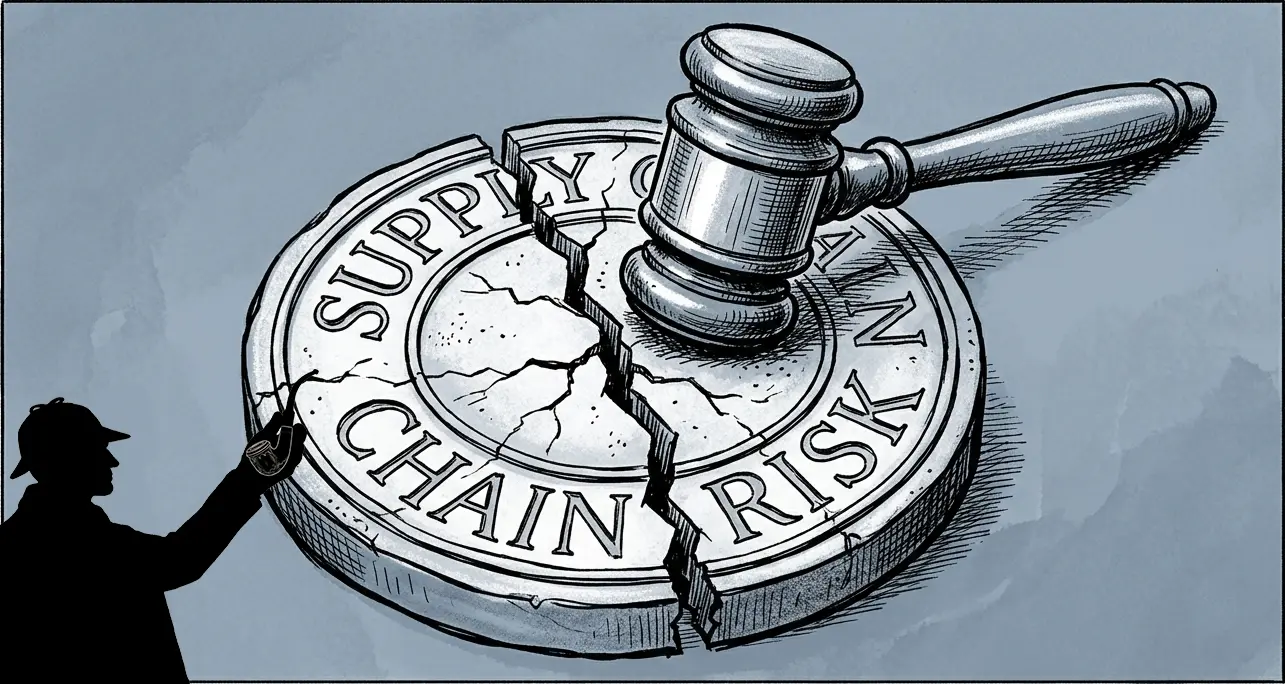
In March, the Pentagon labeled the AI company Anthropic a national security “supply chain risk” — a designation built for foreign adversaries, applied for the first time to an American firm the government had spent the prior year trying to hire. On August 27, a federal judge said what the label was actually for.
U.S. District Judge Rita Lin’s 59-page ruling doesn’t equivocate. The Department of Defense, she found, retaliated against Anthropic for constitutionally protected speech — its public refusal to let its Claude models be used for domestic mass surveillance or fully autonomous lethal weapons — and did so specifically to make an example of the company’s “arrogance” in pushing back. The government’s own conduct undercut its stated rationale: officials continued pursuing a working relationship with Anthropic even after branding it a saboteur, and the president himself said in April that talks with the company were still going well. None of that, Lin wrote, is consistent with a genuine fear that Anthropic would poison its own software to harm national security.
The channel that got made costly
What the Pentagon actually punished was a form of institutional whistleblowing: a vendor telling the government, on the record, where it would and wouldn’t let its technology be used. That kind of public refusal only works as a check on power if a company can afford to make it. Branding a critic a “supply chain risk” — the same label used for firms suspected of secretly working against American interests — doesn’t have to succeed in court to do its job. It only has to make every other vendor in the room calculate the cost of speaking up the way Anthropic just did.
What the ruling settles, and what it doesn’t
Lin’s order permanently blocks the specific designation and the directive ordering federal agencies to drop Anthropic. A separate, narrower dispute over Pentagon contracting rules remains pending before the D.C. Circuit, and the Justice Department has appealed comparable rulings in this fight before — so the underlying question of how far a government can go in punishing a contractor for its public positions isn’t fully closed, even with this ruling on the books.
What is settled, on this record, is the mechanism — the third time in eight days this project has documented the same actor making an oversight or dissent channel expensive rather than disproving what it found. A company said it wouldn’t build something. The government tried to make that refusal cost the company its business. A judge wrote fifty-nine pages establishing, in detail, that this is what happened. The next vendor watching won’t need the fifty-nine pages to get the message.
Origin case: TNG Essay 6 — The Evidence They Won’t Answer
Copyright 2026 — Steve Sagnotti
Sources: Judge Rita Lin’s Aug. 27, 2026 ruling (N.D. Cal.); The New York Times, “Trump Administration’s Blacklisting of Anthropic Was Illegal, Judge Rules,” Aug. 27, 2026; The Guardian and PBS NewsHour, Aug. 28, 2026.
Leave a Reply