Notes from the Field — August 25, 2026
In 1989, England sold off its water. The terms of that sale — how much investors could take out, how much had to go back in — were set once, in a negotiation the public never sat in on, and they have not meaningfully changed since.
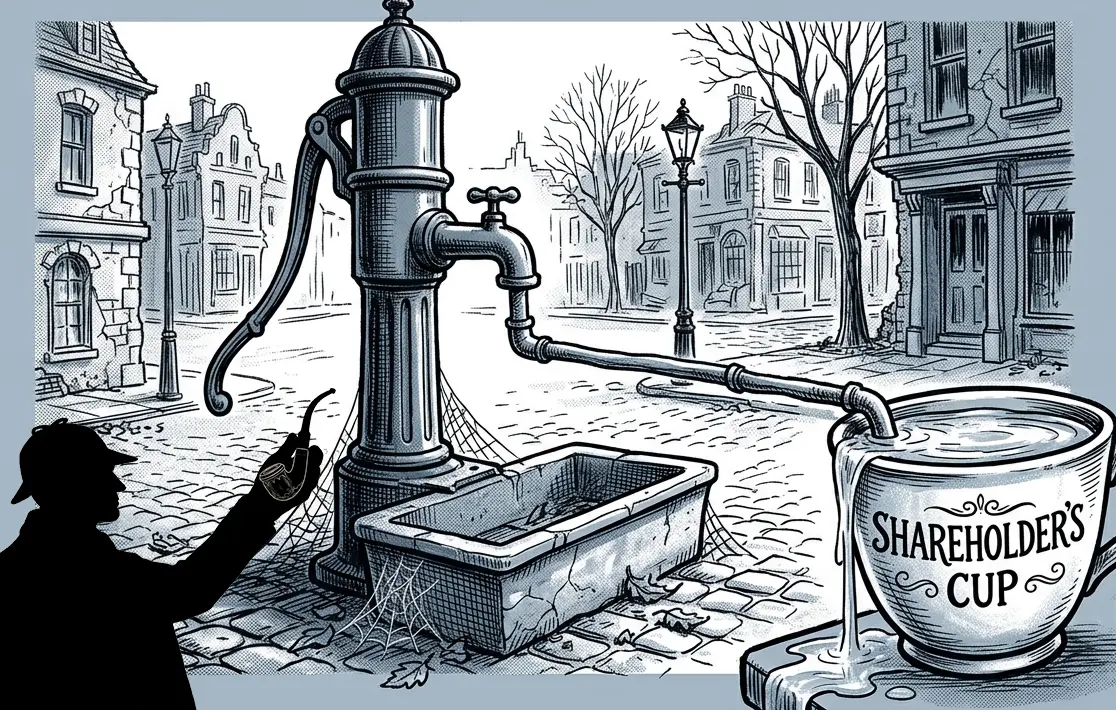
Thirty years of data now make the shape of the deal legible. Between 1991 and 2019, the shareholders of England’s water companies collected roughly £57 billion in dividends — an average of more than £2 billion a year. Independent analyses of the sector’s own regulatory filings put that figure at nearly half of everything the companies spent on maintaining and upgrading the pipes and treatment plants people actually depend on. The money went out even as the companies borrowed heavily and the infrastructure that was supposed to justify the deal kept failing: chronic leaks, and sewage discharged onto beaches and into rivers, some of it illegally.
Most of those shareholders aren’t in England at all. The largest parent companies are foreign-owned, so a substantial share of the return on a British household necessity leaves the country entirely.
The comparison next door
Scotland took a different path in 1989 and kept its water system in public hands. It now invests more per household in infrastructure than England’s private companies do, while charging less — and paying no dividends at all. The contrast doesn’t prove privatization itself was the error; it shows that the specific terms England fixed in 1989 could have been fixed differently, and weren’t required to move since.
That’s the part of this story that outlasts any single company’s balance sheet. Regulators have occasionally tightened dividend rules at the margins. Thames Water has come close enough to insolvency to ask for a government backstop. None of that has touched the underlying arrangement: a rate structure written once, in a room the public didn’t control, that nobody with the power to revisit it has ever been required to.
What the frame leaves out
Coverage of any single company’s crisis — a fine here, a near-collapse there — treats each as its own story. The frame that produces is one of scattered corporate mismanagement, correctable case by case. What it leaves out is the sequence: the terms were set at the moment of maximum leverage for the people setting them, and every subsequent year of extraction has simply been that original choice compounding.
Every household water bill still carries it forward. The pipes still leak. The dividends still clear. Nobody who set the original terms has ever had to explain them to the people paying for them since.
Origin case: TNG Essay 11 — Out of Frame
Copyright 2026 — Steve Sagnotti
Sources: Devi Sridhar, “From Scotland, I look at England’s water privatisation disaster,” The Guardian, Aug. 25, 2026; independent dividend and capital-expenditure analyses of water-sector regulatory filings, 1991–2019.
Leave a Reply