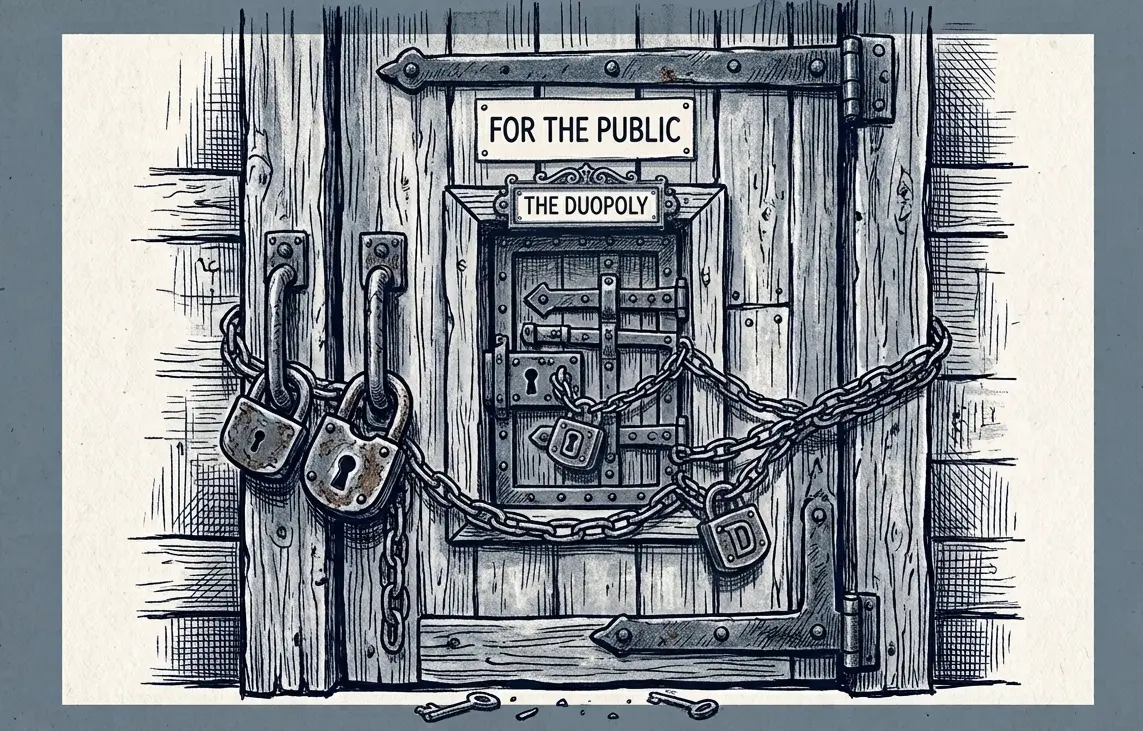
Block 4, Article 2 — How 45 Percent of Americans Got Locked Out
© 2026 Steve Sagnotti.
Forty-five percent of American adults identify with neither major party. They are the largest single bloc in the electorate — significantly larger than either party. They have no structural home in the system they fund.
The debate commission the parties built for themselves
From 1976 through 1984, presidential debates were organized by the League of Women Voters — an independent civic organization with no party affiliation. In 1988, the two parties informed the League that they required control of debate format, participant selection, questioner approval, and staging. The League withdrew. Its withdrawal statement called the parties’ demands an attempt to “perpetrate a fraud on the American voter.”
The Commission on Presidential Debates was incorporated that same year — a nonprofit founded by the DNC and RNC, governed by former party officials and campaign operatives, designed to manage every presidential debate thereafter.
The 15% polling threshold for third-party participation was implemented in January 2000 — the cycle after Ross Perot’s 1992 debate appearances demonstrated exactly what a third-party candidate could do with a national stage. Perot polled at roughly 8 percent before the debates. He participated. He finished at 19 percent of the popular vote — the strongest third-party showing since Theodore Roosevelt in 1912.
The threshold was set to make sure that sequence could never repeat.
To qualify for a presidential debate, a candidate must poll at 15 percent in surveys that frequently don’t include third-party candidates by name — because those candidates haven’t been in the debates that would produce the polling. The exclusion is circular by design.
The commission was framed as a civic institution replacing a partisan one. The League of Women Voters understood what was being asked of them in 1988 and said so plainly. The arrangement has operated without significant public challenge for thirty-seven years.
The private club with a public bill
Sixteen states run fully closed primaries — registered Democrats and Republicans only, no exceptions. Eleven more are semi-closed, with independents admitted only at the party’s discretion. Nationwide, 28 percent of all eligible voters live in fully closed primary states. Forty-five percent of them identify as independent. They fund the selection. They are barred from it.
Democrats hold 27 percent of the electorate. Republicans hold 28. Together they represent just over half the country. The plurality they exclude from the primary that decides most general elections is larger than either of them.
The parties’ legal defense for this arrangement is consistent and successful: the Democratic National Committee and the Republican National Committee are private organizations. The Supreme Court has confirmed it repeatedly, at the parties’ own request, in cases where they sought protection from state regulation. Parties have the right to set their own membership rules, control their own candidate selection, and exclude who they choose. These are First Amendment associational rights. The courts have been clear.
The parties are correct. They are private organizations. The question nobody followed up with in those courtrooms: then why is the public paying for it?
Primary elections are administered by public employees, on public property, with public equipment, funded by taxpayers. The practice was cemented by a 1972 Supreme Court ruling — Bullock v. Carter — that parties could not charge candidates excessive filing fees to appear on the primary ballot. The ruling was about candidates, not parties. The parties absorbed it as a license to have the public fund their internal selection process permanently. The parties closed the primaries, kept the public funding, and went back to court the next time someone objected to call themselves private organizations again.
Between 2000 and 2013, New Jersey’s independent voters paid approximately $100 million to fund primaries in which they could not vote. One state. Thirteen years. The same arithmetic runs in Florida, Pennsylvania, New York, Connecticut, and Maryland — every closed primary state where 45 percent of the taxpayers fund a process designed to exclude them.
American contract law rests on a principle so foundational it is rarely stated: a contract binds the parties who agreed to it. It cannot bind people who were never at the table. The ballot access statutes, the closed primary systems, the debate thresholds — these were written into public law by legislatures the two private organizations control, and are now enforced against the 45 percent of Americans who belong to neither organization and agreed to none of its terms. The contract was written by two parties, in their favor, without the consent of the people it most constrains. In any other domain of American law, the doctrine that would void it exists. The courthouse that would apply it is occupied by judges selected through the pipeline those same private organizations funded. The doctrine is there. The court is not.
The closed primary ensures the committee assignments are filled by members who survived a donor-funded primary, not a constituent-responsive one. The 45 percent locked out of that primary are the voters most likely to challenge the royalty rates, the lease mandates, and the extraction subsidies those committees protect. The door that holds them out is not incidental to the commons extraction this series documents. It is load-bearing.
Changing the terms of that arrangement requires legislation from the legislators those terms produced. Block 5 shows what the 45 percent can do instead — and what the locked door does to those attempts.
This is not democracy
A democracy is a system in which the people govern themselves. What the current arrangement offers is a choice between two candidates selected by private organizations the voter may not belong to, in an election the voter funded, administered by rules the organizations wrote, on a stage the organizations control.
That is not self-governance. It is a managed menu.
The founders warned it would come to this. It took two years to start and two centuries to complete. Washington called these organizations potent engines by which cunning and unprincipled men would usurp the reins of government. He was not describing a hypothetical. He was describing the system that was already forming around him. The system that is now complete calls itself democracy and uses the public’s money to administer the machinery of its own perpetuation.
The realignment that pressure produces but the door prevents
Every previous American party realignment followed the same pattern. A crisis arrived that the existing parties could not contain. Enough voters concluded the existing options were inadequate. An alternative organized, gained ballot access, and either replaced one of the existing parties or forced structural reorganization.
The conditions for realignment are present. Sixty-two percent of Americans told Gallup in October 2025 that a major third party is needed. The 45 percent who identify as independent are the largest single bloc in the electorate — larger than either party. The 2008 financial collapse, the COVID pandemic response, and the early dislocations of AI displacement have each generated the kind of mass dissatisfaction that historically precedes structural change.
The realignment has not come. The door built in 1888 and reinforced in 1987 is holding it out.
A third-party candidate who cleared every ballot access threshold in all fifty states would still face a debate stage they cannot enter without polling 15 percent in surveys that don’t include their name. They would run in a presidential election where winner-take-all rules in forty-eight states ensure that votes received in a state they don’t win count toward nothing. They would compete against two parties with institutional infrastructure — donor networks, state party organizations, campaign finance pipelines — built over a century and a half.
Where reform has succeeded — open primaries in Washington, California, Alaska, and now New Mexico — the evidence is clear. California’s approval of state government rose 20 points after top-two primaries were implemented. Alaska’s Lisa Murkowski, the only Republican senator who voted to impeach Donald Trump and won reelection, credits the open primary with her survival. As reform pressure builds, the parties are responding: in 2024, ballot measures for nonpartisan primaries were defeated in multiple states, and party-controlled legislatures are currently working to close primaries further in approximately a dozen states. The door was not built against fringe candidates. It was built against the plurality. And the parties are reinforcing it.
The next article shows what the members who made it through that door are required to do once they arrive.
Do you know how your representative was selected before you voted?
| Whether your state’s primary is open, closed, or semi-closed — and whether independents can participate | https://ballotpedia.org/Primary_election_types_by_state |
| How the Commission on Presidential Debates sets its participation threshold — and who funds it | https://debates.org/about-cpd/ |
Sources
1. League of Women Voters withdrawal statement, October 3, 1988. LWV historical record. https://www.lwv.org/league-women-voters-education-fund/league-women-voters-and-presidential-debates
2. Commission on Presidential Debates — founding 1987. https://debates.org/about-cpd/ — CPD 15% threshold established 2000: https://debates.org/about-cpd/overview/
3. Perot 1992 — ~8% pre-debate, 18.9% final. FEC 1992 results. https://www.fec.gov/introduction-campaign-finance/election-and-voting-information/
4. Theodore Roosevelt 1912 — 27.4%. U.S. National Archives. https://www.archives.gov/electoral-college/1912
5. 16 closed / 11 semi-closed primary states. Movement Advancement Project. https://mapresearch.org/democracy-map/partisanship-of-state-primary-election-systems/
6. Gallup 45% / 27% / 28% breakdown. https://news.gallup.com/poll/700499/new-high-identify-political-independents.aspx
7. Gallup 62% want third party, October 2025. https://news.gallup.com/poll/696521/americans-need-third-party-offer-soft-support.aspx
8. Party autonomy doctrine. Tashjian v. Republican Party of Connecticut, 479 U.S. 208 (1986). https://supreme.justia.com/cases/federal/us/479/208/ — California Democratic Party v. Jones, 530 U.S. 567 (2000). https://supreme.justia.com/cases/federal/us/530/567/
9. Democratic Party v. Wisconsin ex rel. La Follette, 450 U.S. 107 (1981). https://supreme.justia.com/cases/federal/us/450/107/
10. Bullock v. Carter, 405 U.S. 134 (1972). https://supreme.justia.com/cases/federal/us/405/134/
11. New Jersey $100 million 2000–2013. Independent Voter News, 2014. https://ivn.us/posts/2014/07/23/ivn-explained-cost-holding-partisan-primaries/
12. Washington top-two / California Prop 14 / 20-point approval increase. Unite America. https://www.uniteamerica.org/primary-problem
13. Alaska top-four / Murkowski quote. NPR, May 30, 2026. https://www.npr.org/2026/05/30/nx-s1-5398836/single-party-primary-elections-reshaping-congress
14. New Mexico Senate Bill 16, April 2025. MultiState Elections. https://www.multistate.us/elections/primary-types-101
Block 4, Article 2. © 2026 Steve Sagnotti.
Leave a Reply