Notes from the Field — Dispatch, June 12, 2026
Three companies made news the same week for opposite reasons, and the reasons were the same reason.
I. THE PRODUCT GROWS. THE PAYROLL DOESN’T.
Salesforce cut 86 jobs in California in early June — its third round of layoffs in roughly nine months, hitting sales, administrative, and technology and product functions. The cuts landed the same week the company said its AI product, Agentforce, had reached $1.2 billion in annual recurring revenue, up 205 percent from a year earlier.
CEO Marc Benioff explained the math himself, before the layoffs were even announced. On the company’s May 27 earnings call, Benioff said Salesforce’s engineering headcount had remained near 15,000 people for about two years, and he attributed the stagnant hiring to AI: “The reason it’s been mostly flat is because we have been using AI to create more efficiency for our engineers.” Flat is the polite word. The company is growing revenue 205 percent on the product built to need fewer of the people who used to build it.
Where did the money go instead? In February 2026, Salesforce’s board authorized $50 billion in share repurchases — a $25 billion accelerated buyback that drove the company’s diluted share count down 10 percent year over year, funded in part by new long-term debt. Salesforce returned 87 percent of its free cash flow to shareholders through buybacks in fiscal 2026, up from 63 percent the year before. The AI product grows the revenue. The buyback grows the value per remaining share. The people who lost their jobs building the product that made both possible are not shareholders of record.
II. THE JOBS THAT REPLACE THEM AREN’T THE SAME JOBS
Meta laid off 8,000 employees — roughly 10 percent of its workforce — in May. The following month, it announced something that sounds, on its face, like the opposite of a layoff: a $115 million commitment to train workers for data center construction jobs, with free tuition, housing, and a guaranteed job on completion.
The timing is the argument. Meta laid off 8,000 employees in May 2026, part of a broader reallocation toward AI spending. Cutting thousands of knowledge workers one month and launching a massive blue-collar hiring initiative the next tells you everything about where Meta sees its bottleneck. The knowledge workers were cut because AI now does more of what they did. The trade workers are being trained because AI’s physical infrastructure — the data centers — still needs people to wire, weld, and pour concrete.
But read the fine print on what that second job actually is. Once a data center opens, the permanent workforce it requires is typically far smaller than the surge of construction workers needed to build it. The academy trains people for the construction phase — the temporary phase. It is not training anyone for a permanent seat inside the thing being built. The institutional reassurance is the same one Dispatch Nine documented: workers displaced by AI will simply retrain into the new economy. What the retraining actually offers, in this case, is a five-week credential into a job that ends when the building is finished.
III. THE EXCEPTION THAT SHOWS THE SCALE
Then there’s SpaceX. Its IPO this month is, by every measure, a genuine worker windfall. More than 4,400 current and former SpaceX employees are expected to become millionaires in the IPO, including welders and machinists who received equity alongside engineers. Juan Hernandez, a former SpaceX welder who was offered $10,000 in stock in 2015, now holds roughly 6,500 shares worth close to $880,000 at the IPO price. It is, genuinely, a story about hands-on labor being rewarded like engineering labor. That part is real, and it matters.
But the same windfall shows the shape of the hierarchy it sits inside. SpaceX director Antonio Gracias owns shares that could ultimately be worth some $65 billion. Another director, Luke Nosek, holds a stake estimated at roughly $5 billion. COO Gwynne Shotwell and CFO Bret Johnsen each hold stakes that could be worth more than $1 billion. A welder’s $880,000 is real money and a real story. It is also roughly a ten-thousandth of one director’s stake. The distance between those two numbers is the hierarchy, measured in a single company, in a single week.
And a labor economist flagged what the equity model actually does to risk. Jason Schloetzer, an accounting professor at Georgetown’s McDonough School of Business, said SpaceX illustrates how more financial risk is being shifted onto workers: “The traditional industrial model paid skilled labor through pensions, profit-sharing, and union-negotiated packages where employers carried much of the uncertainty. Equity changes that risk profile.” The welder held that stock through a decade in which it could have gone to zero. It didn’t. This time.
IV. ONE MECHANISM, THREE FACES
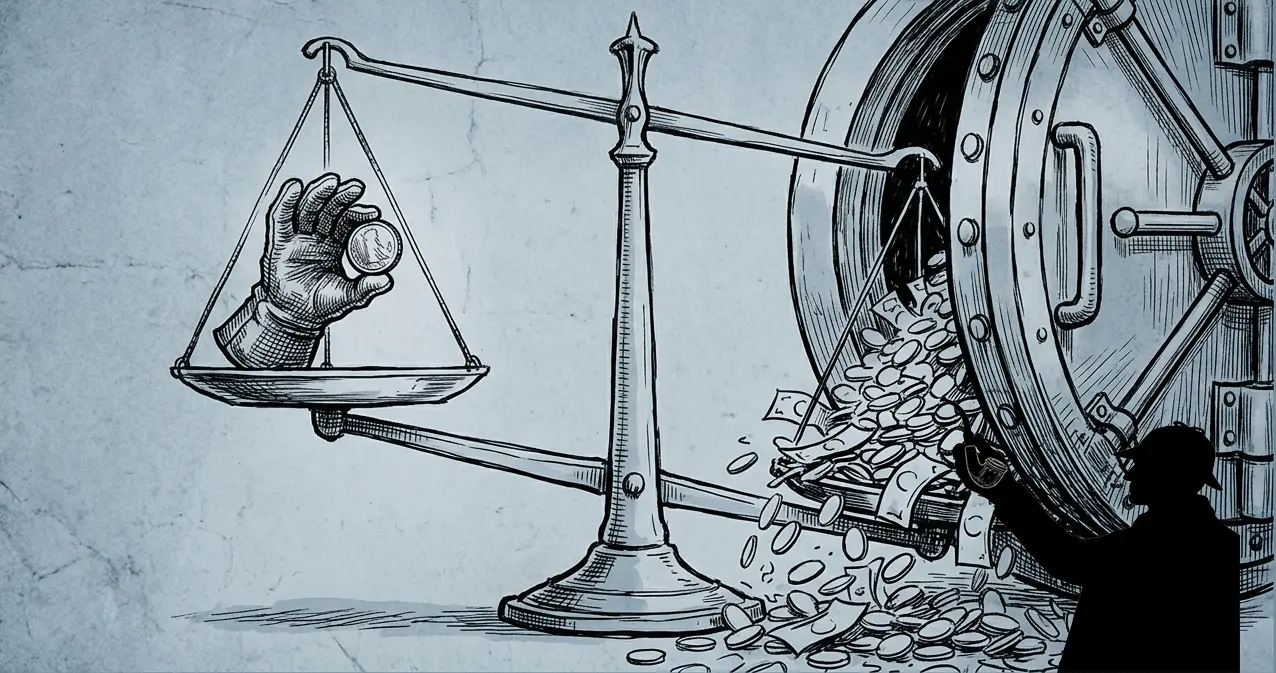
Power does not require conspiracy. It only requires that the people in the room share a common interest in the outcome. Salesforce’s board didn’t call Meta’s board to coordinate a strategy. Meta didn’t call SpaceX. Three separate companies, in three separate industries, arrived at the same allocation in the same month: AI revenue flows to the product and to the owners of the company; AI-driven cost savings flow to buybacks and infrastructure; and workers get whichever of three outcomes their job happens to sit closest to — displacement, temporary retraining, or, in the rarest case, a fraction of the equity upside if they were hired early enough and held on long enough.
The tool changed with the century. The problem being solved did not.
The welder’s $880,000 will make headlines this month. The 86 people cut from Salesforce and the thousands cut from Meta will not make headlines next month, because by then they’ll just be looking for work, and that isn’t news. It will just be the way things are.
—
The Converging Frames — Essay 12
The False Frame — Essay 13
Copyright 2026 — Steve Sagnotti
Sources:
Quartz, “Salesforce layoffs hit Agentforce, MuleSoft, Marketing Cloud,” June 2026.
Inc., “Last Month, Salesforce Announced It Hit $1.2 Billion in AI Revenue—Now It’s Laying Off Staff,” June 2026.
Salesforce Form 10-K, FY2026, SEC filing.
Fortune, “Meta is tackling the blue-collar worker shortage by investing $115 million in data center trade jobs,” June 10, 2026.
CryptoBriefing, “Meta launches $115M America’s Workforce Academy,” June 2026.
Fortune, “Meet the SpaceX employees who are set to become multimillionaires thanks to its IPO,” June 11, 2026.
Fox Business, “How the historic SpaceX IPO is turning everyday workers into overnight millionaires,” June 2026.
Leave a Reply