Notes from the Field — Dispatch, June 3, 2026
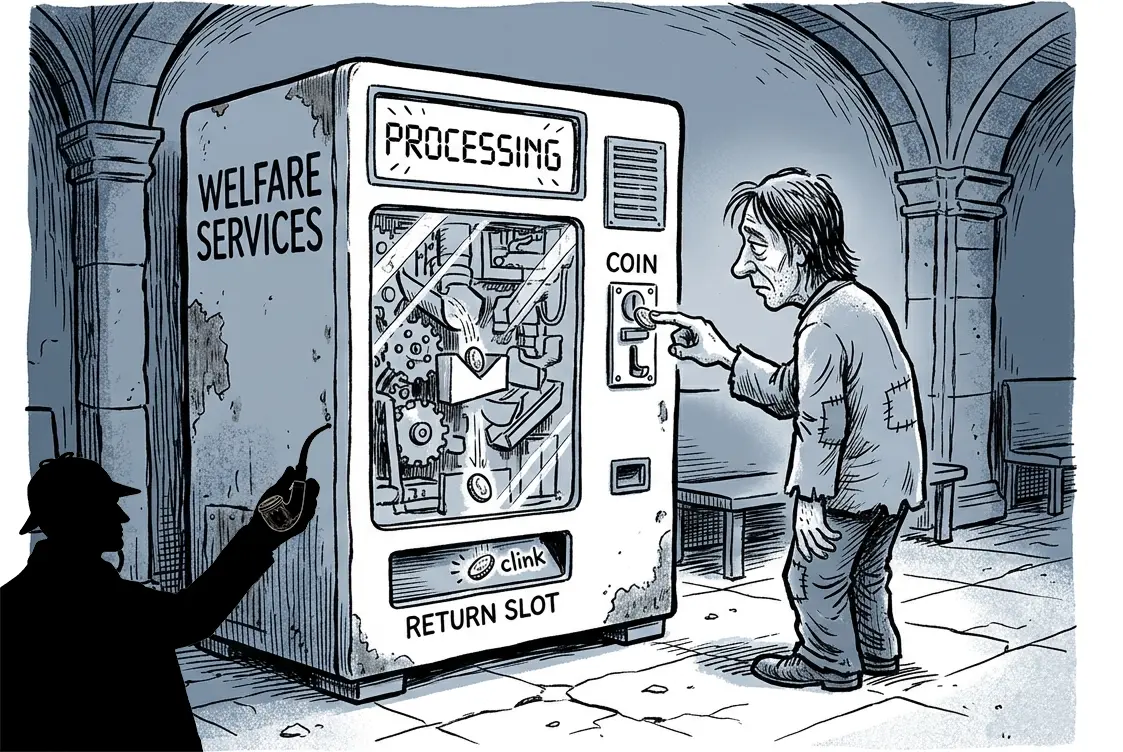
The Australian government’s admission came at Senate estimates on June 3, in the flat language of bureaucratic disclosure: the Department of Employment and Workplace Relations said that approximately 300,000 Centrelink payments had been illegally cancelled between 2020 and 2024, due to a glitch in the automated mutual obligations system. The system had cancelled payments before the legally required 28-day window had elapsed, cutting off benefits for people on JobSeeker, Youth Allowance, Disability Support, and Parenting Payment — the populations at the floor of the welfare system — without the legal notice required before cancellation.
This was not the first admission. The government had previously conceded 9,510 unlawful cancellations. Independent analysis by Economic Justice Australia identified the actual number as approximately 310,000. The government quietly paused new payment cancellations in July 2024. It did not announce the pause. It did not publicly acknowledge the gap between 9,510 and 310,000 until Senate estimates compelled it.
Australians of a certain age will read the phrase “automated Centrelink system” and feel a specific kind of recognition. The Robodebt scheme ran from 2016 to 2019 under the Liberal-National Coalition government, using automated income-averaging calculations to raise debt notices against welfare recipients — more than half a million inaccurate notices, pursuing people for money they did not owe, with the burden of proof reversed: the recipient had to prove the debt was wrong, not the government. The Federal Court ruled Robodebt unlawful in 2019. The subsequent royal commission produced 57 recommendations. The settlement cost over $1.8 billion. The commission’s final report described it as a “shameful chapter in the administration of the commonwealth.” Its 57 recommendations were made so the scheme’s mistakes would never be repeated.
The mutual obligations glitch is not Robodebt. The mechanism is different — a timing error in cancellation, not a fraudulent debt-calculation method. But the structural pattern is identical: an automated government system making administrative decisions about individual welfare entitlements at scale, without individual review, producing illegal outcomes that only became fully visible when external pressure forced disclosure. The government’s initial figure was 9,510. Economic Justice Australia’s independent analysis found 310,000. The ratio between what the government admitted and what actually happened is approximately 33 to 1.
There is an additional detail. The government commissioned a Deloitte review of the automated system. Large portions of that review, it emerged, were themselves generated using artificial intelligence. A government review of an automated system that illegally cancelled welfare payments was partially written by another automated system. Economic Justice Australia’s Kate Allingham said the organisation had “not seen anything that assures us” that reforms were actually happening. Meanwhile, between January and March 2026 alone — after the pause on cancellations was announced — nearly 300,000 suspension notices were issued. More than 3,300 per day.
The structural argument is not about the Albanese government’s intent or competence. It is about what automated administrative systems do at scale when human review is removed from decisions that affect individual legal entitlements. The Centrelink system’s function is to determine whether individual recipients have met their mutual obligations. That determination — whether a specific person in a specific circumstance did or did not comply with a requirement — is an individual judgment about an individual situation. Automating it at scale means replacing those individual judgments with a rule set applied uniformly. When the rule set has a timing error, 300,000 people lose payments they were legally entitled to keep, before anyone notices, and the government’s first disclosure puts the number at 9,510.
The Robodebt royal commission made 57 recommendations to prevent this from happening again. The reforms, critics say, have largely recycled old ideas. The Deloitte report reviewing the system was partially written by AI. Cancellations were paused; suspensions were not.
The silence won’t feel like silence. It will just feel like the way things are.
Essay 12 — The Converging Frames
(See also: Essay 13 — The False Frame)
Copyright 2026 — Steve Sagnotti
Sources:
The Guardian, “Hundreds of Thousands of Centrelink Payments Cancelled Illegally, Albanese Government Admits,” June 3, 2026.
YourLifeChoices, “The Government Just Admitted to 300,000 Illegal Centrelink Cancellations: What Happens Now?” June 2026.
Victoria Legal Aid, “Learning from the Failures of Robodebt — Building a Fairer, Client-Centred Social Security System” (case history), 2026.
Wikipedia, “Robodebt Scheme” (scheme history and outcomes), retrieved June 2026.
Colitco / Economic Justice Australia, “Centrelink Debt Scandal: Automated Failures and Pattern of Review,” 2025–2026.
Leave a Reply