Notes from the Field — October 9, 2026
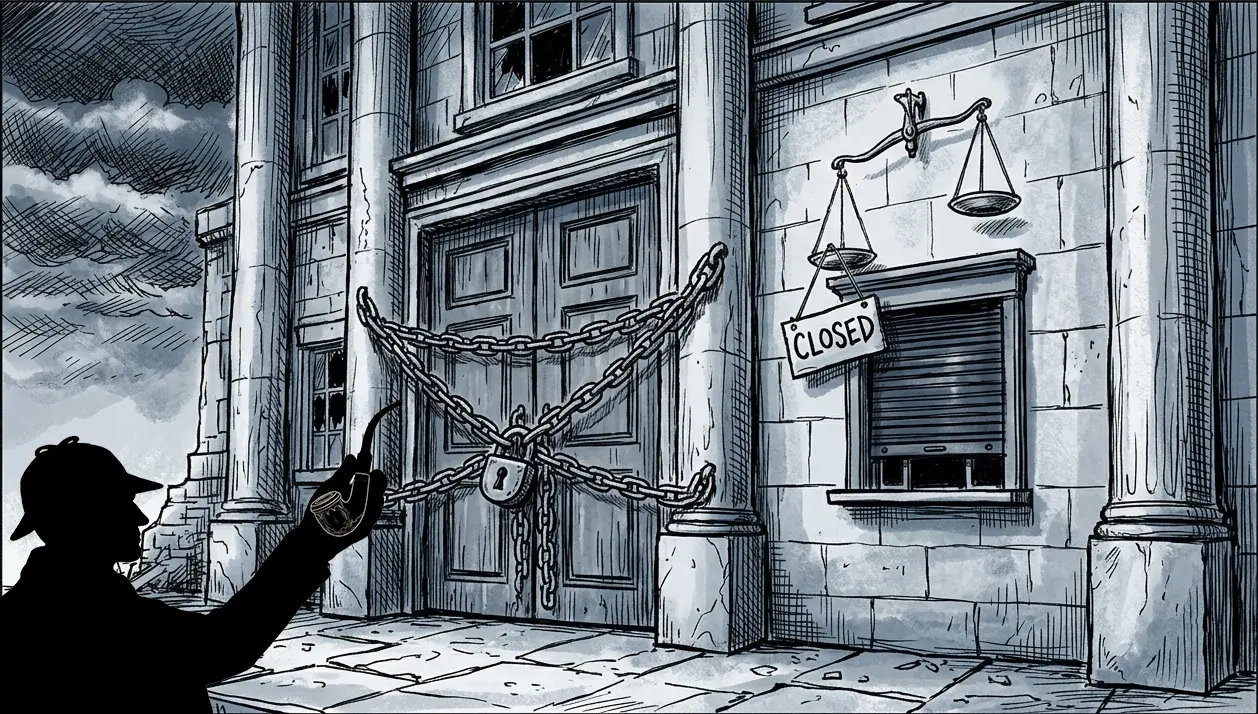
A tribunal can keep its judges, its mandate and its building, and still stop working. It stops when the banks close its accounts, the insurers drop its coverage and the software vendors cut it off. No one has to abolish it.
That is The Broken Gauge’s argument, documented in real time. Before accepting that something was never examined, check whether the channel that would have examined it was disabled first, and how recently.
What happened on Friday
On October 9, Secretary of State Marco Rubio announced sanctions on the International Criminal Court itself. Earlier American sanctions had named individual prosecutors and judges. These name the institution. Reports say they block any assets the court holds in American jurisdictions and give American companies and individuals six months to wind down their dealings with it. The practical meaning, as Reuters described it, is a court that could be cut off from American banks, insurers and software providers.
Rubio’s own words set the aim: “We will ban transactions with this rogue court, cutting off their resources and crippling its ability to operate against us.” Elsewhere in his statement: “Either the ICC will end its threats, or we will end the ICC.” He told allies who belong to the court and “rely on American service members for their defense” to rein it in, or the United States would keep dismantling it “brick by brick.”
The court said “history will judge this moment.” Its deputy prosecutor, Nazhat Shameem Khan, told Reuters the sanctions would not halt its investigations.
The grievance and the gap
Rubio’s stated objection is the court’s past investigation of American soldiers in Afghanistan. According to Reuters, the court has since closed it. His statement says the president “will never allow the International Criminal Court to prosecute Americans.” Stephen Rapp, the State Department’s war-crimes ambassador under President Obama, told PBS that no case against the United States is pending, and that the case involving Israel is still stuck on a jurisdictional question. Rapp is describing the record as he sees it, and he is one voice. What can be said from the reporting is that the open grievance is a closed investigation.
If the case the sanctions would stop is not on the docket, then what they remove is the court’s ability to open one. What this looks like is a gauge disabled before the reading. That is the dispatch’s own inference. Rubio’s statement does not say it, and it names no future case.
The same day
Hours before the announcement, the Nobel Committee gave its Peace Prize to Navi Pillay, a former ICC judge, saying it chose her because “institutions of international law are under political attack.” Rubio’s statement did not mention the award. Reports say the sanctions had been in preparation before it. Pillay learned of the prize at the Nuremberg Academy, which she helped found as its first president. Rapp noted on PBS that the first judgments against Nazi leaders were issued in that city’s courtroom eighty years ago this month. An American, Justice Robert Jackson, was the chief U.S. prosecutor there.
The pattern is the same. The speed is not. Nuremberg took a world war to bring about. Taking away what a court needs to function took one announcement.
The sequence
The court opened an investigation into American conduct in Afghanistan, and closed it. Its prosecutors and judges were sanctioned. Then the court. Then the banks, insurers and software companies it depends on were told to wind down. A Republican bill to sanction the court had been blocked in the Senate earlier, according to news reports. This time no vote was needed. An executive order was enough.
The court keeps its mandate. What it cannot do without is commercial plumbing that sits inside the jurisdiction of a government that has said, in its own words, that it wants the court’s ability to operate crippled. The six-month wind-down, and a possible European blocking statute, are the two things that still stand between the court and that outcome.
The Floor Fell Out — Broken Frames (The Broken Gauge)
Origin case: TNG Essay 6 — The Evidence They Won’t Answer
Copyright 2026 — Steve Sagnotti
Sources: Reuters reporting on the October 9 sanctions, via Northeast Times; Agence France-Presse via The Jakarta Post, “US announces sanctions on ICC, hours after Nobel award to former judge,” October 10, 2026; Nick Schifrin interview with Stephen Rapp, PBS NewsHour, “Navi Pillay wins Nobel Peace Prize after long career of investigating war crimes,” October 9, 2026; Scripps/TNND, “Trump administration takes aim at ICC with sweeping sanctions,” October 9, 2026; Associated Press via Spectrum News, October 9, 2026.
Leave a Reply