Notes from the Field — October 9, 2026
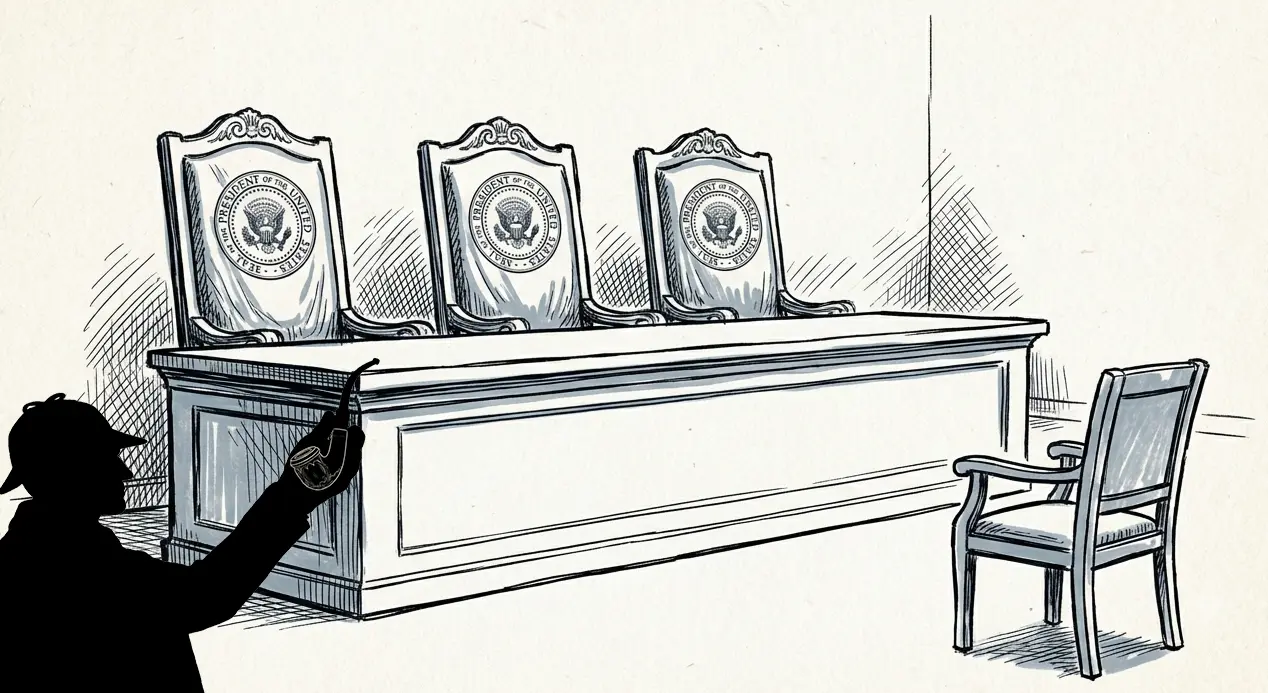
Federal law lets a president remove a Federal Reserve governor only “for cause.” It does not say who decides whether cause exists. On October 9, President Trump answered for himself. He created a “committee of inquiry” to examine Governor Lisa Cook, named its three members, set a closed-door hearing at the White House for November 5, and wrote into his memo that Cook “shall” attend.
When a room rules on its own standing, the first question is whether the room is also the beneficiary. Here the room is the White House, the standing at issue is the president’s power to fire, and the person who wants the answer built the room.
Who sits in it
The accusation is not new. Trump first tried to fire Cook in August 2025, alleging she listed two different homes as her “primary” residence on mortgage applications in 2021, before she joined the Fed. Cook denies wrongdoing. Her lawyers call it an “inadvertent error.” She has not been charged with a crime.
The Supreme Court ruled in June that Cook could keep her job for now. A footnote said nothing prevented Trump from trying again, so long as she got proper notice and a chance to respond. The committee is his attempt to supply both.
Its three members are Kevin Hassett, the president’s top economic adviser, whom the Associated Press describes as a frequent echo of Trump’s criticism of the Fed; Keith Sonderling; and Andrea Lucas, who chairs the Equal Employment Opportunity Commission. All three are Trump appointees. The memo says the committee will recommend whether there is cause to fire her. The president wrote the memo.
On October 14, Cook’s lawyers answered in a letter to a White House counsel. They called the panel “demonstrably biased” and noted that Hassett has already said the president has “cause.” They said Cook will be at monetary policy meetings in Europe on November 5, and that the earliest she could appear is after the Fed’s December 8–9 meeting. They did not rule out appearing. A hearing “with demonstrably biased members, unspecified additional allegations, and an unclear schedule for the disclosure of any additional evidence,” the letter said, “is not a process that respects the appearance or history of independence.”
What the headline question leaves out
Coverage asked whether Cook will show up and whether the hearing will be fair. Those are questions about the room. The one that goes unasked is why the person deciding whether cause exists should be anyone the president picked at all.
The “for cause” clause is what makes a governor’s vote the governor’s own. Without it, a seat on the board is held at the pleasure of the person who dislikes the votes. AP reports that Trump has repeatedly demanded lower interest rates, and that the Fed raised rates on September 16 in a unanimous vote that included Cook’s. What this looks like is a process designed so that the answer to “is there cause?” arrives from inside the same circle as the question. Whether rates have anything to do with it is not shown. The memo grounds the inquiry in the mortgage allegations.
Power does not require conspiracy. It only requires that the people in the room share a common interest in the outcome. None of the three members has to act in bad faith for this to work. A panel chosen by the person who wants a finding already knows what kind of finding is welcome.
Not the first commission
Scott Alvarez, formerly the Fed’s chief counsel, told AP that President William Howard Taft set up a similar commission in 1912 to remove two officials from an independent agency. Alvarez said the new committee goes beyond the process the Supreme Court described, and that the allegations against Cook do not appear to meet the “for cause” standard the Court set out. Jaret Seiberg of TD Cowen’s Washington research group wrote to clients that the firm does not see why the White House would start the process “if it were not trying to create a way to justify removing Cook.” Those are their readings, not findings.
AP notes that no president in the Fed’s 113-year history has sought to remove a governor. In the 1912 case and this one, the instrument is the same: a commission and a hearing. What it looks like, as the dispatch’s own reading, is a record that lets a removal read as the end of a process instead of the start of one.
The sequence
He accused her. He asked the Court to remove her, and the Court let her stay and described the process he would need. He built the process. He chose the panel. He set the date. The panel will tell him whether he has cause, and he will decide what to do with what it says.
As of October 14, every step between the accusation and the answer belongs to someone the accuser appointed. The only independent check left is a court that would hear Cook’s case after she is gone.
Essay 3 — The People in the Room (The Self-Dealing Room)
Copyright 2026 — Steve Sagnotti
Sources: Christopher Rugaber, Associated Press via PBS NewsHour, “Trump establishes committee to investigate Federal Reserve’s Lisa Cook in latest effort to fire her,” October 9, 2026. Christopher Rugaber, Associated Press via PBS NewsHour, “Lawyers for Federal Reserve’s Lisa Cook say White House hearing set up by Trump is ‘biased,’” October 14, 2026. The Guardian and The New York Times coverage of the October 9 memo.
Leave a Reply