Block 4, Article 3 — Your Representative’s Primary Job Is Not Representation
© 2026 Steve Sagnotti.
There is a building four blocks from the Capitol where members of Congress spend four to six hours a day making phone calls. You paid for the office they left to do it.
The member of Congress you voted for arrived in Washington owing a debt. Not to you.
The party recruited them. The party ran polling in their district. The party sent consultants. The party’s congressional campaign arm spent money on their race — targeted ad buys, voter contact, get-out-the-vote infrastructure. None of it was free. The price was not itemized. It was understood. The first campaign is an investment. The investment books an obligation. The obligation runs to the party.
The party collected when the member arrived.
The pricing structure
Committee seats are not distributed by seniority, expertise, or constituent need. They are sold.
The DCCC and NRCC publish internal dues schedules — documents that have leaked to reporters periodically and been confirmed through member accounts. The assessment varies by committee and by position, calibrated to market value. A seat on a low-profile committee costs less. A seat on Ways and Means, Financial Services, Energy and Commerce, or Natural Resources costs more — because those committees regulate industries with money to spend on access, and the party has priced the seat accordingly. Top leadership pays the most. Speaker, Majority Leader, Whip — assessments reportedly ranging from $800,000 to over $1 million per cycle.
The member pays by making calls.
Four to six hours a day, in party-operated call centers in rented office space across the street from the Capitol. Across the street because using official offices for fundraising would violate federal law. The member is on the public payroll while working a shift for the private organization. The public office sits vacant while the public employee works for the private party.
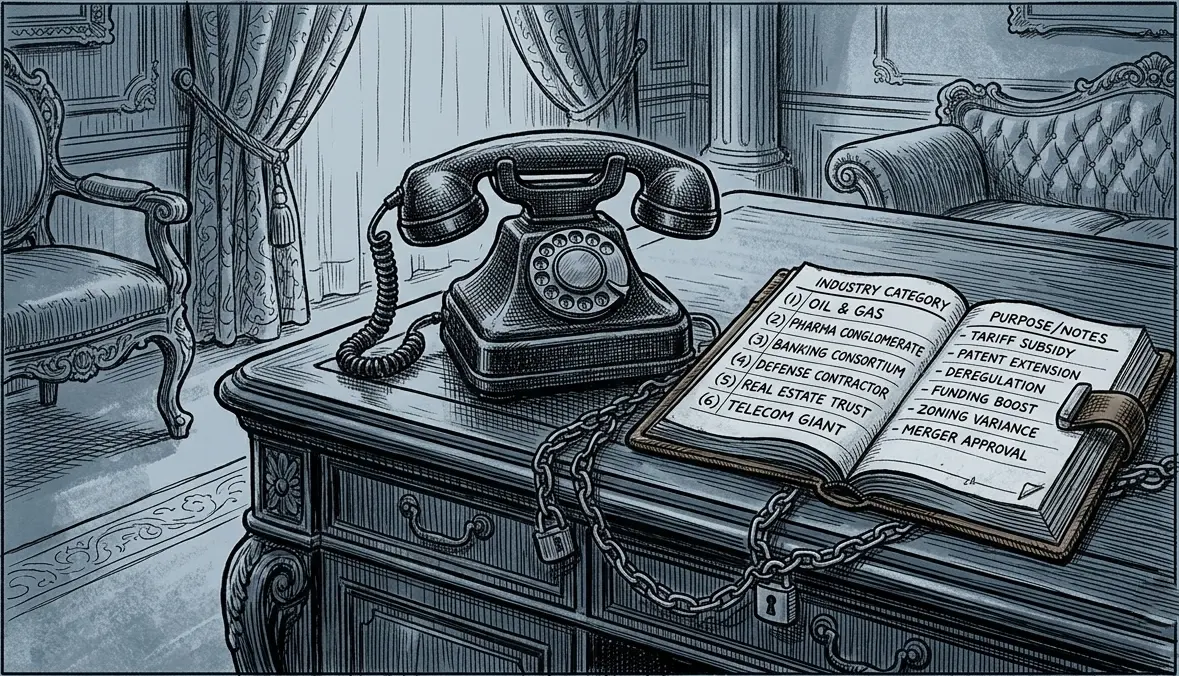
The calls go to donors whose industries intersect with the member’s committee assignment. A member on Energy and Commerce calls energy and pharmaceutical donors. A member on Natural Resources calls oil, gas, mining, and timber donors. Nothing illegal is said. Nothing needs to be. The donor knows which committee the member sits on. The member knows the donor knows. The conversation proceeds.
The money goes to the DCCC or NRCC — not directly to the member’s campaign account. It is credited against the member’s dues. When the dues are met, the seat is secure. When they are not, the committee assignment is at risk. The donor is paying the member’s rent. The rent is set by the regulatory value of the seat. The constituent paid for the public office. That office sits vacant four to six hours a day while the member is across the street dialing for the party.
The member’s call went to staff. The lobbyist’s call went through. The member’s Washington hours were framed as public service. The calls that defined them had to be made from a private phone across the street.
The room where compliance is enforced
The accountability mechanism operates inside the call center.
In the DCCC and NRCC call centers, a whiteboard tracks every member’s progress against their dues obligation — updated in real time, visible to every member who walks in. The member who is behind can see it. The member who is ahead can see it. The peers making their numbers can see the peers who aren’t. No manager is required. No threat needs to be made. The social pressure operates automatically from the information in the room.
The whiteboard makes a specific thing real: not the legislation, not the constituent services, not the committee work — the number. The member is not thinking about the aquifer when a pledge comes in. They are thinking about the number. The sophomore who exceeded their dues last cycle got a better committee assignment. The lesson was not lost on anyone in the room.
The party’s organizational structure multiplies the ceiling. The RNC, DNC, NRCC, DCCC, NRSC, and DSCC are separate legal entities — each with its own FEC filing, its own contribution limits, its own staff. An individual donor who has maxed out to a candidate can give separately to each committee. More entities means more pipes carrying money toward the same destination. The organizational complexity that looks like accountability is the mechanism that defeats it.
The exposure
The Capitol Police jurisdiction ends at the Capitol complex boundary. A sitting member of Congress walking across the street to the call center leaves that jurisdiction the moment they step off federal grounds. The call center is private space — commercially leased, privately staffed, secured by whatever the building’s standard lease includes. No federal officer. No public accountability for who enters. No official record of who the member speaks to or what is promised.
The system that demands the exposure also profits from it. The most predictable, most documented, most off-the-record moment in a federal official’s working week is when they are raising money for the private organization that helped elect them. The call center exists because official offices cannot be used for fundraising under federal law — a rule intended to protect the public from exactly the kind of access-for-money transaction the call center conducts at industrial scale four blocks away. The letter of the law was honored. The purpose of the law commutes to work across the street every morning.
At the state level the exposure is greater and the security lesser. The state legislator making calls from a folding table in the back of party headquarters has no security detail, no building protocol, no record of attendance. At the county level there is no facility at all — a phone, a list, a member’s personal time, and an obligation that was never written down but is understood by everyone in the room. The county commissioner taking a call from the developer whose zoning variance is pending next week is doing exactly what the senior senator does in the Capitol Hill call center. The senator’s version has marble floors. The commissioner’s version has a folding table. The mechanism is identical.
The optimization
The member who is good at the calls faces a specific problem: the better they perform, the more they are expected to perform. The dues schedule is not a ceiling. It is a floor. Exceed the number and get a better committee assignment. The better assignment carries a higher assessment. The higher assessment requires more call time. The four hours a day in the first term becomes the organizing principle of the member’s professional life by the third.
The hours not on the phone have to go somewhere. Legislation still has to be drafted. Constituents still have to be called back. The member delegates.
The people doing that drafting frequently came from the industries the committee regulates — and will return to those industries when the stint ends. They draw a government paycheck. They hold a staff title. But the frame they bring to the work, the options they present to the member, the language they put in the bill — all of it was shaped by where they came from and calibrated to where they’re going. The constituent never had anyone in that room.
The industry’s framing went into the bill.
The money that stays in the room
The war chest is not one thing. The official campaign committee receives contributions subject to FEC limits and reports publicly — personal use prohibited, records available. The practical opacity runs alongside it.
The leadership PAC is a separate committee the member controls, legally distinct from their campaign account. Leadership PACs are not bound by the personal-use ban that applies to authorized campaign committees. Issue One and the Campaign Legal Center examined leadership PAC spending and found that 120 members of Congress — roughly one in five — spent less than 50 percent of their leadership PAC funds on politics between 2019 and 2020. Forty-three members spent less than 25 percent on politics. The remainder went elsewhere: Disney World, five-star resorts, private planes, Paris. These expenditures are reported as political fundraising expenses. The FEC has unanimously recommended closing this loophole five times since 2009. Congress has not acted. The only people who can change the rule are the ones who benefit from it.
Then there is the personal portfolio. Forty-four percent of House members and 54 percent of senators own individual stocks. Congressional stock owners made approximately 11,000 trades in 2023 alone. The STOCK Act of 2012 was passed with bipartisan promises to stop trading on congressional knowledge. The penalty for a reporting violation is $200. No member of Congress has ever been prosecuted for insider trading under the Act. For committee chairs and leadership — the people with the most sensitive regulatory information — trade frequency fell after 2012 but average trade size and risk-adjusted returns remained largely intact. The $200 fine is not a deterrent. It is a processing fee.
The full architecture: the donor funds the call center. The call center funds the dues. The dues buy the committee seat. The committee seat produces the regulatory outcome. The member holds stock in the regulated industry. The regulatory outcome moves the stock price. The leadership PAC books the resort as a fundraising expense. The constituent funded the primary that started the chain. The royalty rate that has not moved since 1920 is one outcome of this architecture. The $200 fine for late stock disclosure is another.
Public campaign financing would end the dues system and sever the chain. The legislation to pass it must clear the committees whose chairs are most dependent on the system it would eliminate. The member holding regulated-industry stock while sitting on the committee that regulates it is doing nothing illegal — Block 8 owns the legal architecture that makes that true; this article plants the thread.
A representative who swore to provide for the general welfare, staffed by people who came from the industries they regulate and will return to them, working four to six hours a day raising money from those same industries — is not representing the constituent. That is the word for what is not happening here. The royalty rate held at 12.5 percent since 1920. The lease mandated on 200 million acres. The aquifer drawn down. The commons priced by the people who profit from it, drafted by people who came from industry, voted on by members who needed industry money. That is how public wealth becomes private profit. Not with a crime. With a system.
The next article shows what that system purchased — the procedural architecture that governs every bill before a single vote is cast.
Do you know how much your representative raised last cycle — and from which industries?
| Your representative’s top donor industries and total fundraising by cycle | https://www.opensecrets.org/members-of-congress |
| Your representative’s committee assignments and the industries those committees regulate | https://clerk.house.gov/committees |
| Your representative’s stock holdings and trades | https://disclosures.house.gov |
Sources
1. Call time 4–6 hours daily / dues structure. Ryan Grim and Sabrina Siddiqui. “Call Time for Congress Shows How Fundraising Dominates Bleak Work Life.” HuffPost, January 2013 (paywall).
2. Dues schedule by committee / $800K–$1M+ leadership assessment.
3. Federal law prohibiting official office fundraising. 2 U.S.C. § 439a. https://uscode.house.gov/view.xhtml?req=granuleid:USC-prelim-title2-section439a&num=0&edition=prelim
4. Capitol Police jurisdiction boundary. https://www.uscp.gov
5. Whiteboard / leaderboard. Tim Alberta, American Carnage (2019). Harper. WorldCat: https://search.worldcat.org/title/1088919097 — Ryan Grim and Sabrina Siddiqui, HuffPost, January 2013.
6. Leadership PAC personal use — 120 members / 43 members. Issue One / Campaign Legal Center. https://campaignlegal.org/update/leadership-pac-loophole-members-congress-are-using-political-money-personal-use
7. FEC five unanimous recommendations since 2009. Scripps News / Howard Center, May 2024. https://scrippsnews.com/stories/fec-has-tried-to-close-leadership-pac-loophole-for-years-congress-hasnt-let-them/
8. Congressional stock ownership — 44% House / 54% Senate / 11,000 trades 2023. Campaign Legal Center, September 2024. https://campaignlegal.org/update/congressional-stock-trading-continues-raise-conflicts-interest-concerns
9. STOCK Act $200 fine. Campaign Legal Center, March 2026. https://campaignlegal.org/update/congressional-stock-trading-and-stock-act
10. Committee chair trade returns post-STOCK Act. CEPR VoxEU, December 2025. https://cepr.org/voxeu/columns/political-power-and-profitable-trades-us-congress
11. Lobbyist-drafted legislation. Lee Drutman, The Business of America is Lobbying (2015). Oxford University Press. WorldCat: https://search.worldcat.org/title/1022846195
12. Reverse revolving door. The Intercept, February 15, 2023. https://theintercept.com/2023/02/15/congress-bank-lobbyists-banking-committee/
13. LegiStorm / Bloomberg Government analysis, November 2019 (paywall).
14. Staff connection value — 18% premium. Bertram, L. Journal of Politics, Vol. 80, No. 4. University of Chicago Press, 2018 (paywall). https://www.journals.uchicago.edu/doi/10.1086/698848
15. OpenSecrets revolving door by committee. https://www.opensecrets.org/revolving-door/congressional-committees
Block 4, Article 3. © 2026 Steve Sagnotti.
Leave a Reply