Block 4, Article 1 — Two Founders, Two Years, Two Hundred Years
© 2026 Steve Sagnotti.
The founders could see it coming. Washington named it before he left office. Madison had named it before the Constitution was ratified. Neither warning changed what happened next.
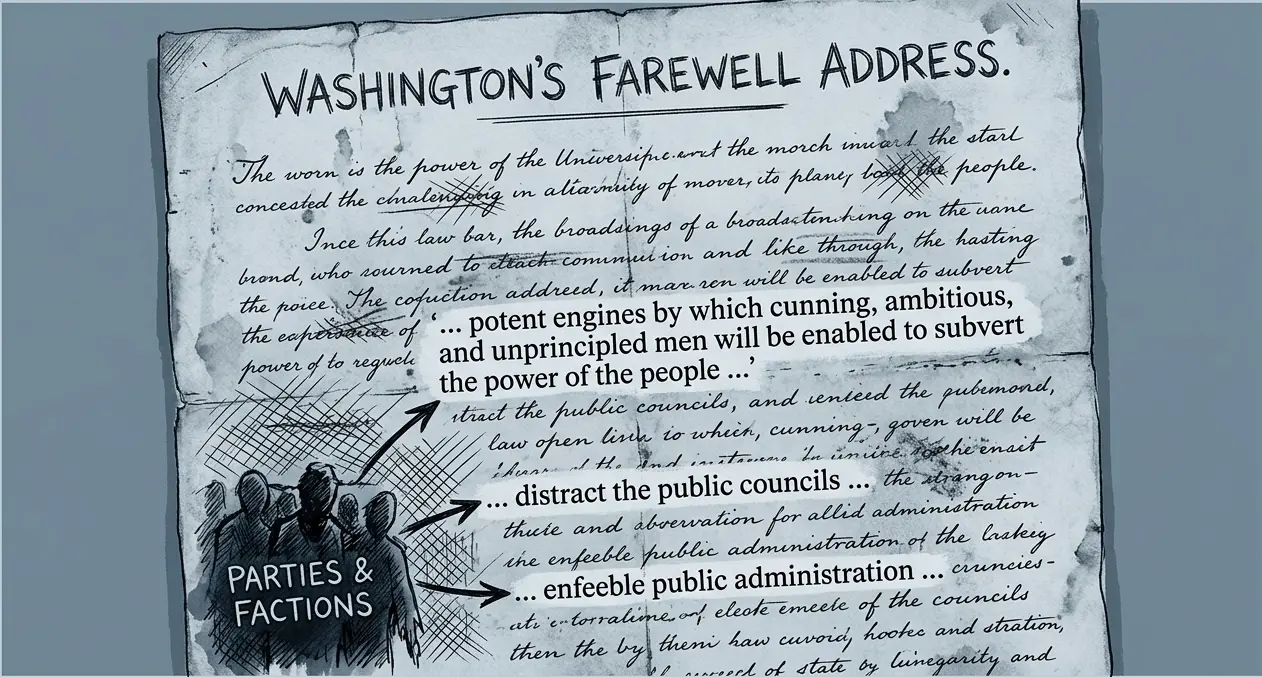
On September 19, 1796, George Washington published his Farewell Address. He had served two terms and refused a third. He used the occasion to name what he believed would destroy the republic he had helped build.
He was specific. Political parties — factions organized around interest or passion — would become “potent engines by which cunning, ambitious, and unprincipled men will be enabled to subvert the power of the people.” They would “distract the public councils,” “enfeeble public administration,” and render alien to each other those who should be bound together. He did not describe a hypothetical. He had watched both parties form around him during his own presidency, despite his refusal to join either. He understood what they were.
Madison had made the same argument from theory nine years earlier. Federalist 10 is the most rigorous treatment in the founding literature of what parties actually are: factions, organized around interests or passions, dangerous not because their members are corrupt but because the organizational logic of a faction produces outcomes that serve the faction at the expense of the whole. Madison proposed scale as the remedy — a large republic would contain so many competing factions that none could dominate. He was right about the mechanism. He was wrong about the scale required to defeat it.
The parties that formed within two years of ratification proved large enough to absorb competing factions, durable enough to outlast every crisis that should have ended them, and sophisticated enough, by 1888, to write the ballot access laws that made them permanent.
The founders’ hostility to parties is not decorative history. It is the original statement of the problem this series documents.
Five realignments, one frozen door
The American party system has reorganized itself five times. Each reorganization ended an era that looked permanent and produced a new alignment its participants assumed would last. None did.
The Federalists opposed the War of 1812 and were read as disloyal — the party collapsed. The Whigs elected a president in 1848 and ceased to exist by 1856, destroyed by their inability to hold North and South together on slavery. The Republican Party was founded in 1854 and won the presidency in 1860 — six years from founding to the White House, with Lincoln taking 39.8 percent of the popular vote in a four-way race. The New Deal ended Republican post-Civil War dominance. The Civil Rights Act forced the New Deal coalition’s internal contradiction into the open, and the fifth realignment produced the current arrangement: two geographically sorted, tribally opposed parties governing a country in which 45 percent of voters identify with neither.
Each previous transition happened because the existing party structure failed the country badly enough that voters found a different one. The current system is the first in American history to survive multiple crises — the 2008 financial collapse, a global pandemic, the early shock of AI displacement — without producing a structural realignment.
The crisis conditions that have historically broken party systems are present. The realignment has not come. Something is different this time. The next two sections show what.
The reform that locked the door
Before 1888, political parties printed their own ballots. The party ticket was a physical object — distinctive by size and color, sometimes by scent. Tammany Hall’s Tim Sullivan scented his party’s tickets so they could be tracked to the ballot box. Party operatives at polling places watched who voted and how. Vote buying was systematic. Coercion was rampant.
The Australian ballot reform ended all of that. Government-printed, secret ballots, first adopted in Massachusetts in 1888, universal across the states by mid-century. It was a genuine democratic improvement.
What nobody mentions: when the government took over ballot printing, state legislatures had to decide which candidates and parties would appear on the official ballot. The state legislatures were controlled by the two existing parties. They wrote the ballot access laws. They wrote them to protect themselves.
Before the reform, a third-party candidate simply printed their own ballot and handed it to voters. After the reform, getting on the ballot required satisfying requirements the existing parties wrote. They wrote them to prevent a third option.
The Australian ballot reform was framed as the end of machine politics. The machine that replaced it was quieter, and written into law.
The private organization that runs public elections
The Democratic National Committee and the Republican National Committee are private organizations — incorporated nonprofits, with no status in the Constitution. The Supreme Court has consistently protected that status: parties have the right to set their own membership rules, control their own candidate selection, and govern their own conventions without state interference. These are First Amendment associational rights. The courts have been clear.
The primary election deciding who represents you is administered by public employees, on public property, with public funds — and controlled by a private organization that can legally exclude you from participating.
Forty-five percent of American adults identify as independent. In closed primary states, those voters are excluded from publicly funded elections by the private organizations that designed the exclusion. The party told the court it is a private association with the right to run its own affairs. The court agreed. Nobody followed up with the next question: then why is the public paying for it?
Either primaries are public functions open to all taxpayers who fund them, or they are private functions the parties pay for themselves. The current arrangement — private control, public funding — is not a compromise. It is a subsidy. The 45 percent excluded from that subsidy are the same voters who might otherwise challenge the committee assignments that set extraction rates on publicly owned resources. The private organization has no obligation to represent them. It has every incentive not to.
The warning Washington issued in 1796 required actors the system was already preventing from forming. The people who might have heeded it were the people the duopoly was already producing. Block 5 shows what that self-sealing mechanism costs the 45 percent it locks out.
The next article shows what the parties built with the architecture the ballot reform handed them.
Do you know whether your state’s primary is open or closed?
| Whether your state uses an open, closed, or semi-closed primary — and whether independents can participate | https://ballotpedia.org/Primary_election_types_by_state |
| Your state’s ballot access requirements for third-party and independent candidates | https://ballotpedia.org/Ballot_access_for_political_candidates |
Sources
1. Washington, George. Farewell Address. September 19, 1796. Avalon Project, Yale Law School. https://avalon.law.yale.edu/18th_century/washing.asp
2. Madison, James. Federalist No. 10. November 22, 1787. Avalon Project, Yale Law School. https://avalon.law.yale.edu/18th_century/fed10.asp
3. Lincoln 39.8% four-way race, 1860. U.S. National Archives. https://www.archives.gov/electoral-college/1860
4. Australian ballot reform — Massachusetts 1888. CRS, IN12389, 2023. https://crsreports.congress.gov/product/pdf/IN/IN12389
5. Tammany Hall / scented tickets. Cambridge/BJPS, “Anti-Partism and Party Control of Political Reform in the United States,” 2000 (paywall).
6. Party autonomy doctrine. Tashjian v. Republican Party of Connecticut, 479 U.S. 208 (1986). https://supreme.justia.com/cases/federal/us/479/208/ — California Democratic Party v. Jones, 530 U.S. 567 (2000). https://supreme.justia.com/cases/federal/us/530/567/
7. Gallup. Party Affiliation, 2025 — 45% independent. https://news.gallup.com/poll/700499/new-high-identify-political-independents.aspx
8. Bullock v. Carter, 405 U.S. 134 (1972). https://supreme.justia.com/cases/federal/us/405/134/
9. Five party realignments. V.O. Key, “A Theory of Critical Elections,” Journal of Politics, 1955 (paywall). Walter Dean Burnham, Critical Elections and the Mainsprings of American Politics (1970). Norton. WorldCat: https://search.worldcat.org/title/98525
Block 4, Article 1. © 2026 Steve Sagnotti.
Leave a Reply