Prologue: The Inheritance
© 2026 Steve Sagnotti.
Something has gone wrong. You can feel it before you can name it.
You show up to vote. The promises are large. The direction doesn’t change. The economy grows on paper while your own situation stays where it was or drifts backward. Everything is presented as a battle between two sides — and the battle never seems to resolve anything except which team controls the room where nothing changes. The fruit that used to ripen on the vine, sweet and seasonal and grown nearby, now comes from somewhere far away in every season and doesn’t taste the way it did. The water that used to run clean now burns in some places coming out of the tap. Wells that worked for decades have gone dry and had to be dug hundreds of feet deeper. We call this progress. The question the frame doesn’t ask is: progress for whom?
That feeling — the gap between what you were told the system does and what you have watched it actually do — is accurate perception. It is not cynicism. It is not apathy. It is pattern recognition. The gap has a history. The history has rooms. The rooms have records.
There was a time when this was not as it has become.
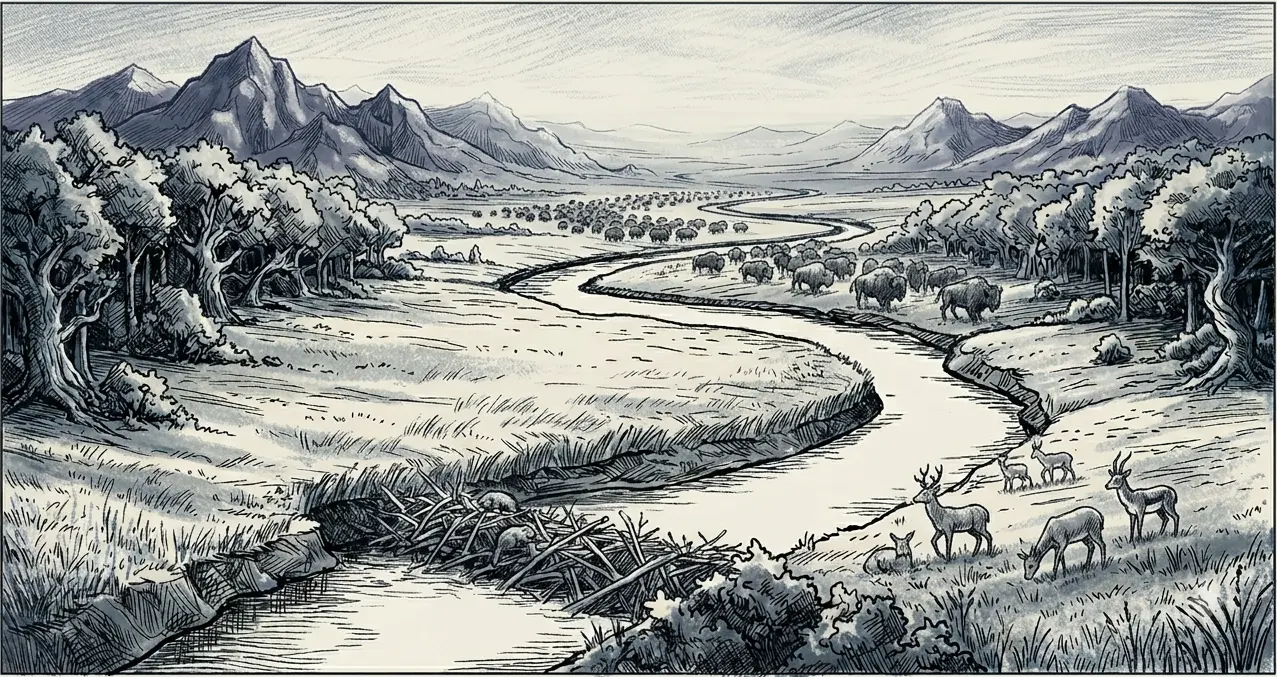
Katharine Lee Bates climbed Pikes Peak in the summer of 1893 and wrote down what she saw. Amber waves of grain. Purple mountain majesties. The fruited plain. She was not writing a fantasy. The abundance was real — the topsoil deep, the rivers clean, the fisheries so thick that Lewis and Clark had described the salmon runs as uncountable. The bison had numbered sixty million on the plains. A continent so large and so full that the genuine operating assumption — the frame that organized the first era of American resource policy — was that it could not be used up.
By 1893, when Bates stood on that peak, the assumption was already failing. The bison were nearly gone. The salmon runs were thinning. The topsoil was moving. The abundance had a ceiling, and the country was pressing against it. What Bates saw was real — and it was already in the process of being converted into something else.
George Washington did not wait for the country to discover what would threaten it. He named it on his way out the door.
In his 1796 Farewell Address — the last public act of his presidency — he warned with specific urgency about the danger of political parties. They would become, he wrote, “potent engines by which cunning, ambitious, and unprincipled men will be enabled to subvert the power of the people.” They would distract public councils, enfeeble public administration, and render alien to each other those who should be bound together. He had watched both parties form around him during his own terms, despite his refusal to join either. He understood what they were: organizations whose internal logic would eventually subordinate the public good to the faction’s survival.
Madison had made the same argument nine years earlier in Federalist 10: factions, organized around interests or passions, are dangerous not because their members are corrupt but because the organizational logic of a faction produces outcomes that serve the faction at the expense of the whole.
Within two years of Washington’s address, the parties had hardened. Within a century, two of them had written the ballot access laws, the debate commission rules, and the legislative architecture that made their permanence structural rather than electoral. The duopoly Washington named as the republic’s specific danger is now so thoroughly established that questioning it is framed as naive. The warning is in the record. It was not in the frame.
The selling of the commons that followed — of the land, the water, the minerals, the spectrum, the knowledge that belonged to everyone — and of the representation that might have protected it, is what this series documents. Not the loss. The mechanism.
When a proposed change threatens the arrangements that produce these outcomes, the argument arrives on cue, framed as: too complex, too entrenched, too interlocked to move. What that framing excludes is that the argument was constructed inside a room that had already decided which questions were permitted — and that outside that room, other answers exist. Norway built a sovereign wealth fund from its petroleum commons and now holds over a trillion dollars in trust for its citizens. Alaska built a version of the same. Texas built one in 1839 for its public schools, and it is still running. The answers were not unavailable. They were outside the frame.
The frame was tended carefully by the people for whom the argument inside it was working. The two parties Washington warned about now operate the room where the arguments are permitted. The binary that makes every question about which side you’re on is the frame. What it excludes is the question of what the arrangement is actually doing — and for whom.
That feeling you have — that the votes don’t move the needle, that the promises don’t land, that something structural is wrong in a way neither party will name — is accurate. Washington named it in 1796. The rooms have confirmed it ever since.
This series opens those rooms one at a time. The frozen House. The rigged map. The locked door. The captured process. The money pipeline. The bought bench. The doubt machine. The darkened room. The balance sheet of what was taken. Twelve blocks, step by step, naming names, showing the mechanism and the record behind it.
Once you see what the rooms were doing, you will see it everywhere. That is the point. What you do with it is yours.
Check This Yourself
The Farewell Address is public record, in Washington’s own words:
avalon.law.yale.edu/18th_century/washing.asp
Ask an AI: “What did George Washington warn about political parties in his Farewell Address, and how does the current two-party system compare to what he described?”
Sources
1. Katharine Lee Bates / Pikes Peak, 1893. Historical record.
2. Bison figures (sixty million). Smithsonian Institution.
3. Salmon runs / Lewis and Clark. Historical record / National Archives.
4. Washington, George. Farewell Address. September 19, 1796. Avalon Project, Yale Law School. https://avalon.law.yale.edu/18th_century/washing.asp
5. Madison, James. Federalist No. 10. November 22, 1787. Avalon Project, Yale Law School. https://avalon.law.yale.edu/18th_century/fed10.asp
6. Norway Sovereign Wealth Fund. Norges Bank Investment Management. https://www.nbim.no — Fund value page: https://www.nbim.no/en/investments/the-funds-value/ Current value (end-2025): 21,268 billion NOK ≈ $2.19 trillion USD. Update at publication.
7. Alaska Permanent Fund Corporation. https://apfc.org
8. Texas Permanent School Fund, established 1839. Texas Education Agency. https://tea.texas.gov/finance-and-grants/state-funding/additional-finance-resources/permanent-school-fund
9. Cooper’s Ferry 16,500-year occupation. Science (2019). https://doi.org/10.1126/science.aax9830
10. Saudi Arabia alfalfa ban. MEWA mechanism document: https://qanoniah.com/en/File/Jy4DGw9da7vj1vg78Qv65RrKX-Mechanism-for-Implementing-Regulations-on-Halting-the-Cultivation-of-Green-Fodder — Argaam (English): https://www.argaam.com/en/article/articledetail/id/1875260
Prologue. © 2026 Steve Sagnotti.
Leave a Reply