Notes from the Field — Dispatch, May 27, 2026
Redistricting in the United States is supposed to happen once a decade, after the census. The census counts people. The count determines how many House seats each state gets. Legislatures then draw the maps. The process has always been political — the party in power draws lines that favor itself. But the once-a-decade rule, however imperfect, established at minimum that voters get to live inside a known district for a predictable period of time.
That rule is now gone.
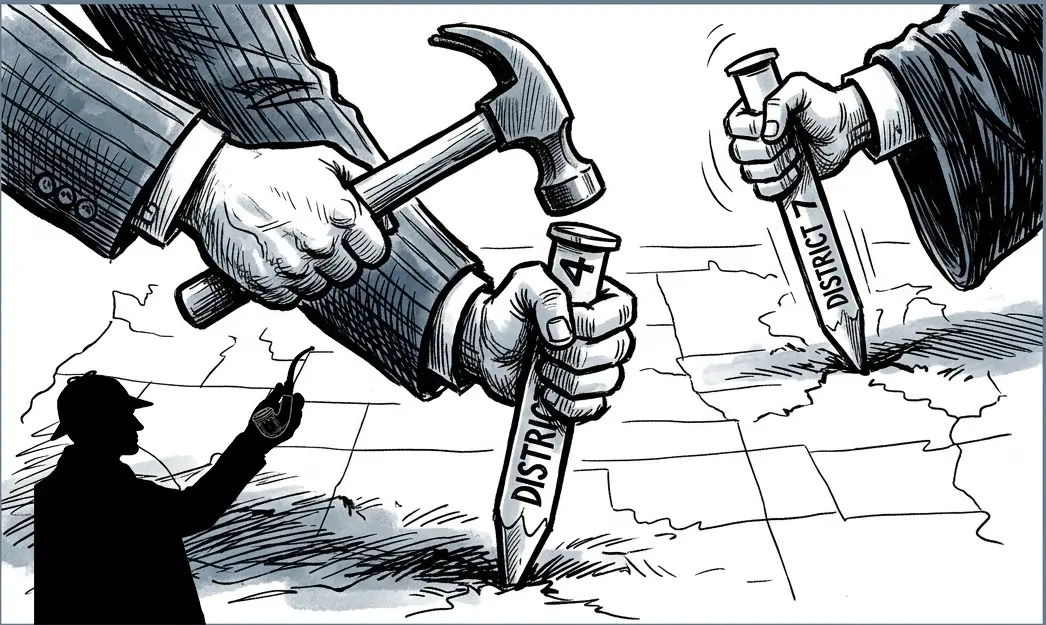
On the same day in May 2026 — Tuesday, May 26 — two things happened simultaneously in two Southern states that together define the new landscape. In South Carolina, the Republican-controlled state Senate voted down a new congressional map that would have eliminated the state’s only Democratic seat, a majority-Black district held for more than three decades by Rep. James Clyburn. In Alabama, a federal three-judge panel blocked a Republican-drawn congressional map that the court found had been designed to eliminate one of the state’s two majority-minority districts in violation of the Fourteenth Amendment. Two states. One day. One defeat by legislative defection, one defeat by federal court order.
The South Carolina story requires the full context. Trump had personally lobbied the Republican state Senate majority leader by phone — twice — and called into a private caucus meeting to pressure Republican senators into supporting the remap. The Republican-controlled House had already passed the new map. What stopped it was a coalition of twelve Republican senators who broke with the president, led by Senate Majority Leader Shane Massey, who gave a forty-five-minute floor speech about the dangers of antidemocratic gerrymandering. Among the quieter concerns: the new district lines would have redistributed Democratic voters into currently safe Republican seats, making those seats more competitive — a risk Republican incumbents weren’t willing to take on behalf of a national party strategy. The Senate adjourned without a vote, scheduling a return date of June 10 — the day after the state’s already-scheduled primary — effectively ending the redistricting push for the 2026 cycle in South Carolina.
The Alabama story is different in kind. Alabama’s redistricting fight did not start in 2026. In 2023, the same three-judge panel found that Alabama’s existing congressional map violated the Voting Rights Act and ordered the legislature to create a second district where Black voters could elect a representative of their choice. The legislature drew a new map — and the new map, the court found, still failed to comply. Alabama appealed. The Supreme Court, earlier in 2026, narrowed the Voting Rights Act in a Louisiana case that many states read as a green light to redraw maps without Black-majority districts. Alabama drew another map. The same three-judge panel — two of whom were Trump appointees — blocked it. The court found the map “intentionally discriminated based on race in violation of the Constitution,” specifically noting that the legislature “well knew that a plan without an additional Black-opportunity district would dilute Black Alabamians’ opportunity to participate in the political process, and it intentionally enacted that very plan.” Alabama’s attorney general announced immediate appeal to the Supreme Court.
Both cases are instances of the same mechanism at different stages of maturation. The South Carolina push was an attempt to use mid-cycle redistricting — outside the normal decennial process — to manufacture House seats before a midterm where the party holding the White House historically loses ground. The Alabama situation is further along: a legislature that has been in active defiance of federal court orders about its congressional map since 2023, drawing and redrawing lines until it finds a configuration a court will accept or the Supreme Court overrules the lower court.
What these two cases document, separately and together, is the use of the map-drawing function as an ongoing, continuously adjusted tool for managing electoral outcomes — not a one-time decennial process that constrains what a legislature can do, but a living instrument to be redrawn whenever the political calculus shifts. Trump’s mid-decade redistricting push has, according to reporting at the time of the South Carolina vote, already netted Republicans approximately nine net House seats through redrawn maps in states where the effort succeeded. The South Carolina defection and the Alabama court order are not a reversal of that trend. They are two speed bumps on a longer road.
The frozen House has 435 seats. It has had 435 seats since 1929. The party holding a slim majority in that chamber is now managing that majority in part by redrawing the districts from which its majority is elected, mid-decade, at the direction of the executive. South Carolina’s Senate Majority Leader gave a speech about antidemocratic gerrymandering and won the vote — this time. Alabama’s attorney general said it’s not a matter of whether they win, only when.
The silence won’t feel like silence. It will just feel like the way things are.
Essay 11 — Out of Frame
Broken Frames — Block 3: The Map That Chooses (not yet published — thebrokenframes.substack.com/s/broken-frames)
Broken Frames — Block 5: The Locked Door (not yet published)
Copyright 2026 — Steve Sagnotti
Sources:
Associated Press / Mississippi Today, “South Carolina Senate Rejects Trump’s Call to Redraw Congressional Maps,” May 26, 2026.
MS NOW / NBC News, “South Carolina Senate Rejects Trump Push to Redraw Clyburn District,” May 26, 2026.
MS NOW, “Why a Dozen South Carolina Senators Bucked Trump on Redistricting,” May 27, 2026.
NPR, “Trump-Backed Redistricting Plan Is Rejected in South Carolina,” May 26, 2026.
NBC News, “Federal Court Blocks Alabama from Using GOP-Drawn Congressional Map,” May 26, 2026.
CNBC, “Judges Block Alabama Redistricting Maps That Would Dilute Black Vote in Midterms,” May 26, 2026.
Washington Times, “Federal Court Blocks Alabama Republicans’ Congressional Map,” May 26, 2026.
PBS NewsHour, “Federal Court Blocks Alabama Plan for New Congressional Districts,” May 26, 2026.
Leave a Reply