Essay 15 — What can be built before the window closes
Steve Sagnotti · steves-head.space
“The best time to plant a tree was twenty years ago. The second best time is now.”
— Chinese proverb
“We are trying to construct a more inclusive society. We are going to make a country in which no one is left out.”
— Franklin D. Roosevelt, 1936
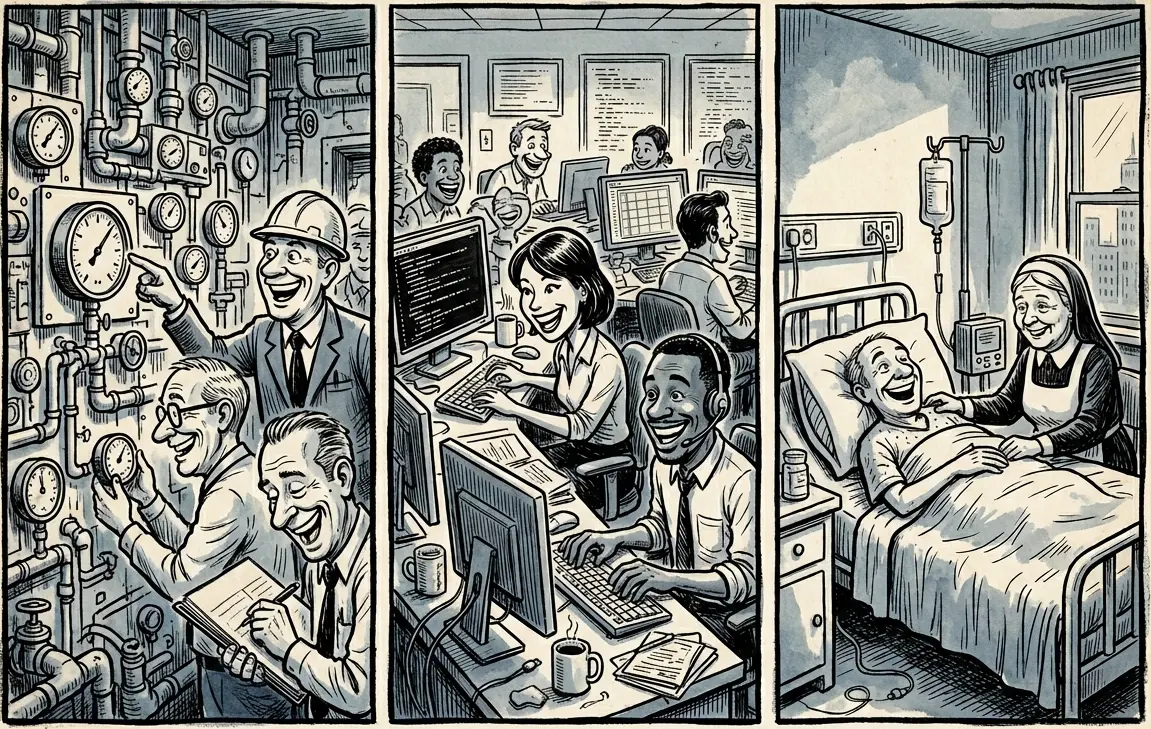
The preceding essays raised a question without answering it. What happens to the people?
Not the people in the aggregate — the displacement wave, the labor market adjustment, the transitional cohort. The specific people. The Class of 2026 entering the desert this month. Michelah in 2031. The fifty-five-year-old whose job the model absorbed last quarter. The question was asked at the end of Essay 13 and left there deliberately, because the answers that follow require a different kind of evidence than the documentation that preceded them.
This essay is one answer — the shovel-ready answer, the one that does not require waiting for the room to be rebuilt first. Essay 14 named what a repaired room would build. This essay names what can be built before the repair is complete, because the 2031 window does not wait for the renovation.
The false frame has a specific answer to the displacement wave. It is already being built. Thirty-four permanent detention facilities. Eight mega-centers. Ninety-two thousand beds. Infrastructure owned, not leased, distributed across the national geography, available for whatever population the room decides requires containment next. The false frame looks at ten million displaced workers and sees a management problem. The cost is fifty-five thousand dollars per person per year at the low end. Scale that to the displacement wave the preceding essays document and the math produces a number the fiscal spiral cannot absorb. The false frame does not acknowledge this. The two rooms — the one tracking displacement and the one tracking the debt spiral — are still not talking to each other.
A stability frame looks at the same ten million people and sees something different. Not a management problem. A workforce. One that happens to coincide with a documented inventory of work the market will not fund but the country demonstrably needs. The math from this vantage point runs differently: the same fiscal pressure that makes the warehouse unaffordable also makes the productive alternative attractive, because workers in the revenue column pay taxes and workers in the expenditure column consume them. The choice between the two is not ideological. It is arithmetic. The stability frame makes the arithmetic visible.
This essay builds that frame.
I. The Math Nobody Is Doing
Essay 12 established the Jennifer Harris mechanism: as one dollar of value creation shifts from workers to owners, total tax revenue falls ten to fifteen cents. The displacement wave and the debt spiral are not parallel crises. They are the same crisis viewed from two angles. The worker who loses her job stops paying payroll taxes and starts drawing on unemployment, food assistance, Medicaid. She moves from the revenue column to the expenditure column at the exact moment the fiscal system is least able to absorb the shift.
The containment apparatus does not reverse this. A person in an ICE detention facility at fifty-five thousand dollars per year is not in the revenue column. She is a permanent expenditure line. The infrastructure is owned. The operating cost runs whether or not the beds are full. The reconciliation act that funds the detention expansion simultaneously cuts the programs the displaced would draw on outside it. Both outcomes move workers further from the revenue column. Neither addresses the underlying arithmetic.
The WPA at its peak employed 3.3 million workers simultaneously. At prevailing wages, those workers paid income tax, spent money in local economies, and maintained the consumer base that market activity depends on. The net fiscal cost of the program — accounting for the tax revenue generated, the economic activity multiplied through local spending, and the reduction in relief expenditure — was substantially lower than the gross appropriation. The false frame presents this as a historical curiosity. The stability frame recognizes it as a mechanism. The mechanism is available.
The question the stability frame asks is simple: what does it cost to warehouse a displaced worker, and what does it cost to employ one productively? The answer to the first question is documented. The answer to the second depends on what the work is, which is the subject of the next section. But the framing matters before the numbers do. Inside the false frame, employment programs are expenditures to be minimized. Outside it, they are investments whose return includes tax revenue, consumer spending, and the maintenance of a social fabric that is considerably cheaper to preserve than to repair after it tears.
II. It Has Been Done Before
In 1933, the United States faced a displacement wave of a different kind. Twenty-five percent unemployment. Hoovervilles in every major city. The Bonus Army — veterans of the First World War, promised compensation that hadn’t arrived — marching on Washington and being dispersed by cavalry. The false frame of that moment had an answer too: the market would self-correct, government intervention would make things worse, the men sleeping in parks were there by the logic of their own choices.
Franklin Roosevelt’s administration did not wait for the room to repair itself. It identified work the market would not fund but the country needed, paid people to do it at scale, and kept them economically active during the lag. The Works Progress Administration employed 8.5 million people across infrastructure, arts, literacy programs, and environmental work. The Civilian Conservation Corps put three million men to work in forests, parks, and watersheds — building trails, planting trees, fighting erosion, maintaining the public lands that private industry had no incentive to steward. The men who arrived having never held a shovel left having built something visible, something that still exists, something with their names on it in the sense that matters.
The substitutability objection is real and the essay should name it honestly. A displaced farmer in 1933 could dig a ditch. A displaced customer service worker or junior analyst in 2026 cannot be sent to the forest with the same ease. The skills gap runs differently now. But the mechanism survives even when the substitutability doesn’t: identify work the market won’t fund but society needs, pay people to do it at scale, keep them economically active during the lag. The specific work changes with the era. The structural logic does not.
The WPA wasn’t a government employment program in the sense the false frame uses to dismiss it. The government defined the need, provided the funding, and set the standard. Private contractors bid on the work. Private firms executed it. The government did not pour the concrete or plant the trees directly. It created the demand signal and the funding mechanism that private industry lacked any incentive to create on its own. The interstate highway system — the largest public works program in American history — was built by private contractors on federal contracts. Nobody calls it socialism. The WPA worked the same way. The stability frame makes no new argument here. It recovers an old one that the false frame has spent fifty years misrepresenting.
III. The Work That Is Waiting
The substitutability problem dissolves when the inventory of needed work is examined honestly. The false frame presents the displacement wave as a mismatch between available workers and available work — too many people, not enough jobs. The stability frame asks a different question: what work exists that the market is not doing?
The answer is not abstract. It is documented, understaffed, and urgent.
The United States Forest Service manages 193 million acres of national forest and grassland. Its own assessments document a chronic backlog in fire mitigation, trail maintenance, watershed restoration, and invasive species management — work that directly reduces the catastrophic fire risk that has cost the country hundreds of billions of dollars in recent years. The agency does not have the workforce to do what its own scientists say needs doing. The CCC precedent is direct: this is exactly the work the corps did, at exactly the scale the corps operated, in exactly the terrain the corps knew. The need was there in 1933. It is larger now.
Federal inspection and oversight capacity is chronically understaffed across every domain where the public’s investment requires monitoring. Food safety. Workplace safety. Environmental compliance. Infrastructure inspection. The bridge that fails, the mine that collapses, the contaminated water supply — these are not accidents of nature. They are the predictable output of an inspection regime whose capacity has been systematically reduced by the same purchased legislation Essay 11 documented. The work of inspection is not make-work. It exists because the things being inspected exist and the rules governing them exist. The question is only whether anyone shows up to enforce them. Tripling federal inspection capacity would not require inventing new work. It would require staffing the work that is already documented and already undone.
Care work is the largest single category of documented need that the market chronically underserves. The World Economic Forum’s Future of Jobs report identifies care roles — home health aides, childcare workers, elder care specialists — as among the fastest-growing by absolute numbers through 2030. The demographic driver is not a projection. The baby boom generation is aging. The care it requires is not optional and it is not automatable. These roles cannot be sent to a server farm. They require people, in rooms, with other people. They are chronically underpaid because the people who perform them have historically had the least bargaining power and the people who need them have historically had the least political power. A public employment option with a wage floor in care work absorbs displacement and delivers something the market has spent decades demonstrating it will not deliver on its own.
The Office of Technology Assessment employed 143 people when Congress eliminated it in 1995 for twenty-two million dollars in annual savings. Restoring it would require people with the analytical skills to evaluate technology policy — exactly the cohort that AI displacement is currently moving out of entry-level white-collar roles. The Class of 2026 entering a desert labor market includes people trained in data analysis, research methodology, and technical communication. The OTA restoration workforce and the displaced analyst cohort are the same population. The work is documented. The workers are available. The room has a vested interest in the vacuum remaining.
Digital literacy infrastructure is the final category. The ZipRecruiter survey found that only one in three members of the Class of 2026 received meaningful AI training in college. Someone has to build that training infrastructure at community college level across the country. The need is documented, the timeline is urgent, and the work requires people who understand both the technology and the communities it is entering. This is not make-work. It is the foundational investment that determines whether the next cohort is better positioned than the one entering the desert now.
IV. The Hiring Condition
A standard infrastructure contract does not solve the displacement problem. The lowest bidder hires whoever they want, mostly experienced trades workers who already have jobs. The bridge gets built. Michelah is still in the desert.
The condition that makes a stability frame program different from a standard public works bill is written into the contract terms: a documented percentage of labor hours must go to workers from the displaced cohort. Not a mandate on every private firm in the economy — a condition on firms accepting public contracts for publicly funded work. The legal architecture for this already exists. Section 3 of the Housing and Urban Development Act requires that federally funded construction projects prioritize hiring low-income residents of the area where the work is done. Davis-Bacon requires prevailing wages on federal contracts. The mechanism is established. The variable is which workers the condition prioritizes.
This is also the answer to the dignity question, which is real and which the essay should not paper over. A person hired by a private contractor doing documented infrastructure work on a public contract is not a government charity case. She is a worker with a paycheck from a private employer, doing a job that needed doing, in a sector that is expanding because the public decided the need was real. The employment relationship matters. The nature of the work matters. A stability frame that produces government make-work produces neither stability nor a frame that can survive political scrutiny. One that produces private employment on real public need earns its constituency the way Social Security did — through the visible, specific, nameable thing it built.
The enforcement of the hiring condition requires the inspectors to exist. This is where the two arguments converge: the oversight capacity that monitors contract compliance is the same capacity that monitors workplace safety, environmental compliance, and infrastructure integrity. You cannot enforce a condition you cannot monitor. The false frame that eliminated inspection capacity also eliminated the mechanism for ensuring public contracts serve public purposes. Rebuilding one requires rebuilding the other. They are the same repair.
V. Skills, Matching, and the Service Question
The draft board analogy is not decorative. When the United States needed to mobilize millions of people rapidly in 1940, it did not do so by posting job listings. It assessed what it had, determined what it needed, and matched them at scale through a mechanism — imperfect, sometimes unjust, but operationally effective — that converted civilian capacity into military capability faster than any previous mobilization in history.
The displacement wave requires a matching problem of comparable scale. Not the same mechanism — a national citizen service is not conscription, and the essay should be clear on this distinction — but the same underlying challenge: how do you connect the skills a population has with the work a society needs, at a speed the crisis requires, without waiting for the market to do it over a decade?
The stability frame’s answer is a National Citizen Service: a voluntary program, structured around meaningful tracks, available to every American at the transition point between education and employment. Not a program for the displaced specifically — a program for everyone, at the moment everyone faces it. Military service is one track. Forestry and public lands is another. Care work is another. Infrastructure inspection and oversight is another. OTA restoration and technical assessment is another. Digital literacy infrastructure is another.
The voluntary-with-incentives model has a documented record. The CCC did not conscript its workers. It offered wages, housing, food, and skills in an economy where the alternative was nothing. The enrollment exceeded projections. People self-select toward meaningful work when meaningful work is available and the alternative is a desert. The Class of 2026 entering the labor market now is not choosing between a national service program and a good private sector job. For a significant fraction of them, they are choosing between a national service program and the desert Michelah described.
Matching within the program is where AI earns its place on the productive side of the ledger rather than the destructive side. The draft board in 1940 used paper forms and interview panels. A modern matching system ingests documented need — which forest districts are most understaffed, which inspection backlogs are most critical, which communities have the highest care worker shortages — against documented capacity — what skills the incoming cohort has, what training they can acquire in what timeframe — and produces placements that serve both the individual and the public need. The army got its infantry because infantry was what the moment required. It also got its eleven navy volunteers because eleven people wanted to be there and the navy needed them. Both mechanisms — directed placement weighted to need, and self-selection weighted to fit — are available and can operate simultaneously. AI makes the optimization tractable at a scale that was impossible in 1940.
The skills gap the false frame presents as an obstacle is, from inside the stability frame, a design parameter. You don’t send the displaced analyst to dig the ditch. You send her to do the environmental baseline survey, the OTA restoration work, the digital literacy training. You send the displaced logistics worker to the inspection corps. You send the person with no formal credential and strong hands to the forest, where the work is learnable and the need is urgent and the result is visible. The frame that sees only “displaced workers” and “available jobs” cannot make these connections. The frame that sees documented need and documented capacity and asks how to connect them can.
VI. The Bottleneck and the Tool
The sprint model cannot work if the permitting process takes a decade. This is not a metaphor. The United States has the longest infrastructure permitting timelines in the developed world by a significant margin. A highway project that takes two to three years to permit in Germany takes seven to ten years here. A transmission line that takes eighteen months in Australia takes a decade in the United States. The causes are documented: NEPA environmental review averaging four and a half years to complete, multi-agency coordination with no required timeline, litigation as a de facto veto independent of the merits, and permitting agencies chronically understaffed relative to the volume of projects in their queues.
The result is that the United States cannot build the infrastructure its own engineers say it needs at anything like the speed the problems require. The grid buildout needed for the energy transition, the water infrastructure repairs the American Society of Civil Engineers documents, the broadband deployment needed to close the digital divide — all of them are stuck in permitting queues. The 2031 window arrives before the shovels go in.
AI changes this calculation at specific, documented points in the process. A full Environmental Impact Statement currently takes teams of consultants three to five years to produce, at costs running into the tens of millions for large projects. AI can draft the baseline environmental survey, model impacts across scenarios, cross-reference existing databases of species habitat, water quality, soil composition, and air quality, and produce a structured document in weeks rather than years. The review process still requires human judgment and public comment — that is appropriate and the stability frame does not propose eliminating it. But the document production bottleneck is an AI-solvable problem with existing technology. The NEPA timeline compresses dramatically when the EIS takes months rather than years.
Multi-agency coordination — the problem of eight agencies with incompatible systems, timelines, and data formats that no one is required to reconcile — is addressable by AI as a coordination layer. A project dashboard that ingests the requirements of every relevant agency, identifies conflicts and dependencies, flags what can proceed in parallel, and surfaces the critical path. This exists in private sector project management. It does not exist for federal permitting. Building it is exactly the kind of OTA-restoration, technical-capacity work the previous section identified as waiting for a workforce.
The permitting bottleneck is not entirely accidental. Utilities have used permitting complexity to block transmission lines that would enable competing renewable energy. Established developers have used NEPA to block competitors. The tool is real and has legitimate uses; it has also been captured by actors whose interests have nothing to do with environmental protection. AI-assisted permitting reform is not anti-environment. The environmental analysis still happens. It happens faster and with better data. A document that took four years to produce because eight agencies couldn’t reconcile their timelines doesn’t take four years because the analysis requires it. The stability frame names the difference between a timeline that reflects the work and one that reflects who benefits from the delay..
VII. The Sprint
You do not need Rome. You need the foundation before 2031.
The false frame’s approach to large public problems is the monolith: design the complete solution, assemble the complete funding package, build the complete political coalition, execute the complete program. This approach has a specific failure mode: it takes longer than the crisis it is designed to address. The decade-long infrastructure project can be cancelled by a change in administration before it is complete, producing nothing. The workforce reabsorption program designed in the conventional model — full scope, full design, full permitting, full funding before anyone reports to work — does not help the Class of 2026. It might help the Class of 2036 if everything goes well.
The stability frame’s approach is different in sequence, not in ambition. Fund the first stage with defined success metrics. Stage two is contingent on stage one results. Produce something real at each stage — something that builds its own constituency, something that exists and is therefore harder to eliminate than something that is merely planned. The shack goes up before the house is designed, not because the house isn’t the goal, but because the shack tells you things a blueprint never could — where the wind comes from, which wall you’ll want to extend first, what the foundation actually required when the ground turned out to be different from the survey.
Applied to the workforce: a pilot National Citizen Service in three states, authorized and funded for one stage, tells you what a national program designed from scratch never could. Which work categories absorb workers fastest. Which training pipelines produce useful skills in six months versus two years. Which communities have the infrastructure to support a corps presence. You learn cheaply, at small scale, before committing the full apparatus. The pilot produces visible results. Visible results build the constituency for the next stage. The constituency funds the next stage. Medicare is one example of how a program can be built — not as a comprehensive national health system but as a limited program for the elderly that proved itself and built its own political base over decades..
The sprint model also answers the political capture problem that the previous essay documented. A decade-long monolith has to hold its coalition for a decade. A sprint-stage authorization has to hold it for one budget cycle. The people who benefit from inaction can block a comprehensive bill. Blocking a pilot is harder — the argument against a pilot is the argument against learning, and that argument is harder to make with a straight face to the 45 percent who have concluded the room produces nothing for them.
VIII. The Standard Arguments
The stability frame will generate objections. They will arrive in the same forms that every accountability proposal in this project has generated. They deserve substantive answers rather than dismissal, because some of them have real merit.
“This is socialism. The government should not be in the business of employing people.”
The government has been in the business of employing people for the entire history of the republic. Postal workers. Federal inspectors. Forest rangers. The military. The argument is not against government employment. It is against government employment of people the current political coalition would rather see in a warehouse. The WPA employed 8.5 million people through private contractors bidding on public contracts. The interstate highway system was built the same way. National defense — the expenditure no one calls socialism — dwarfs any workforce program this essay contemplates. The label is not an argument. It is a way of preventing one.
“This takes work away from private industry.”
The opposite is closer to accurate. Private industry is not doing the work this essay describes — not because it couldn’t, but because there is no profit in it. The Forest Service’s fire mitigation backlog does not generate revenue. The inspection of a bridge does not produce a product to sell. The care worker serving an elder on Medicaid does not generate a margin worth pursuing. Private industry leaves this work undone because private industry is not designed to do work it cannot monetize. A stability frame program creates contracts that private industry bids on and executes. The contractor who wins the forest restoration contract, the inspection services contract, the care infrastructure contract — that is a private firm earning a market return on publicly funded work. This is how public infrastructure has always been built in America. The stability frame does not nationalize anything. It creates demand that private industry is well positioned to meet, with the condition that the workforce doing the meeting includes the people who need the work.
“We can’t afford it.”
The fiscal spiral Essay 12 documented makes this the most self-defeating objection available. The question is not whether the country spends money on the displacement wave. The infrastructure is already built and already being funded. The question is what the expenditure produces. Fifty-five thousand dollars per person per year to warehouse someone who used to be a taxpayer produces a permanent expenditure line, a population removed from the consumer base, and a social fabric under pressure. A wage and meaningful work produces a taxpayer, a consumer, and someone with a reason to show up tomorrow. The fiscal responsibility argument for the warehouse is the argument that the expensive option is cheap because you don’t count the cost. The stability frame counts the cost.
“The government can’t run anything efficiently.”
The CCC built 800 parks, planted three billion trees, and constructed 125,000 miles of roads in nine years. The WPA built or repaired 650,000 miles of roads, 78,000 bridges, 125,000 civilian and military buildings, and 700 miles of airport runways. These are not theoretical projections. They are the current inventory of infrastructure still in use. The efficiency objection has a specific structural problem: it is made against programs that worked while ignoring the programs it favors that did not. The F-35 program is eleven years late and $165 billion over budget. The Pentagon has never passed an audit. The efficiency argument is applied selectively, to programs that serve the wrong constituency.
“Who decides where people go? This sounds like forced labor.”
The National Citizen Service described in this essay is voluntary. It offers tracks, not mandates. The CCC enrolled its workers. The navy got its eleven volunteers because eleven people wanted to serve on ships. A voluntary program with real tracks and real wages and real work will attract the people for whom it makes sense, which is a large fraction of the people currently in the desert. The matching system optimizes within the choices people make, weighted toward documented need. The army sends more people to infantry than to signals corps because infantry is what the army most needs. A citizen service sends more people to fire mitigation and inspection than to digital literacy infrastructure for the same reason. This is not coercion. It is the ordinary logic of a program that has to accomplish something as well as employ someone.
“Private contractors will capture the contracts the way defense contractors do.”
This is the most legitimate objection and it deserves the most substantive answer. Yes, contractor capture is a real and documented risk. The defense procurement system is the clearest example of what happens when large public contracts meet organized private interests over a long enough timeline. The stability frame’s structural defense is the sprint model: stage-gate funding with measurable output requirements at each stage makes extraction harder than in a decade-long monolith where the contractor is paid regardless of what gets built. The inspection capacity rebuilt under this program is also the inspection capacity that monitors contract compliance — the same workforce that checks the bridge checks whether the hiring condition was met and whether the stage-gate deliverable was delivered. Accountability is built into the mechanism as a design requirement, not assumed from the good intentions of the participants.
IX. The Frame from Here
The Class of 2026 is entering the desert this month. They did everything they were told. They incurred the debt. They earned the credential. The entry point was closing before they arrived, for reasons documented across the preceding essays, arranged by people who had a vested interest in the arrangement.
Inside the false frame, they are a labor market adjustment. A transitional cohort. An efficiency gain distributed across a generation. The quarterly report that records their displacement also records the margin improvement it produced. They do not appear in the same column.
Outside it, they are the workforce for the most urgent documented needs in the country. The forest that needs tending. The bridge that needs inspecting. The elder who needs someone in the room. The community college that needs someone to build the AI literacy infrastructure the next cohort will require. The OTA that needs the analysts the AI displacement wave just produced. The environmental baseline survey that needs to be done before the permitting clock can start. They are not a problem to be managed. They are the answer to a set of problems the market has been declining to solve for decades, now arriving with the workforce to address them at exactly the moment the problems are becoming undeniable.
A stability frame connects those two things. Not because it is generous. Because it is cheaper than the alternative, faster than the monolith, and productive in ways the warehouse is not. The false frame will call it make-work. The forest will still be standing. The bridge will still be inspected. The elder will still have had someone in the room.
The window is 2031. The permitting clock is running. The workforce is already in the desert.
The structural repairs are real and worth building. They are not the whole answer. The whole answer is older — there before the first room was built, there before the first council met to decide what you were allowed to know about yourself. The next essay returns to it.
— — —
Steve Sagnotti is a serious amateur photographer, writer, and technologist based in Oregon. With his camera he tries to capture common images not often seen, leading to common questions not often asked.
© 2026 Steve Sagnotti
— — —
Sources
Section I — The Math Nobody Is Doing
Jennifer Harris mechanism (10–15 cents tax revenue loss per dollar shifted from labor to capital): Harris, Jennifer. New York Times, April 8, 2026.
ICE detention cost ($55,000 per person per year): Migration Policy Institute, October 2025; National Immigration Forum, November 2025.
WPA peak employment (3.3 million simultaneous workers):
Section II — It Has Been Done Before
WPA (8.5 million employed total): Federal Works Agency. Final Report on the WPA Program, 1946.
CCC (3 million enrolled, 1933–1942): National Archives, Civilian Conservation Corps records.
Bonus Army, 1932:
Section III — The Work That Is Waiting
Forest Service fire mitigation backlog: U.S. Forest Service, National Forest System Land Management Planning data.
World Economic Forum. Future of Jobs Report 2025, January 2025.
Office of Technology Assessment: established Pub.L. 92-484, 1972; terminated January 1995. Annual budget: $22 million.
ZipRecruiter AI training data (1 in 3 graduates): ZipRecruiter/PureSpectrum Annual Grad Report 2026.
Section IV — The Hiring Condition
Section 3, Housing and Urban Development Act of 1968: 12 U.S.C. § 1701u.
Davis-Bacon Act: 40 U.S.C. § 3141 et seq.
Section V — Skills, Matching, and the Service Question
Selective Service Act: 50 U.S.C. § 3801 et seq.
CCC enrollment and voluntary model
Section VI — The Bottleneck and the Tool
U.S. infrastructure permitting timelines vs. international comparisons:
NEPA EIS average completion time (4.5 years): Council on Environmental Quality data.
American Society of Civil Engineers infrastructure grades: ASCE Report Card for America’s Infrastructure, 2025.
Germany infrastructure acceleration legislation:
Section VII — The Sprint
Medicare origins and incremental expansion:
Section VIII — The Standard Arguments
CCC output (800 parks, 3 billion trees, 125,000 miles of roads): National Archives CCC records; American Conservation Experience.
WPA output (650,000 miles roads, 78,000 bridges, etc.): Federal Works Agency. Final Report on the WPA Program, 1946.
F-35 program cost overruns and timeline: Government Accountability Office. F-35 Joint Strike Fighter: DOD Needs to Complete Developmental Testing Before Making Significant New Investments.
Pentagon audit failures: DOD Inspector General.
Leave a Reply