My Christmas gift to Marge arrived a few weeks late, but it did arrive. She now has a smart office, the smartest room in our smarter home.It took a little bit of hardware and a smaller bit of configuration for her dark office to light up by simply entering the room. If she’s gone for 3 minutes the lights will turn off, waiting for the next entry.
To sense someone in the room takes a sensor, we are using a millimeter microwave with included luminance sensor. A table lamp has a smart bulb. Home Assistant talks to these devices over the zigbee network they create. A second sensor provides temperature and humidity in the room.
The code is real simple. If the luminance meter indicates less than 20 lux and the presence sensor indicates a person is present, then turn on the light and keep it on as long as someone is in the room. If no one is in the room for 3 minutes, turn the lights off.
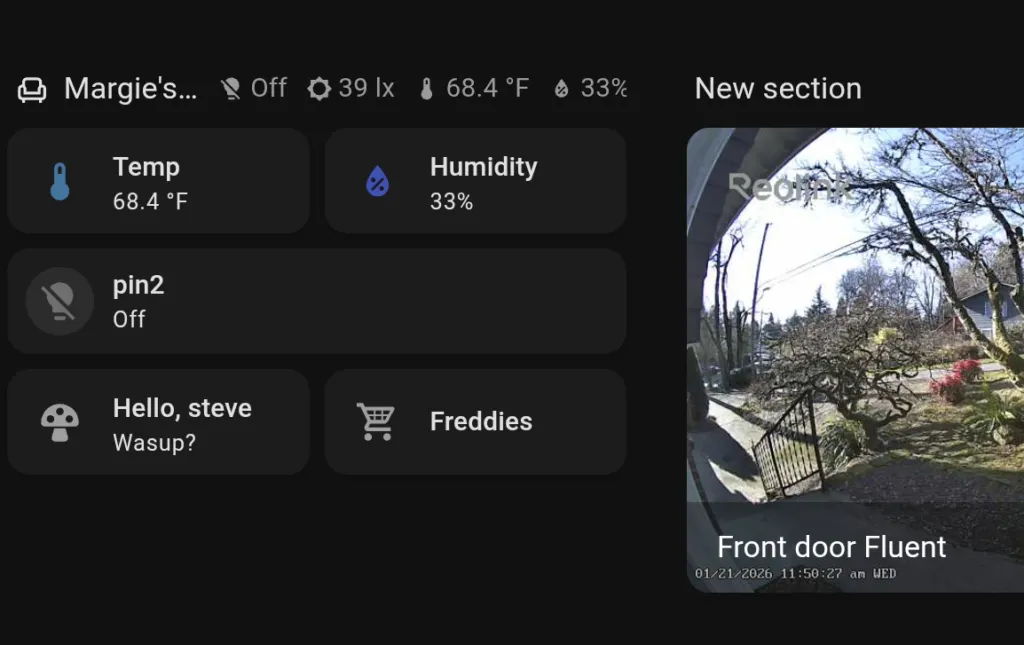
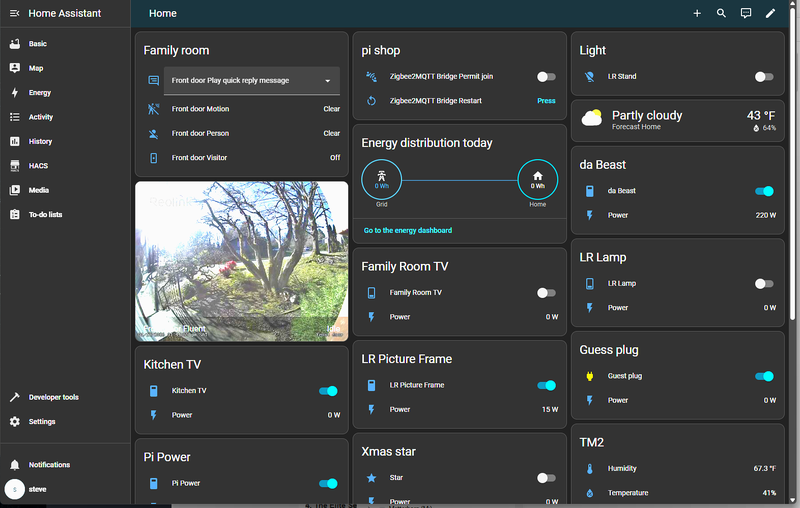
When creating dasboards there are lots of options, from the tools to use to what you want to see or do from the dashboard. This is the one I set up for Margie. Able see the status and to control much of house, from her easy chair or beach chair.
I have a different dash for my view. Each is a tab, so it is easy to swipe between the two, or add more as desired.
HA is doing a good job of being an assistant. Adding calendars, weather forecast, live front door feed to HA shopping lists, or a gazillion other ways to tailor it to your needs and desires is truly making our homes smarter and taking us into the age of George Jetson.
Notifications from HA are the new norm. Don’t have to wonder if the mail was delivered.
Most “Smart Homes” are rented, not owned. They rely on cloud-dependent devices that stop working when the internet drops or a corporation changes its terms of service. For those who demand privacy, speed, and absolute control, there is a better way: The Private Digital Estate (PDE).
Your PDE should be tailored to your needs and have foundational services such as media serving, secure document retrieval, and private communication. This article looks at one of the core pillars of a PDE: a Concierge Service. In this case, we are utilizing Home Assistant as the intelligence layer, supported by a high-performance 5-container stack.
The Digital Concierge:
The HA StackThe Concierge is the face of your estate—the intelligence that makes life seamless. By running this service in a containerized environment on a Raspberry Pi 5 with NVMe storage, we ensure that the “brains” of the house are faster than any cloud server.
MThe Concierge is supported by a specialized staff of four secondary containers that handle the heavy lifting:
1. The Archivist (MariaDB)
The Role: High-Velocity Data Integrity.
The Strategy: Standard smart homes suffer from “digital amnesia” during outages. By offloading history to MariaDB on local NVMe storage, your estate maintains a lightning-fast, permanent ledger. Every energy spike, temperature shift, and security event is stored in your private vault—not a corporate database.
2. The Universal Liaison (Zigbee2MQTT)
The Role: Direct Hardware Command.
The Strategy: To maintain a low-latency perimeter, we utilize Zigbee sensors. This service acts as the direct interface with your radio hardware (/dev/ttyUSB0), translating physical mesh signals into a digital language the Major Domo understands. By containerizing this liaison, we ensure that hardware upgrades never cause a “house-wide” disruption.
3. The Private Exchange (Mosquitto MQTT)
The Role: The Stealth Messaging Hub.
The Strategy: This is the estate’s secure internal intercom. When a sensor detects motion, the message is passed through Mosquitto. This “internal talk” is invisible to the outside world, ensuring that the heartbeat of your home remains instantaneous and entirely private.
4. The Elite Sentinel (Frigate + Coral TPU)
The Role: AI-Powered Vision.
The Strategy: Standard cameras are “dumb”—alerting you to rain or shadows. Frigate, powered by the Coral TPU (a dedicated AI accelerator), provides pro-grade computer vision at the edge. It identifies people and objects locally, alerting the Major Domo only when a genuine event occurs. Your video feeds never leave the premises.
Global Connectivity without Exposure
While the core stack handles the “Heavy Lifting,” it sits within a secure, multi-node strategy. We bridge the gap between “Local-Only” and “Global-Access” using two sophisticated gatekeepers:
Tailscale (The Private Tunnel): Consider this a private, invisible fiber-optic cable connecting your mobile device directly to your estate. You check in from London as if you were in the living room, without ever opening a “door” to the public internet.
Cloudflare (The Secure Gateway): For specific web-facing needs, Cloudflare acts as your digital security detail, masking your home’s physical IP address and shielding the estate from bad actors.
The Executive Summary: The Strategic Payoff
By migrating from cloud-dependent toys to this NVMe-powered local stack, you secure:
Feature
The Cloud Experience
The Private Estate
Latency
500ms – 2s (Round-trip)
<10ms (Local Instant)
Privacy
Data Harvested for Ads
Sovereign Vault Storage
Resilience
Fails when Internet drops
Full Offline Autonomy
Cost
Monthly Subscription Fees
Zero Recurring Costs
The Digital Concierge is just one key pillar in the Private Digital Estate. While it handles the “live” operations of your home, other pillars—such as your Private Cinema (Media Server) and Document Vault—provide the luxury and security of total data ownership. These pillars will be up to the host to define, but when built on a sovereign foundation, they remain available to you whether you are at home or away.